1800 121 5955

Key Takeaways
- Fixing a user experience defect after launch costs 100 times more than addressing the same issue during initial design, making UX research a core financial control.
- The most frequently used UX research methods are surveys (79%), usability testing (71%), and interviews (66%), which must be balanced between generative discovery and evaluative testing.
- Within the Nielsen Norman Group’s 20-method framework, concept testing user research validates whether a product’s value proposition solves a real user problem before sprint capacity is committed.
- 58% of product professionals use AI in their workflows in 2026 (up from 44% in 2025) to speed up transcription and thematic coding, but human domain judgment and methodological triangulation remain essential.
- In regulated BFSI and healthcare builds, combining an internal team with a specialist UX research agency eliminates multi-month domain ramp-up and prevents B2B participant recruitment fraud.
User experience research methods are the structured techniques—including contextual interviews, moderated usability testing, concept testing, diary studies, and quantitative surveys—used to uncover user behaviors, mental models, and workflow friction before and during software development. Enterprise products rarely fail because teams lack ambition; they fail because ambition outpaces understanding.
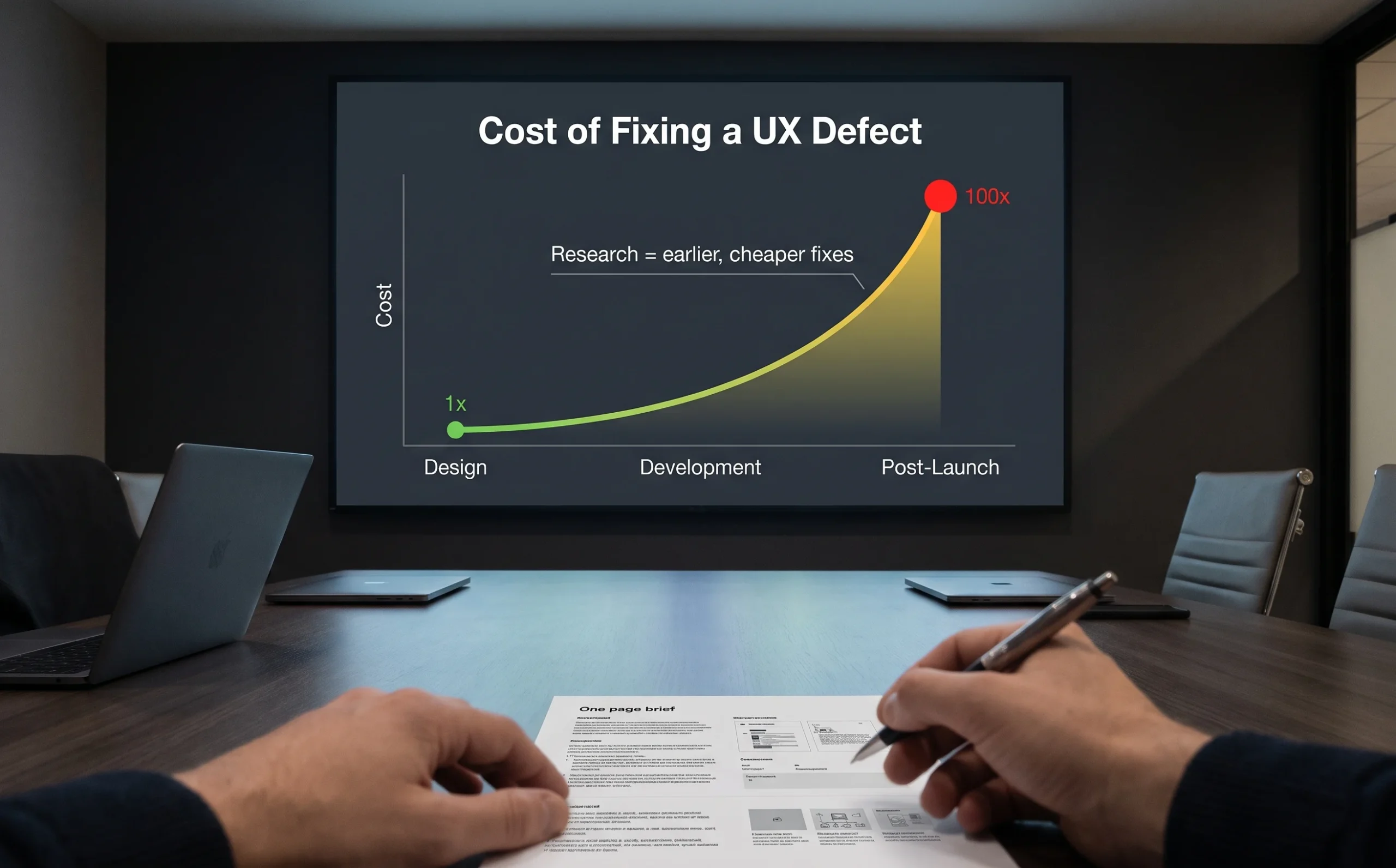
In regulated industries, a flawed workflow does not fail quietly. A confusing authentication flow in a core banking migration generates compliance risk, call-center volume, and quarterly churn—by which point the fix is no longer a design revision, but a full re-architecture. Fixing a user experience defect after a product has been launched costs 100 times more than addressing the same issue during the initial design phase. That 100x multiplier is the entire financial argument for research spend.
Enterprise product leaders in 2026 have retired ‘move fast and break things’ in favor of ‘move right,’ where velocity is earned by removing uncertainty before engineering commits capacity. With the most frequently used UX research methods including surveys (79%), usability testing (71%), and interviews (66%), and 58% of product professionals using AI in their workflows in 2026 (up from 44% in 2025), here is how to select the right research methods, validate product-market fit with concept testing, protect B2B data integrity, and decide when to partner with a UX research agency.

How do you navigate the 2026 user experience research methods landscape?
Navigate the user experience research methods landscape by matching each method to the specific decision blocking your roadmap, splitting your investment between generative research (which tells you what to build) and evaluative research (which tells you whether what you built holds up). Skipping generative work and over-investing in evaluative testing leads teams to optimize products nobody asked for.
The most frequently used UX research methods include surveys (79%), usability testing (71%), and interviews (66%), alongside longitudinal and structural techniques:
- Surveys (79% adoption): Quantify the shape and frequency of a problem across a large population, sizing an issue before you spend headcount investigating it.
- Usability testing (71% adoption): Exposes exactly where a workflow breaks under real task pressure, which is where multi-step compliance and clinical journeys tend to collapse.
- User interviews (66% adoption): Surface the reasoning behind behavior, including the off-platform spreadsheet workarounds users have invented and never reported.
- Diary studies: Track how an enterprise product performs across days or weeks, essential for claims processing, commercial onboarding, and workflows with a long operational tail.
- Card sorting and tree testing: Validate information architecture against user mental models before navigation decisions get baked into front-end code.
While 58% of product professionals use AI in their workflows in 2026 (up from 44% in 2025) for transcription, synthesis, and first-pass thematic coding, AI only compresses the analysis cycle—it never replaces the judgment call about which question to ask.

Why is concept testing user research the executive’s secret weapon for product-market fit?
Concept testing user research sits precisely where design thinking user research hands off to engineering, interrogating the value proposition itself at the last moment when changing your mind is still cheap. You put a proposition in front of target practitioners—as a storyboard, a value statement, or a clickable sketch—and find out whether the problem you framed is one they recognize.
The Nielsen Norman Group framework describes 20 common research approaches, highlighting concept testing as vital for early-stage validation. For enterprise teams, the alternative validation route—building a live pilot and watching adoption—consumes an entire development cycle to produce the same signal. The most expensive feature in any enterprise roadmap is the one that was never contested before it entered the sprint backlog.
In ScreenRoot’s BFSI and healthcare engagements, concept testing asks concrete domain questions before code exists: Does a wealth management client understand why a goal-based portfolio view beats a holdings table? Does a clinician believe a consolidated patient timeline will save them time, or do they see one more system to reconcile? Testing a concept against audit trails, consent flows, and role-based disclosure rules early prevents structural rework that no front-end polish can disguise later.
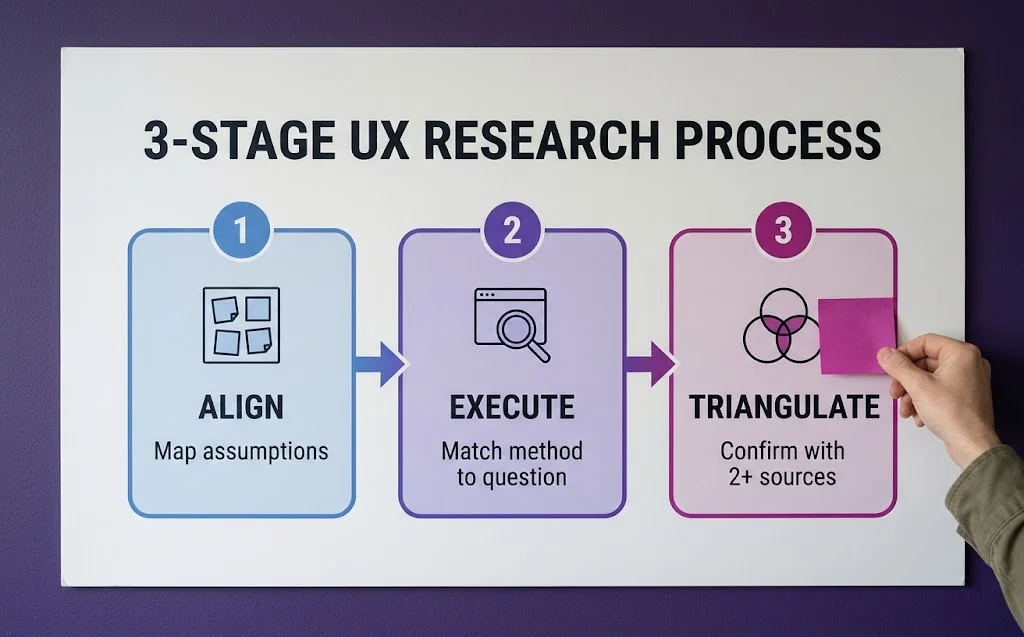
What is the modern 3-stage UX research process from assumptions to action?
The difference between actionable insight and wasted research expenditure is process discipline across three stages: Align, Execute, and Triangulate.
1. Align through assumptions mapping. Bring the product head, compliance lead, engineering manager, and commercial sponsor into one room to write down what they believe is true about the user. Their disagreements form the research agenda. This surfaces internal bias and manufactures stakeholder buy-in, because leaders defend findings that test their own stated assumptions. Translate vague requests (‘see if users like the new dashboard’) into prioritized questions attached to specific roadmap decisions.
2. Execute by matching method to question, not habit. If the question is ‘how many,’ run a survey. If it is ‘why,’ run interviews. If it is ‘can they complete this,’ run a usability test. Recruit for the actual operator population—including the edge cases sales teams would rather ignore—and document the protocol so a second researcher could replicate it.
3. Triangulate across independent sources. No single method is trustworthy alone. Pair behavioral analytics with qualitative interviews, then check both against support tickets and session recordings. A finding only graduates to a roadmap decision when it appears independently in at least two sources.
How do you ensure participant data integrity in complex enterprise research?
Ensure participant data integrity in enterprise research by designing anti-fraud screeners with red-herring options and open-ended domain vocabulary questions. When you need forty verified commercial underwriters or practicing nurse managers, financial incentives attract professional panel participants who will say whatever gets them through a binary screener.
- Build red-herring questions into screeners. List plausible but nonexistent software tools, certifications, or regulatory workflow steps alongside real ones. Anyone claiming familiarity with the invented option is automatically disqualified.
- Pro-Tip—Eliminate binary screener questions entirely. Asking ‘Do you process insurance claims daily?’ hands the participant the correct answer. Asking ‘Walk us through the last claim you handled and which system you used’ cannot be gamed without genuine domain experience.
- Anchor sessions in past behavior and code transcripts systematically. Inside the session, ask participants what they did last time rather than what they would do next time. On the back end, code transcript segments by theme, cluster tags into validated patterns, and translate each pattern into a ‘How Might We’ engineering statement (e.g., turning ‘Users distrust the approval status indicator’ into ‘How might we make approval progress legible at a glance?’).

When should you build an in-house team vs. hiring a specialist UX research agency?
Deciding between an in-house research team and a specialist UX research agency is a question of cadence, objectivity, and regulated domain depth rather than budget alone. Most mature enterprises run a hybrid model: a lean internal team owns continuous discovery and institutional memory, while a specialist agency is engaged when stakes spike around a core platform replacement, new regulatory regime, or new market entry.
| Factor | In-House Team | Specialist UX Research Agency |
| Speed to first insight | Slower initially; hiring and ramp-up take months | Faster; established recruitment panels and tested protocols |
| Domain expertise | Deep in your product, narrower across the sector | Broad pattern recognition across comparable regulated builds |
| Cost structure | Fixed salary, benefits, tooling, panel subscriptions | Project-based, scales with actual research demand |
| Continuity | Strong institutional memory of past studies | Requires deliberate knowledge transfer at handoff |
| Objectivity | Subject to internal politics and roadmap pressure | External position makes uncomfortable findings easier to deliver |
| Best suited to | Continuous discovery on a mature, stable product | High-stakes validation, new market entry, compliance-sensitive launches |
Domain expertise tilts the decision in BFSI and healthcare. A researcher who has never sat through a KYC flow or a clinical documentation audit spends the first month learning what your team already knows. ScreenRoot combines 16+ years of domain expertise in highly regulated industries with a research-first methodology, removing that ramp-up entirely.
How do real-world case studies prove the value of outcome-driven UX research?
In regulated transformations, the engineering fix is often inexpensive once structured observation diagnoses the real failure mode:
- Banking—Untangling a multi-product onboarding flow: A digital banking client had an application journey that worked beautifully in demos and poorly in production. Moderated usability testing with real applicants revealed the breakdown was not in the form fields at all—it was in the disclosure sequence, where regulatory language appeared at the exact moment users were trying to make a decision, causing them to stop and re-read rather than proceed. Restructuring when disclosures surfaced resolved a drop-off problem the team had blamed on form length for two quarters.
- Healthcare—Making a clinical interface legible under time pressure: A provider platform carried extensive functionality clinicians genuinely needed, arranged assuming unhurried attention. Task-based testing in realistic conditions showed the information hierarchy inverted under pressure: the data clinicians reached for most urgently sat deepest in the navigation. Reorganizing around observed task frequency rather than feature taxonomy turned a dense interface into one that supported the actual pace of care.
What is the bottom line on UX research for enterprise leaders?
For executives presenting a UX research business case to a steering committee, four principles hold across every product cycle:
- UX research is a financial control, not a design preference. Fixing a defect after launch costs 100 times more than addressing it during initial design, meaning research budget is remediation budget spent earlier and at a steep discount.
- Balance generative discovery with evaluative testing. Use interviews and concept testing to make sure you build the right thing before using usability testing to make sure you build it right.
- Protect study integrity with rigorous screening and triangulation. Use red-herring screeners to block fraudulent B2B participants and require at least two independent evidence sources before altering the roadmap.
- Bring regulated domain expertise to the table early. Partnering with specialists who understand BFSI and healthcare compliance constraints ensures research findings translate directly into shippable, audit-ready product architecture.
Frequently Asked Questions
Why does fixing a UX issue after launch cost 100 times more?
Once a product is in production, fixing a workflow defect requires re-architecting live databases, rewriting APIs, updating compliance documentation, retraining support staff, and recovering churned users—whereas fixing the same flaw during early concept testing or prototyping only requires updating a design file.
What are the most commonly used user experience research methods in 2026?
The most frequently used UX research methods are surveys (79%), usability testing (71%), and user interviews (66%), supported by concept testing, diary studies for multi-day workflows, and card sorting or tree testing for navigation hierarchy.
How does concept testing user research differ from usability testing?
Concept testing happens earlier and evaluates the value proposition itself—asking whether target users recognize the problem and want the proposed solution—using storyboards or clickable sketches. Usability testing evaluates whether users can successfully complete tasks inside a specific interface design.
How do you prevent fake participants in enterprise B2B user research?
Avoid yes/no screener questions that telegraph the desired answer. Instead, include red-herring questions listing plausible but nonexistent industry tools alongside real ones, and require open-ended responses where candidates must use authentic domain vocabulary to describe a recent workflow.
When should an enterprise hire a UX research agency instead of using an in-house team?
An in-house team is ideal for continuous discovery on a stable product, while a specialist UX research agency like ScreenRoot is best suited for high-stakes platform migrations, new market entries, and regulated BFSI or healthcare builds requiring immediate B2B recruitment and external objectivity.
De-risk your next enterprise build with ScreenRoot
If your team is planning a core platform migration or launching a high-stakes workflow in banking, insurance, or healthcare, replace roadmap guesswork with evidence. Explore ScreenRoot’s research-led case studies at screenroot.com/work/ or contact us to scope a targeted discovery engagement.
Written by Team ScreenRoot. 16+ years leading enterprise UI/UX research for BFSI, SaaS, and Healthcare clients.
When you’re ready, let’s talk.
📞 Call us (Toll-Free): 1800 121 5955 (India)
✉️ Email us: [email protected]