1800 121 5955
In short: AI is shifting enterprise software from command-based interfaces, where users learn the system, to intent-based ones, where the system interprets what users want. For business leaders, that means faster onboarding, higher productivity, and lower training overhead, but only when the design is grounded in real user research rather than assumptions.
Traditional software has always demanded fluency before function, you learn the menus, master the shortcuts, and then, finally, do the work. That bargain is breaking down fast, and AI in UX is the reason why.
For decades, enterprise software operated on a single assumption: users adapt to the system. Onboarding meant memorising navigation paths. Productivity meant surviving a learning curve steep enough to make any new hire question their career choices. The interface dictated what was possible, not the other way around.
AI flips that contract entirely. Instead of clicking through nested menus to reach an outcome, users can simply state what they want. “Show me Q3 pipeline by region.” “Draft a follow-up email for this deal.” The system interprets intent and acts.
As the Nielsen Norman Group notes, this shift from command-based interfaces to intent-based, outcome-oriented ones represents the most significant change in UX since the move from text-based interfaces to the graphical user interface. That’s not hyperbole, it’s a structural redesign of how humans and software relate.
“The shift from command-based interactions to intent-based outcome specification represents the biggest change in how we interact with computers since the introduction of the graphical user interface.” — Nielsen Norman Group
For business leaders, the implications are immediate and measurable. Faster onboarding, higher daily productivity, and reduced training overhead are all downstream effects of removing interface friction. Understanding what your users actually need, explored through systematic behavior analysis – is the foundation for designing AI experiences that deliver on that promise. And that connection between smarter UX and real business outcomes is exactly where the story gets interesting.

The Revenue Reality: Linking AI UX to the Bottom Line
Treating AI user experience as a cosmetic upgrade is a costly mistake. It’s one of the highest-leverage revenue levers available to B2B enterprises today.
AI-driven personalization can lift revenue by roughly 10% to 15%, according to McKinsey & Company research, by making digital interactions more relevant at every stage of the buyer journey. That’s not a marginal improvement, it’s a structural shift in how value is created through software.
Friction is the enemy of conversion. In complex B2B sales funnels, even small moments of confusion – a buried feature, an unclear next step, a tool that assumes expertise the user doesn’t yet have, compound into lost deals. Intent-based design removes those friction points by surfacing what users actually need, when they need it, rather than forcing them to navigate toward it. The result is a shorter path from interest to action.
Relevance drives decisions. Tailored digital interactions signal to users that a platform understands their context, their role, and their goals. That sense of alignment builds trust, and trust accelerates commitment. Working with a team that can identify the right research approach early in the design process is often what separates platforms that convert from those that confuse.
For CXOs, the implication is clear: AI UX isn’t just a technical feature to delegate, it’s a strategic investment that belongs in the boardroom conversation. And as the next section explores, many organizations still lack the roadmap to make that investment count.
Bridging the Strategy Gap in Enterprise AI
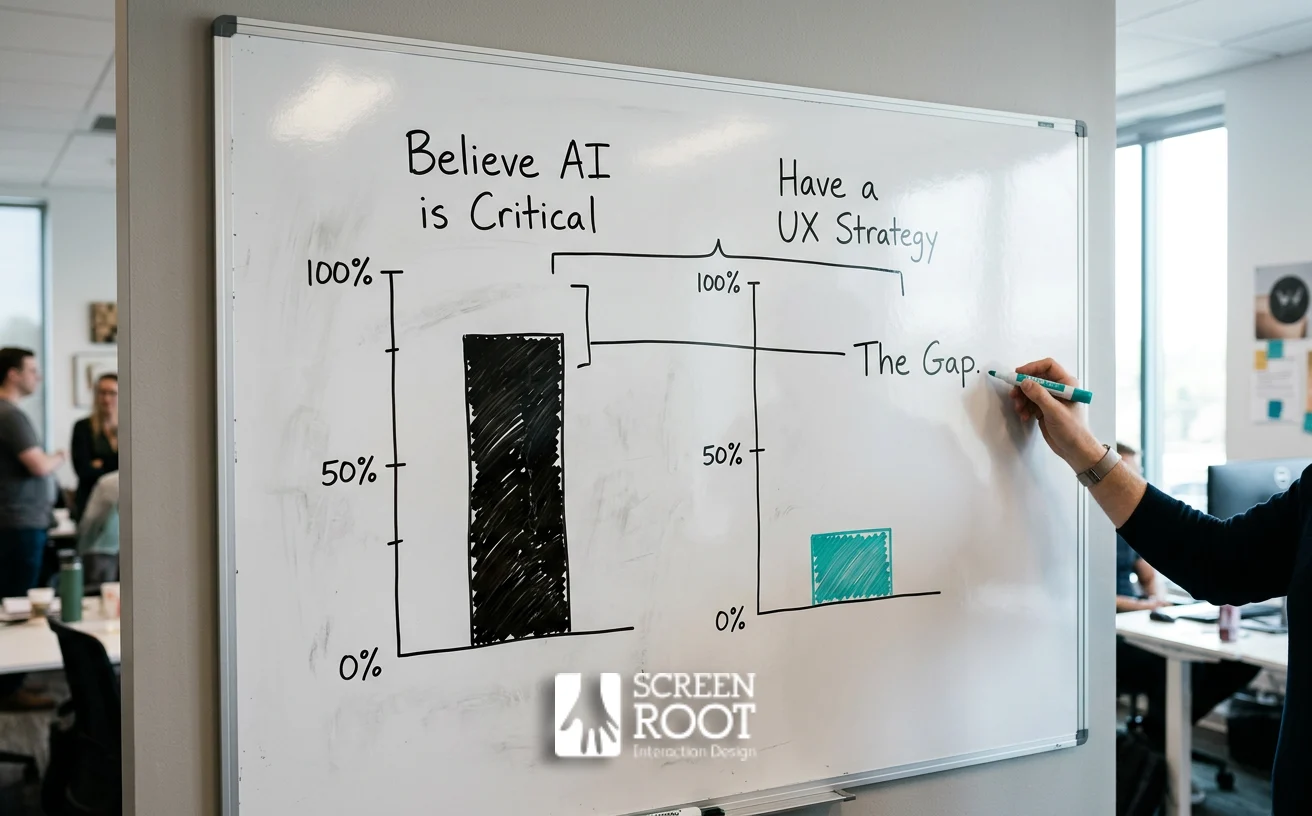
Recognizing AI’s potential and knowing how to deploy it intelligently are two very different capabilities, and the gap between them is widening fast.
Industry research captures the disconnect starkly: while a large majority of business leaders believe AI will be critical to their success within a couple of years, only a small minority report having a clear strategy for the experience layer that makes AI usable. McKinsey has found, for example, that just 15% of marketing leaders believe their company is on the right track with personalization, a proxy for how few organizations have operationalized AI experience well.
Buying into AI without a design roadmap is like installing a powerful engine with no steering wheel. For enterprise teams, this shows up as tools that get adopted, then quietly abandoned – not because the technology failed, but because the experience did.
Regulated industries face this problem with an extra layer of complexity. In BFSI and Healthcare, AI for customer experience must balance personalization with compliance, transparency, and trust – often across workflows that are deeply entrenched and risk-averse. The stakes are high enough that a confusing interface isn’t just a usability issue; it’s a liability. And yet, many organizations in these sectors still treat UX as a post-development concern rather than a strategic input from day one.
UX research is the missing link. Without it, AI products get built around assumptions instead of actual user behavior. Understanding those assumptions early is what separates tools users trust from tools users tolerate. For enterprise leaders willing to invest in a structured AI UX strategy now, the competitive advantage is real, and it compounds over time. The question isn’t whether to act, but how quickly you can move from intent to execution. The answer, as the next section demonstrates, starts with putting research at the center of the design process.

Case Study: How SwiftChat Redefined AI Learning UX
Good AI product design doesn’t just make software prettier, it makes complex systems feel effortless, even for first-time users.
ScreenRoot partnered with ConveGenius to build SwiftChat, an AI-powered learning platform designed to bring conversational UX to one of the most workflow-heavy environments imaginable: large-scale education. The challenge wasn’t just technical. Educational platforms often carry a steep learning curve, with layered content structures, progress tracking, and administrative complexity beneath the surface. For learners on mobile devices, many accessing the platform in low-connectivity environments – friction isn’t an inconvenience. It’s a barrier to completion.
The solution centred on a research-first approach. Rather than designing for ideal conditions, the team invested heavily in understanding real user behaviour before a single interface element was finalised. What emerged was a conversational UX model that guided users through complex workflows using natural-language interaction, reducing cognitive load and making the AI feel like a helpful guide rather than an intimidating system to learn.
And that distinction matters more than it might seem. SwiftChat demonstrates that enterprise-grade AI doesn’t have to sacrifice usability to be powerful. The app is mobile-first, lightweight, and built around how learners actually think — not how developers assumed they would.
When AI feels intuitive, adoption follows. The SwiftChat collaboration is a practical proof point that intent-based design, grounded in genuine research, can close the gap between what enterprise AI promises and what users actually experience. It’s a principle that becomes even more critical in industries where trust isn’t optional — which is exactly where the conversation goes next.

Designing for Trust in Regulated Industries
In regulated sectors like banking and Healthcare, enterprise UX design isn’t just about efficiency, it’s about accountability at every interaction.
Transparency is non-negotiable when AI outputs carry real consequences. In BFSI and Healthcare environments, users need to understand why an AI made a specific recommendation, not just what it recommended. An interface that surfaces clear reasoning, confidence levels, and audit trails doesn’t just satisfy compliance teams – it builds the kind of user trust that drives adoption.
UX design acts as the critical bridge between complex AI logic and human judgment. When a clinician reviews an AI-flagged patient risk or a loan officer evaluates an automated credit decision, the interface shapes how much they trust, and act on that output. Poorly designed screens create hesitation, workarounds, and liability exposure. Well-designed ones create confident, defensible decisions.
Regulated environments also demand that compliance controls are woven directly into the experience:
- Data consent flows that feel seamless rather than obstructive
- Role-based information access that limits sensitive data exposure without slowing workflows
- Audit-ready interaction logs presented in a format users can actually navigate
- Plain-language explainability that decodes AI outputs for non-technical stakeholders
ScreenRoot’s research-driven approach to complex enterprise sectors means these requirements aren’t retrofitted as afterthoughts — they’re embedded from the discovery phase forward. With 16+ years of domain expertise across banking and Healthcare, ScreenRoot understands that in regulated industries, trust is the product. Getting that balance right sets the foundation for the broader strategic conclusions ahead.
The Bottom Line: What You Need to Know
Enterprise AI is moving fast, and the leaders who understand the UX layer will be the ones who pull ahead. This section distils the core arguments into four takeaways you can act on.
- Intent-based interfaces are the new standard.
AI UX has fundamentally shifted from command-based interactions, where users learn the system’s language, to intent-based design, where the system learns theirs. That inversion changes everything about how enterprise software should be built and evaluated. - The revenue case is real.
Personalized AI interactions can lift B2B revenue by around 10–15%, which means UX investment isn’t a cost center, it’s a growth lever. Getting the interface right has direct commercial consequences for enterprise teams. - The strategy gap is your opening.
Most organizations have deployed AI tools without the research foundation to make them effective. Leaders who invest in UX research now, before competitors do, are positioned to capture meaningful market advantage in their category. - Domain expertise is non-negotiable.
As the regulated-industry examples earlier in this article show, successful AI implementation requires more than technical skill. You need a partner who understands the complexity of your sector. With 16+ years delivering enterprise digital experiences, ScreenRoot brings that depth to every engagement.
These four points set the foundation for something practical. The next section outlines how to build an AI UX roadmap that turns this understanding into action.
Building Your AI UX Roadmap
Enterprise AI success doesn’t start with a model, it starts with understanding where your users are losing time, trust, and patience.
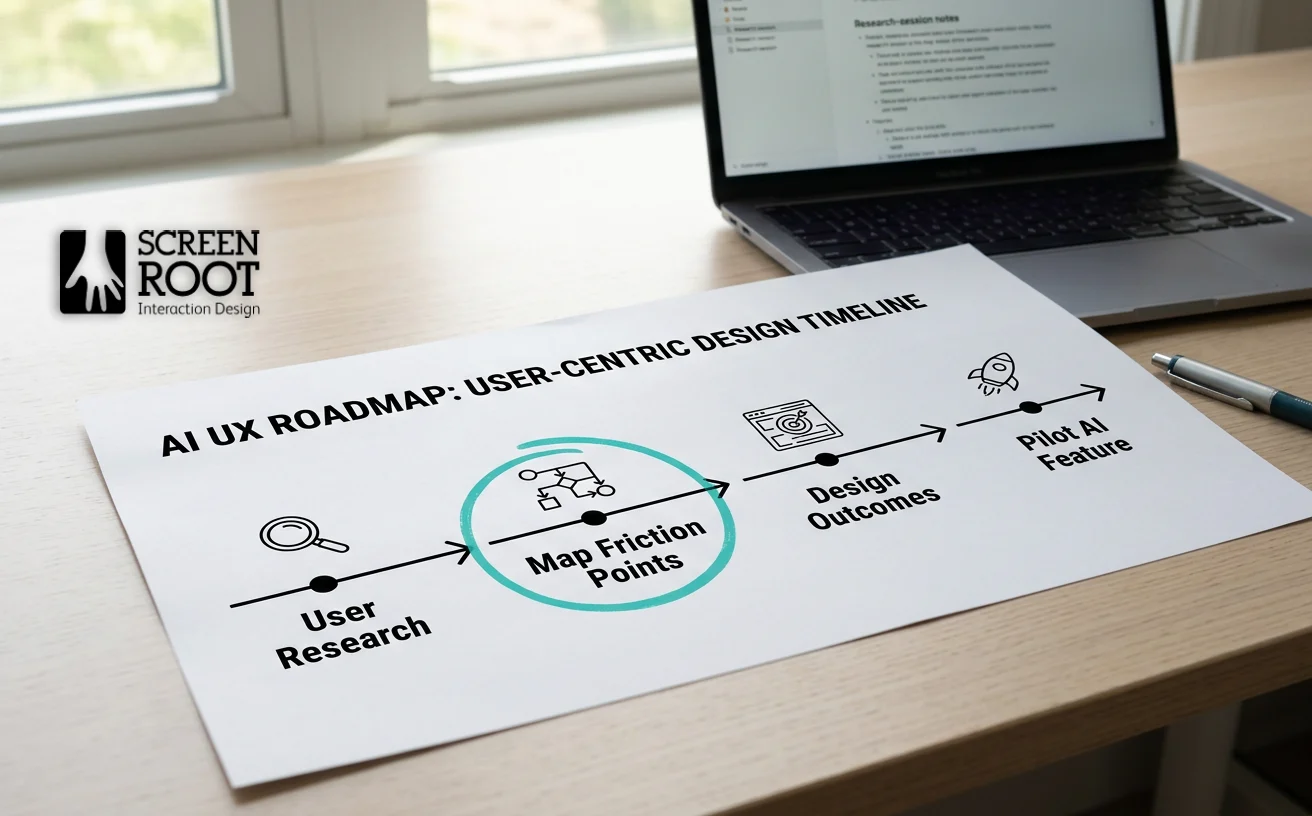
The most effective AI UX roadmaps begin with user research, not technology decisions. Before committing to any interface pattern, map the friction points where employees abandon workflows, request workarounds, or simply stop using a tool altogether. Those gaps are where AI-assisted design delivers its highest return.
Once you’ve identified the friction, resist the temptation to design around features. Focus on outcomes: faster decisions, fewer escalations, clearer audit trails. An interface that helps a compliance officer reach a confident answer in two steps beats one that surfaces twelve AI-generated options with no clear hierarchy. The technology should disappear into the workflow, and that only happens when the design is grounded in what users are actually trying to accomplish.
And that’s where specialized expertise matters. Bridging AI capability with enterprise complexity requires more than good intentions — it requires deep knowledge of both sides. ScreenRoot offers a full suite of services including UX research, usability testing, and design workshops, which means you’re not starting from scratch when the stakes are high.
If you’re ready to move from strategy to execution, explore how intent-based thinking shaped a real product by reviewing the SwiftChat case study — or get in touch with ScreenRoot to discuss a workshop tailored to your organization’s AI roadmap.
Frequently Asked Questions
What is intent-based UX?
It’s an interface model where users state what they want in natural language and the system interprets and acts on that intent, instead of the user learning menus, paths, and commands to reach the same outcome.
How does AI UX affect revenue?
By removing friction and making interactions more relevant. McKinsey research associates strong personalization with roughly a 10–15% revenue lift, and in B2B that shows up as faster onboarding, higher adoption, and shorter paths from interest to action.
Why does AI UX matter more in regulated industries?
Because AI outputs there carry real consequences. Users need to see why a recommendation was made, with clear reasoning, confidence levels, and audit trails – so transparency and explainability become core design requirements, not extras.
Where should an AI UX roadmap start?
With user research, not technology. Map where people abandon workflows or build workarounds first; those friction points are where AI-assisted design delivers the highest return.
Written by Team ScreenRoot. 16+ years leading enterprise UI/UX research for BFSI, SaaS, and Healthcare clients.
When you’re ready, let’s talk.
📞 Call us (Toll-Free): 1800 121 5955 (India)
✉️ Email us: [email protected]