1800 121 5955
In financial services, trust is won or lost in the milliseconds of a digital interaction. A cluttered interface or a confusing consent screen reads as a risk to users’ money. Treating UX as a core pillar of digital transformation strategy, aligned across product leadership and grounded in research-first design, is what builds the durable trust that keeps customers through AI-driven change.

The Strategic Mandate for Digital Trust in BFSI
Digital trust is no longer a UX nice-to-have, in financial services, it’s the difference between a thriving enterprise and a brand quietly losing ground to more agile competitors.
For decades, trust in banking and financial services was built face-to-face. A branch manager who knew your name, a handshake across a desk, a paper statement that arrived like clockwork. That era hasn’t disappeared entirely, but it’s no longer the primary arena where trust is won or lost. Today, that moment happens in milliseconds, when an app loads, when a form feels intuitive, when a security prompt doesn’t make a user question whether they’re being scammed. The digital interface has become the branch.
This shift demands that CXOs stop treating UX as a design department concern and start treating it as a core pillar of digital transformation strategy, one that sits alongside compliance, risk management, and capital allocation. Highly trusted companies outperform their peers by as much as 400% in market value, according to Deloitte. That’s not a soft metric. That’s a board-level conversation. Delivering transparent financial services through well-designed digital experiences isn’t just good practice; it’s a measurable competitive advantage.
And yet, trust isn’t evenly distributed. The United States had a 29-point trust gap between high-income and low-income groups in 2026 when it comes to institutional confidence, according to Edelman. For BFSI organizations serving broad consumer bases, that gap represents both a risk and an opportunity. Poor digital experiences don’t just frustrate users, they widen that gap further, particularly for populations already skeptical of financial institutions. Understanding how users actually interact with your platform is where closing that gap begins.
The sections ahead explore how the C-suite, from the CIO to the Chief Product Officer – can align around digital trust as a unified strategic mandate, not a siloed afterthought.

Aligning the CIO and Product Head on UX Strategy
In financial services, the gap between technical security and user perception isn’t a design problem; it’s an organizational one that quietly dismantles digital trust from the inside out.
The Chief Digital Officer and Chief Product Officer role has evolved significantly over the past decade. What was once a largely technical function, focused on system uptime, data integrity, and infrastructure – now carries an explicit mandate for customer experience. Strategic alignment between CIOs and Product Heads is critical for differentiating financial institutions in an increasingly competitive market. And yet, in practice, many institutions still operate with these two functions pulling in opposite directions.
Fragmented internal silos are where UX design for fintech trust most commonly breaks down. The CIO prioritizes encryption, access controls, and compliance architecture. The Chief Product Officer focuses on conversion flows, onboarding friction, and feature delivery. When those two perspectives don’t share a unified roadmap, the result is a digital product that’s technically secure but perceptually unreliable, riddled with inconsistent interfaces, confusing consent flows, and error messages that read like legal disclaimers. Users don’t distinguish between a bad security decision and a bad product decision. They simply stop trusting the platform.
A unified digital product management function is what closes this gap. When security and experience strategy share the same governance layer, design decisions get stress-tested against both risk tolerance and user expectations simultaneously. Methods like structured usability evaluation become organizational habits rather than one-off exercises. That kind of integration doesn’t happen by accident, it requires deliberate leadership alignment and a shared definition of what “quality” means at the product level. How institutions build that foundation through research-first design is where the real opportunity lies.

Transparent Financial Services Through Research-First Design
Radical transparency in financial interfaces isn’t a design trend; it’s a structural response to the trust deficit that dark patterns have quietly built over the last decade.
Dark patterns, those deliberately confusing opt-out flows, hidden fee disclosures, and pre-checked consent boxes, may have once boosted short-term conversion metrics. But they’ve extracted a steep long-term cost: users who feel manipulated don’t return, and in regulated industries, they escalate. Building trust through design starts with dismantling these friction points systematically, not intuitively. That means usability testing that surfaces where users hesitate, misread, or abandon, and treating those moments as risk signals, not just UX issues. When a user stalls on a fee disclosure screen, that’s a compliance exposure as much as a conversion problem.
Research-driven design is what separates durable digital trust from cosmetic redesigns. ScreenRoot financial UX case studies show a pattern seen consistently across regulated industries: organizations that embed research into their product strategy earlier make fewer costly corrections later. ScreenRoot’s research-first methodology built across 16 years of working in complex enterprise and regulated sectors, treats user insight as a risk mitigation tool, not just a design input. And that reframing matters enormously at the C-suite level, where “UX investment” needs to translate into measurable risk reduction, regulatory alignment, and retention. It’s a perspective that UX design for fintech trust increasingly reinforces: transparency in interface design directly correlates with user confidence and long-term loyalty.
The real competitive advantage isn’t in having the most features; it’s in being the institution users trust enough to use them. As the next section explores, fintech has already internalized this lesson, and other sectors are now looking to that playbook.

Lessons from Fintech: Cross-Industry UX Applications
The trust-building frameworks powering BFSI digital transformation strategy are now the most borrowed blueprints in regulated industries, and Healthcare is leading the charge.
It’s not hard to see why. Both sectors handle deeply personal data, operate under strict regulatory oversight, and serve users who are often anxious, confused, or both. Healthcare UX teams are increasingly looking to fintech for answers on how to simplify complex information without stripping away the context users need to make confident decisions. The parallel is striking: a patient reviewing a lab result and a retail investor reading a fund disclosure face the same cognitive load problem, just in different settings.
Simplifying complex data is where both sectors converge most clearly. Fintech has spent years learning that clarity isn’t dumbing things down; it’s sequencing information so that the right detail appears at the right moment. That lesson transfers directly to healthcare portals, insurance dashboards, and benefits platforms. And as GenAI tools are becoming a popular research channel, with more than 50% of people under 50 expected to use them for financial advice by 2026, the same expectation for instant, plain-language answers is reshaping how users engage with professional services across the board.
Three cross-industry lessons stand out:
- Progressive disclosure works everywhere. Fintech’s approach of layering detail, summary first, depth on demand, reduces overwhelm in healthcare onboarding and insurance claim flows just as effectively as it does in banking apps.
- Transparency reduces friction. When users understand why they’re being asked for information, completion rates improve. This holds whether you’re filling out a loan application or a medical intake form.
- The interface is the product. In the experience economy, a confusing UI isn’t a minor inconvenience; it’s a trust event. Users don’t distinguish between a bad experience and a bad organization.
That last point carries real weight as AI begins to redefine what “good design” even means, a shift the next section addresses directly.
Designing for the Future: AI and the Trust Horizon
Generative AI is reshaping digital banking faster than most compliance frameworks can track, and the financial institutions that thrive will be the ones that treat human-centric design as non-negotiable.
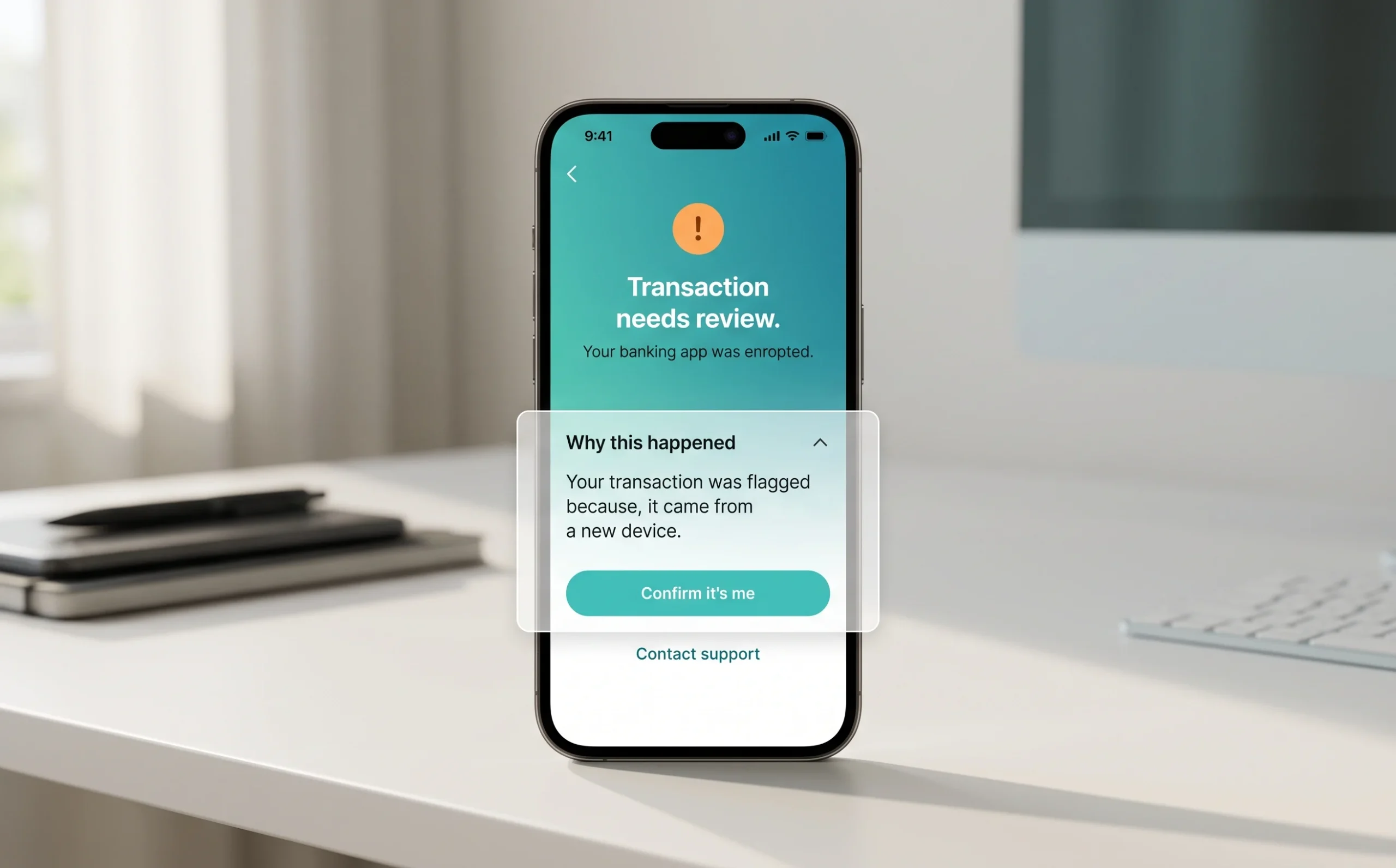
The rise of GenAI in financial services isn’t simply a technology story. It’s a trust story. Automated credit decisions, AI-driven financial advice, and predictive fraud detection all introduce new layers of opacity into user experiences that already struggle with complexity. When an algorithm declines a loan or flags a transaction, the user experience of that moment, how it’s explained, what recourse is offered, how empathetically it’s framed – determines whether a customer stays or walks. And that UX decision doesn’t happen by accident. It happens by design.
Global trust trends offer a useful baseline here. Trust in the financial services sector reached 63% globally in 2026, a 10-point increase since 2021. A meaningful recovery that reflects years of investment in transparency and digital experience. But that momentum is fragile. AI-generated interactions, if poorly designed, can erode it quickly.
“The AI trust gap is real: consumers want the efficiency of automation but demand the accountability of a human. Financial platforms that fail to bridge this gap will face a credibility crisis no marketing budget can fix.”
Future-proofing digital products against AI disruption means validating AI-driven interfaces the same way you’d validate any high-stakes design decision, rigorously and continuously. Applying a ScreenRoot usability testing methodology to AI-generated touchpoints, for example, surfaces the friction points and comprehension gaps that automated systems routinely miss. That kind of structured validation is what separates durable digital products from costly retrofits.
Ultimately, the institutions that lead won’t just be the ones deploying AI – they’ll be the ones governing it with the same design discipline applied to every other customer interaction. That’s the foundation any credible trust-first roadmap needs to be built on.
The Bottom Line: Building a Trust-First Roadmap
Trust in financial services isn’t earned through marketing language; it’s engineered through deliberate design decisions that users experience every single time they open your app.
- Trust as a design output. The most important shift an executive can make is treating trust as a measurable product outcome rather than a brand sentiment. Every interaction, a loading state, an error message, a consent screen, either builds or erodes a user’s confidence. Designing for digital trust means embedding that accountability into your product development cycle from day one, not layering it on after launch.
- Research-first methodology. In regulated sectors, intuition isn’t enough. Systematic user research, behavioral analysis, accessibility audits, journey mapping – surfaces the friction points that erode trust before they become compliance events or churn statistics. This is especially true in financial services, where a single confusing disclosure screen can cost you a customer and a regulator’s goodwill simultaneously.
- CIO and CPO alignment. The organizations consistently outperforming their peers on digital trust share one structural trait: their technology leadership and product leadership operate from a shared roadmap. When infrastructure priorities and experience priorities are siloed, users pay the price in broken flows and inconsistent interfaces. Closing that gap is foundational to any trust-first strategy.
- UX as competitive leverage. And ultimately, UX is the most controllable lever you have for market differentiation. Regulatory requirements create a floor, but design excellence builds the ceiling. The institutions that recognize this are converting interface quality into measurable business outcomes, from improved retention to higher product adoption rates.
What those outcomes look like in practice, how the right design partnership makes them achievable, and that’s where this guide lands next.
Transforming Human-Screen Interactions into Business Outcomes
In financial services, the interface isn’t just a front end; it’s the primary mechanism through which trust is either built or permanently lost.
That’s the lens ScreenRoot brings to its work with leading global brands across banking, healthcare, and manufacturing. The mission is straightforward: help progressive businesses turn complex digital experiences into measurable outcomes, not through cosmetic redesigns, but through structured design workshops, rigorous usability testing, and interaction models that hold up under real-world pressure. In high-stakes sectors where a confusing screen can trigger a compliance failure or a customer walking out the door, that rigor isn’t optional.
And here’s what the C-suite too often overlooks: competitive advantage increasingly lives at the interface layer. Product parity is common. Rate differences are marginal. But the institution that makes a mortgage application feel frictionless, that makes fraud alerts readable rather than alarming, and that makes accessibility a default rather than an afterthought, that institution wins the long game. The design decisions made in your next sprint cycle have real consequences for retention, regulatory standing, and revenue.
If the principles covered throughout this guide resonate, from AI transparency to trust-first roadmaps, the logical next step is seeing those principles in practice. Browse ScreenRoot’s work in banking and healthcare to understand what deliberate, outcome-driven UX looks like at scale. Your interface is already saying something to your users. The only question worth asking is whether it’s saying what you intend.
Written by Team ScreenRoot. 16+ years leading enterprise UI/UX research for BFSI, SaaS, and Healthcare clients.
When you’re ready, let’s talk.
📞 Call us (Toll-Free): 1800 121 5955 (India)
✉️ Email us: [email protected]