1800 121 5955
In short: A UX audit before a redesign is a diagnostic, not a nicety. It surfaces the usability failures, compliance friction, and drop-off triggers hiding in your current product — with evidence — so the redesign fixes real problems instead of repainting them. In regulated banking flows like KYC, that difference shows up directly in completed applications and avoided remediation costs.
In banking and financial services, poor digital design isn’t just a UX problem — it’s a business liability measured in lost customers and regulatory exposure.
The stakes are especially high when you consider that fixing a software error after development costs up to 100 times more than catching it during the design phase, according to the IBM Systems Sciences Institute. Yet many BFSI organizations still treat redesigns as cosmetic exercises, swapping colors and fonts while leaving broken flows untouched underneath.
“If you think good design is expensive, you should look at the cost of bad design.” — Dr. Ralf Speth, former CEO of Jaguar Land Rover
Aesthetic-only redesigns fail because they address symptoms rather than root causes. A new visual layer over a confusing onboarding flow is still a confusing onboarding flow. That’s precisely why conducting a UX audit before redesigning a digital product has emerged as a risk-mitigation strategy, not just a best practice. A structured UX audit surfaces usability failures, compliance friction points, and drop-off triggers before a single line of production code changes.
For banks navigating digital transformation, that diagnostic step can mean the difference between a redesign that drives acquisition and one that simply looks better while failing users in new ways. The Suryoday Small Finance Bank case illustrates exactly how that friction gets uncovered.
Before you redesign, audit — because what you don’t know is costing you customers.
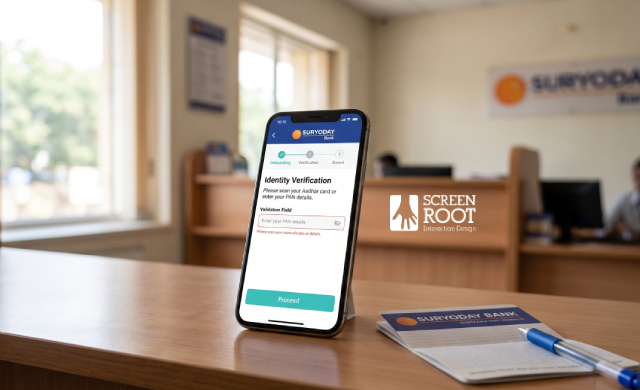
Suryoday Bank: Identifying Friction in the Digital Onboarding Journey
A digital presence alone doesn’t guarantee customer acquisition, and the Suryoday Small Finance Bank case study makes that point with striking clarity.
Despite having a functional digital product, Suryoday was losing potential customers before they could complete onboarding. Analytics confirmed the drop-offs, but raw data couldn’t explain why users were abandoning the process. That gap between what the numbers showed and what users actually experienced became the central problem.
The UX audit process focused on the bank’s digital onboarding and KYC (Know Your Customer) flow — a notoriously complex sequence in financial services that combines regulatory requirements with user-facing design decisions. The audit examined:
- Navigation clarity across onboarding steps
- Form complexity and field-level friction during KYC data entry
- Error handling and recovery paths when users made mistakes
- Progress visibility — whether users understood how far along they were
- Document upload flows, which are common abandonment triggers in banking apps
Usability testing was critical here. In regulated banking flows, friction is rarely obvious in a heuristic review alone. Watching real users attempt to complete KYC verification revealed hesitation points, moments of confusion, and trust gaps that no analytics dashboard could surface. The audit transformed vague drop-off data into a specific, prioritised list of design problems.
Understanding the shape of the problem was only the first step — what came next was deciding how to fix it strategically.
A structured audit turns invisible friction into actionable evidence, which is exactly the foundation any successful redesign needs.

The Strategic Purpose of a UX Audit Before Redesign
A UX audit for mobile redesign acts as a comprehensive health check — surfacing what’s broken, what’s confusing, and what’s silently costing you customers before a single pixel gets changed.
A UX audit doesn’t just find problems; it prioritizes them with evidence, so redesign efforts target real friction instead of assumed friction.
Understanding how an audit differs from usability testing matters here. The table below breaks it down:
| Dimension | UX Audit | Usability Testing |
| Scope | Broad product-wide review | Targeted task scenarios |
| Method | Heuristic analysis, analytics, expert review | Observed user sessions |
| Output | Prioritised issue roadmap | Behavioural insights on specific flows |
| Timing | Before redesign | Before or after redesign |
As Baymard’s UX audit framework explains, an audit evaluates the existing interface against established best practices systematically — not just through one lens. This breadth is what makes it so valuable as a redesign input. A well-structured audit report translates expert findings into a stakeholder-ready roadmap, aligning what the business believes works with what users actually experience.
According to Forrester Research, every dollar invested in UX returns between $10 and $100 — making the pre-redesign audit one of the highest-leverage investments a product team can make.
Before committing to a redesign, run a UX audit to ensure you’re solving real user problems, not expensive assumptions.
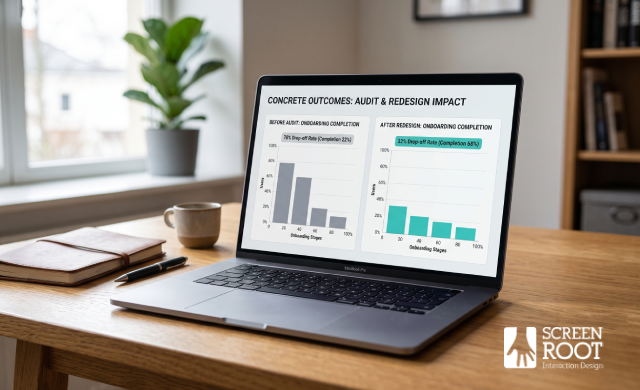
Concrete Outcomes: From Audit Insights to Onboarding Success
Conducting a UX design audit before redesign gave Suryoday Bank a clear, evidence-based roadmap — and the results reflected that discipline.
Before the redesign, the onboarding flow placed excessive cognitive load on users, requiring them to navigate a fragmented KYC process with redundant steps, unclear progress indicators, and ambiguous form fields. Drop-offs were concentrated precisely at those high-friction points.
After the audit findings were applied, the KYC flow was restructured to present only what users needed at each stage — reducing unnecessary decisions and making progress feel achievable. Account opening steps were reordered based on observed user behaviour, not assumptions.
“The audit allowed the redesign to focus on high-impact areas like simplified KYC and streamlined account opening rather than aesthetic changes alone.” — ScreenRoot Case Study
The transition from research to interface wasn’t cosmetic. Findings from structured user research directly shaped interaction patterns, error handling, and information hierarchy across the app. Functional improvements took priority over visual refreshes.
The business impact was meaningful: a smoother acquisition funnel, fewer abandoned applications, and a digital experience built to scale with future compliance requirements.
Research-driven redesigns don’t just fix today’s problems — they create systems that are easier to maintain and adapt tomorrow.
When audit insights drive redesign decisions, the result isn’t just a better-looking product — it’s a measurably more effective one.
Key Takeaways for Product Leaders
Investing in UX audit services before a redesign is one of the highest-ROI decisions a product leader can make — especially in regulated industries where a broken onboarding flow directly translates to lost revenue.
The Suryoday Bank case study reinforces several principles that apply broadly across digital product teams:
- Audit early, fix cheaply.
Research consistently shows that defects caught before development cost a fraction of post-launch fixes. Waiting until after launch to discover friction points multiplies your remediation budget significantly. - Prioritize high-friction workflows first.
In regulated environments like fintech, processes like KYC carry both compliance and conversion weight. Targeting these areas delivers measurable impact faster than surface-level changes. - Let data do the budget justification.
A structured audit produces evidence — heuristic findings, usability benchmarks, and quantifiable UX metrics — that leadership can evaluate objectively, making it far easier to secure redesign investment. - Function over form.
Aesthetic refreshes feel rewarding but rarely move the needle. The improvements that reduced Suryoday’s drop-off rates were structural: simplified flows, clearer error states, and intuitive navigation — not new brand colors.
These principles aren’t unique to banking. Whether you’re in e-commerce, SaaS, or financial services, the fundamentals of experience design remain consistent: understand where users struggle before deciding how to redesign.
If there’s one thing to carry forward, it’s this: the audit isn’t the overhead before the redesign — it’s the strategy that makes the redesign worth doing.
If your own banking digital product faces friction in onboarding or conversion, this case study offers a practical starting point.
The strongest argument for a UX audit isn’t philosophical; it’s financial — and the evidence above makes that case conclusively.
Frequently Asked Questions
What is a UX audit?
A UX audit is a structured, evidence-based review of an existing product against usability best practices, analytics, and real user behavior. It produces a prioritized list of the friction points, compliance risks, and drop-off triggers that are costing you customers.
Why run a UX audit before a redesign instead of after?
Because a redesign built on assumptions repaints symptoms while leaving root causes intact. Auditing first ensures the redesign targets the flows that are actually driving abandonment. It is far cheaper to fix a problem identified in the design phase than after launch, especially in regulated banking.
How is a UX audit different from usability testing?
An audit is a broad, product-wide diagnostic using heuristic analysis, analytics, and expert review to produce a prioritized roadmap. Usability testing is narrower — observing real users complete specific tasks to reveal behavioral friction. Audits tell you where to look; usability testing tells you why users struggle. The strongest redesigns use both.
What does a UX audit cover in a banking or KYC flow?
Navigation clarity across onboarding steps, form and field-level friction during KYC, error handling and recovery paths, progress visibility, and document-upload flows — each mapped to a specific business outcome rather than a design preference.
How much does auditing before a redesign actually save?
Fixing a defect after development can cost up to 100 times more than catching it during design, and every dollar invested in UX returns roughly $10 to $100. In BFSI, avoiding post-launch legal review, accessibility remediation, and re-certification makes the pre-redesign audit one of the highest-leverage steps a product team can take.
Written by Team ScreenRoot. 16+ years designing enterprise UX for BFSI, SaaS, and healthcare clients.
When you’re ready, let’s talk.
📞 Call us (Toll-Free): 1800 121 5955 (India)
✉️ Email us: [email protected]