1800 121 5955
Digital transformation fails when organizations modernize technology without redesigning the end-to-end journeys people use to get work done. A journey-centric, research-first approach maps real workflows, exposes friction across systems and roles, improves high-stakes onboarding, and ensures compliance-heavy BFSI and healthcare platforms are both usable and audit-ready. This turns UX from a late-stage visual exercise into a measurable driver of adoption, efficiency, and long-term ROI.

The Strategic Gap in Modern Digital Transformation
Enterprise digital transformation fails most often not because of bad technology, but because of a fundamental misalignment between system architecture and how real people actually work.
Too many large-scale transformation programs treat the initiative as a technical migration, ripping out legacy infrastructure and replacing it with modern stacks – without asking a more human question: does this actually make the user’s day easier? In regulated industries like BFSI and Healthcare, this gap is especially costly. Systems accumulate features like sediment, each one justified in isolation, until the end-to-end user journey becomes so buried under options, tabs, and workflows that no single user can navigate it intuitively. That’s feature bloat, and it’s quietly undermining ROI across enterprise platforms.
User journey optimization sits at the intersection of this problem. The primary goal for a UX designer in these environments isn’t simply to make screens look cleaner; it’s to surface the underlying business logic in a way that aligns with how users actually think and expect systems to behave. When that alignment breaks down, you get workarounds, errors, and support costs that erode the very efficiency gains transformation promised.
And personalization is no longer a nice-to-have. 71% of consumers expect personalized interactions throughout their digital journey, according to McKinsey, and enterprise users are no exception. Whether it’s a claims adjuster or a loan officer, users expect systems to recognize context and reduce friction. Running structured evaluations of how users interact with complex workflows is one practical way organizations identify where that expectation is going unmet.
Closing this strategic gap requires a shift from feature-led roadmaps to journey-centric design, which is exactly where the real work begins.

Moving Toward Journey-Centric Design for Complex Systems
Journey-centric design reframes the entire design problem: instead of asking “how should this screen look,” it asks “what does the user need to accomplish, and how do we remove every obstacle between here and there.”
That distinction matters enormously in enterprise environments. Traditional page-based design treats each interface as a contained unit, optimized in isolation, measured by its own metrics, and handed off to the next team. But complex systems rarely work that way. A compliance officer in a healthcare platform, for example, doesn’t think in screens. They think in tasks that cross multiple modules, data sources, and approval stages. Designing for that reality means mapping the full end-to-end user journey before a single pixel gets placed.
Three UX disciplines converge when that journey becomes the organizing principle. Interaction design governs how users trigger actions and receive feedback. Visual design ensures information hierarchy reduces cognitive load at decision points. Information architecture structures the underlying content so users can navigate without retracing steps. In simple consumer apps, these disciplines operate somewhat independently. In regulated industries, healthcare, finance, legal – they must be tightly coordinated, because a breakdown in any one layer can introduce compliance risk or costly user error.
Journey mapping is the practical tool that surfaces where those breakdowns happen. By charting each step a user takes, along with their emotional state, system dependencies, and potential failure points, design teams can identify friction that metrics alone won’t reveal. Gartner projects that 60% of companies will adopt a composable business strategy to speed up feature delivery, and journey mapping is precisely what keeps that modular architecture aligned with real user behavior rather than assumed workflows.
Legacy system integration is where journey-centric thinking proves its value most clearly. New digital interfaces often sit on top of older infrastructure, and the seams between them are where users get lost. Understanding how to test those transition points rigorously before launch prevents the kind of friction that erodes adoption, and trust. Getting the research right to power that mapping, however, introduces its own set of challenges worth examining closely.

Solving UX Research Challenges for Better User Insights
Effective digital transformation in user experience design depends entirely on the quality of research behind it. In enterprise environments, that research is far harder to conduct than most teams expect.
UX research in complex, regulated systems introduces obstacles that simply don’t exist in consumer product design. Common challenges include recruiting specialized participants and synthesizing data without compromising compliance. Two problems that, left unaddressed, produce interfaces built around assumptions rather than actual user behavior. The stakes are high when those users are ICU nurses, financial compliance officers, or high-frequency traders operating under time pressure.
Participant recruitment is where many enterprise UX initiatives stall first. Specialized users are hard to access, protective of their time, and often prohibited by their organizations from participating in external research. And when recruitment does succeed, there’s another trap waiting: expert user bias. Power users who’ve spent years working around system inefficiencies adapt so well that they no longer perceive the friction. Their fluency masks the underlying problem, which means researchers need structured observation techniques, not just interviews – to surface what’s really happening.
The core research hurdles in high-stakes environments include:
- Access barriers – regulated industries restrict who can participate and what data can be shared during sessions
- Compliance constraints – synthesizing behavioral data must account for HIPAA, FINRA, or other regulatory frameworks
- Expert user bias – experienced users rationalize workarounds, obscuring true system inefficiencies
- Data synthesis complexity – translating nuanced qualitative findings into actionable product decisions requires deliberate frameworks
Usability testing, when built into the development cycle early, directly reduces long-term costs by catching workflow failures before they’re baked into production systems. What surfaces in a structured research session, a confusing data entry flow, a missing confirmation step, a navigation pattern that breaks under real workload conditions, would cost significantly more to fix post-launch. The research investment isn’t a nice-to-have; it’s a risk management strategy. That’s a reality that connects directly to why onboarding the first high-stakes moment any new user encounters, deserves its own strategic focus.

Optimizing Onboarding for High-Stakes Digital Products
User onboarding optimization in enterprise systems isn’t a minor UX detail; it’s often the single biggest factor separating adoption from abandonment.
Enterprise onboarding operates under entirely different pressures than consumer apps. A B2C user who gets confused can simply uninstall and move on. An enterprise employee doesn’t have that option, they’re required to use the platform, which means friction doesn’t disappear; it compounds. Workarounds emerge, shadow processes take hold, and the investment behind the digital transformation quietly erodes.
Reducing time-to-value is the central goal of onboarding in complex systems. The faster a user completes a meaningful task, approving a transaction, submitting a patient record, generating a report – the more likely they are to build confidence and continue engaging with the platform. In practice, this means designing onboarding flows that surface the right functionality at the right moment, not everything at once.
Effective user onboarding optimization in enterprise systems typically focuses on three areas:
- Progressive disclosure – revealing complexity gradually, so new users aren’t overwhelmed on day one
- Role-based pathways – routing different user types to the workflows that matter most to their daily tasks
- Contextual guidance – embedding tooltips, walkthroughs, or inline prompts exactly where decisions get made, rather than front-loading a generic tutorial
ScreenRoot has applied this approach in banking and healthcare interfaces, environments where a misstep during onboarding doesn’t just frustrate users; it can create compliance risks or costly errors. The results reinforce what the data already suggests: enhancing the customer experience can lead to a 15% reduction in churn. And churn, in an enterprise context, often looks like quiet disengagement rather than a formal opt-out.
This connection between onboarding quality and long-term retention is what makes the stakes so high, and it’s also what makes the regulated industry context especially instructive.
Applying Research-First Methodology in Regulated Industries
In regulated industries like banking and healthcare, UX design for complex systems isn’t just about usability; it’s about designing within constraints that can directly affect compliance, patient safety, and financial integrity.
The challenge is real. Every design decision must balance genuine user needs against strict regulatory requirements – HIPAA in healthcare, SOC 2 in fintech, and a growing web of sector-specific mandates that vary by region. Ignoring either side of that equation creates risk. A workflow that’s compliant but unusable drives workarounds. And a workflow that’s intuitive but non-compliant exposes the organization to serious liability.
Touch interface design has added another layer of complexity. In modern manufacturing floors and clinical environments, users interact with systems through ruggedized tablets, medical-grade touchscreens, and kiosk-style terminals, often while wearing gloves, managing time pressure, or operating in low-light conditions. Designing for these contexts requires far more than aesthetic polish. It demands an understanding of physical environment, cognitive load, and error tolerance that general-purpose UX frameworks simply don’t address.
This is where domain depth matters. ScreenRoot’s 16 years of work in research-driven product strategy for complex enterprise sectors – including banking and healthcare, reflects a methodology built specifically for this kind of stakes-high environment. That accumulated expertise shapes how research is scoped, how journey maps are validated against compliance requirements, and how design decisions get stress-tested before development begins.
“Regulated industries demand that UX teams speak two languages fluently: the language of the user and the language of the domain. Without both, you’re designing blind.”
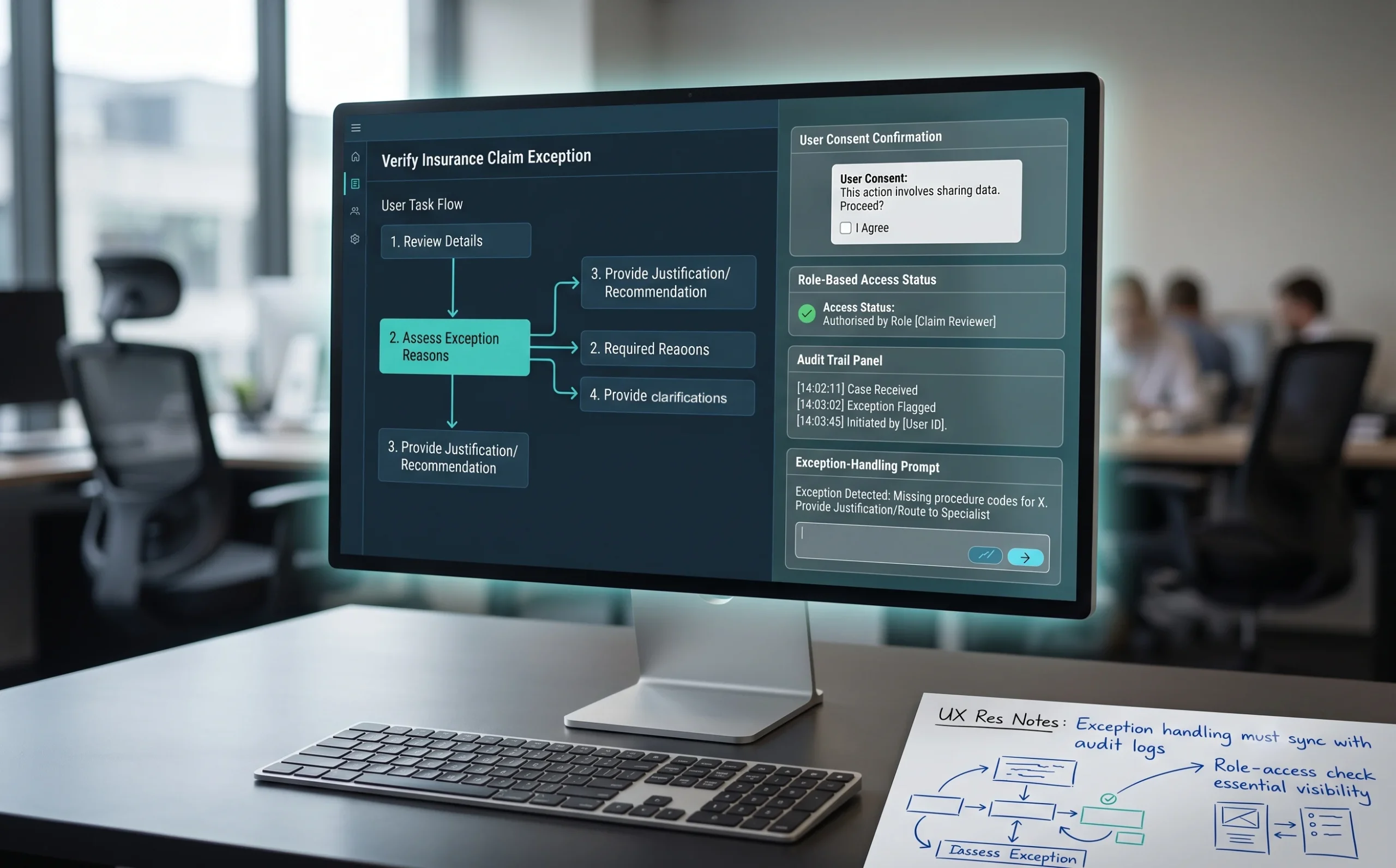
In practice, that means journey-centric design in these sectors never stops at the happy path. It accounts for exception handling, audit trails, consent flows, and role-based access, all woven into the experience architecture from day one. For leaders evaluating whether their transformation strategy can hold up under regulatory scrutiny, the quality of that upstream research work is often what determines the outcome.
The Bottom Line: What Leaders Need to Know
UX is no longer a design department concern; it’s a strategic business driver that determines whether your digital transformation succeeds or stalls at scale.
As explored in earlier sections, the compounding complexity of enterprise systems, regulated workflows, and high-stakes onboarding all point to the same conclusion: organizations that treat UX as an afterthought pay for it in churn, rework, and lost adoption. Harvard Business School confirms that leading in the digital era requires a fundamentally new roadmap, one that puts user experience at the center of strategic decision-making, not at the end of a product sprint.
Here’s what every C-suite leader should take away:
- UX is a strategic lever.
Design decisions directly influence revenue, retention, and employee productivity. Treating them as cosmetic choices is a costly miscalculation. - Research-first methodologies reduce transformation risk.
Skipping discovery doesn’t accelerate delivery, it defers failure. Validated research surfaces critical gaps before they become expensive problems. - Journey-centric design manages complexity at scale.
When systems are intricate and user needs are layered, mapping the full product journey is the only reliable way to maintain coherence across touchpoints. - ROI lives in churn reduction and operational efficiency.
Fewer support escalations, faster task completion, and lower abandonment rates are measurable outcomes, not aspirational ones.
And that’s exactly where the risk of inaction becomes most visible. Without a deliberate, journey-centric UX strategy, technical debt accumulates quietly while user trust erodes steadily. A combination that no late-stage redesign can easily reverse.
Future-Proofing Your Digital Product Strategy
Delaying a journey-centric UX strategy doesn’t pause the problem, it compounds it, turning manageable friction into structural technical debt and user alienation that’s far costlier to reverse.
Technical debt accumulates quietly. Every workaround built on top of a broken user journey adds another layer of complexity your team will eventually have to unwind. And users don’t wait around for that day. They disengage, churn, and find alternatives, often without filing a single complaint. The signal isn’t loud; it shows up in conversion drop-offs, support ticket volume, and stalled adoption metrics.
Specialized partnership becomes essential when the UX challenges you’re facing intersect with compliance requirements, legacy system constraints, and multi-stakeholder workflows. A generalist approach can’t navigate that terrain reliably. Complex enterprise environments require partners who bring research methodology, systems thinking, and domain fluency to the table, not just interface design skills.
The most practical next step is a research audit of your current user journeys. Map what users actually do against what the system assumes they do. The gap between those two things is where transformation fails, and where the clearest opportunities live. It’s unglamorous work, but it’s the foundation every effective digital strategy is built on.
The evolution of human-screen interactions is accelerating, and organizations that invest in understanding those interactions, not just optimizing screens – will be the ones that lead. ScreenRoot transforms human-screen interactions into seamless, outcome-driven experiences, grounding every recommendation in research before a single pixel moves. If your current user journeys aren’t delivering the outcomes your business needs, that’s where the conversation starts.
Written by Team ScreenRoot. 16+ years leading enterprise UI/UX research for BFSI, SaaS, and Healthcare clients.
When you’re ready, let’s talk.
📞 Call us (Toll-Free): 1800 121 5955 (India)
✉️ Email us: [email protected]