1800 121 5955
In short: Enterprise UX is not an aesthetic luxury; it is a commercial risk-management strategy that directly impacts conversion, retention, and operational efficiency. By aligning design goals with enterprise KPIs, enforcing Design QA, and applying research-first usability testing, SaaS and regulated enterprises eliminate hidden UI friction, lower churn, and maximize long-term digital ROI.
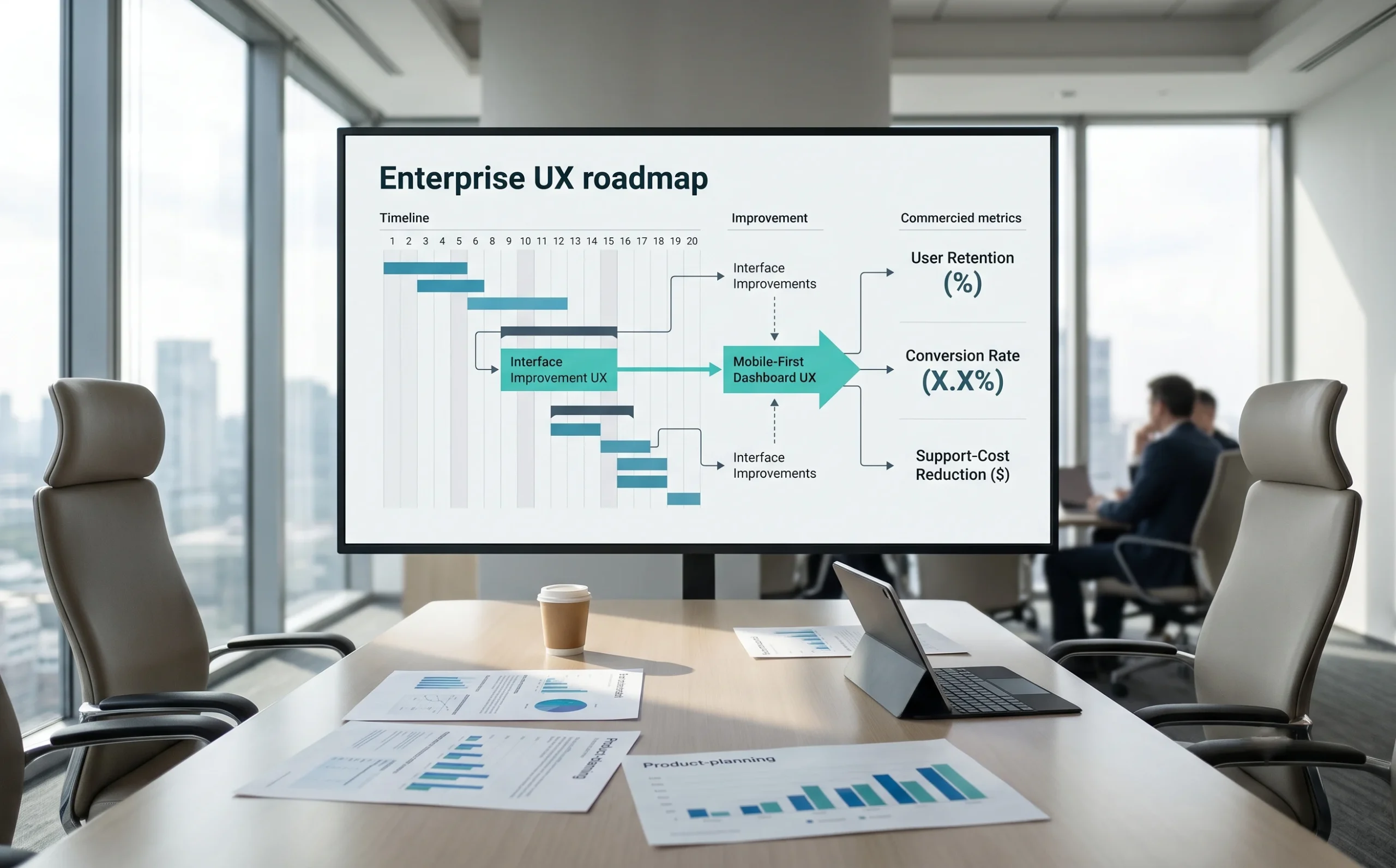
The Business Stakeholder: Why UX Is a Commercial Strategy
UX has never been just about users; it has always been about what well-designed experiences do for the business behind them.
The framing of UX as a purely user-centric discipline has done the field a quiet disservice. Yes, reducing friction and improving usability matter. But the business is the ultimate stakeholder in every design decision. When an enterprise invests in UX, it is managing risk by reducing churn, shortening sales cycles, cutting support costs, and strengthening market positioning against competitors. In SaaS UX especially, where product and experience are inseparable, design isn’t a layer on top of the business strategy – it is the business strategy.
Design thinking, when applied at an enterprise scale, translates directly into measurable growth levers. A well-researched interface reduces onboarding drop-off. A logical information architecture shortens the time a new user reaches their “aha moment”. These aren’t soft wins; they’re pipeline accelerators and retention multipliers. Teams that build with this lens understand that design decisions are, fundamentally, commercial decisions.
And yet, only 4% of organizations reach the highest stages of UX maturity, according to Nielsen Norman Group. That gap matters enormously. UX maturity describes how systematically a company integrates research, design, and measurement into its operations, and the organizations sitting at the top of that scale aren’t there because they care more about aesthetics. They’re there because they treat UX as a core growth function.
That’s the shift this article unpacks. Before exploring how to get there, it’s worth understanding what it actually means to align design goals with the business metrics that decision-makers care about most.
Aligning Design Goals with Enterprise KPIs
UX design for business outcomes means moving well past aesthetics; it’s the disciplined practice of mapping every design decision to a metric that leadership actually tracks.
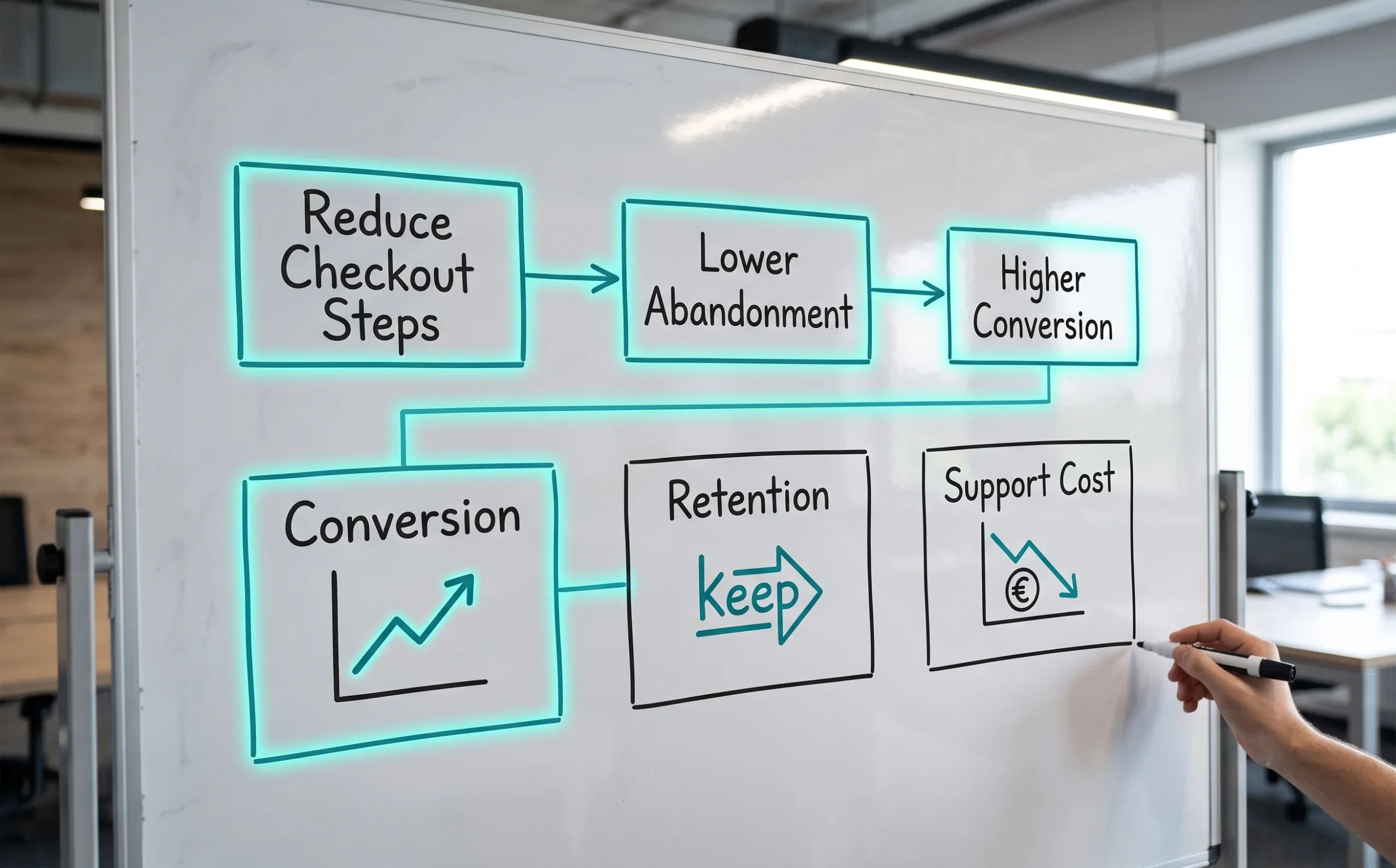
The shift from “does this look good?” to “does this work?” is where enterprise UX starts earning its seat at the strategic table. In practice, strong UX teams don’t just present polished interfaces; they build hypothesis statements that frame design choices as business experiments. A hypothesis might read: “If we reduce checkout steps from five to three, we expect cart abandonment to drop by 15%.” That kind of structured thinking connects the design process directly to revenue targets, not just user satisfaction scores.
What makes this approach credible is the discipline of mapping user actions to specific commercial KPIs. Aligning user needs with measurable commercial KPIs is what separates UX investment from UX expense. The three areas where this mapping delivers the clearest returns are:
- Conversion: Reducing friction in critical user flows.
- Retention: Designing experiences that reward return visits.
- Support Cost Reduction: Building interfaces intuitive enough that users don’t need to submit help tickets.
Each lever has a dollar figure attached to it, and that’s the language that resonates in a boardroom.
Frameworks help sustain this focus over time. The seven pillars of UX – usability, accessibility, desirability, findability, credibility, usefulness, and value; function as a stability checklist for enterprise products. Rather than chasing trends, teams can audit their product against each pillar and identify exactly where experience gaps are creating business risk. And it’s that notion of risk, not just opportunity that becomes especially pointed in heavily regulated industries, where a poor interface isn’t just a conversion problem, it’s a compliance one.
Mitigating Risk in Regulated Industries: BFSI and Healthcare
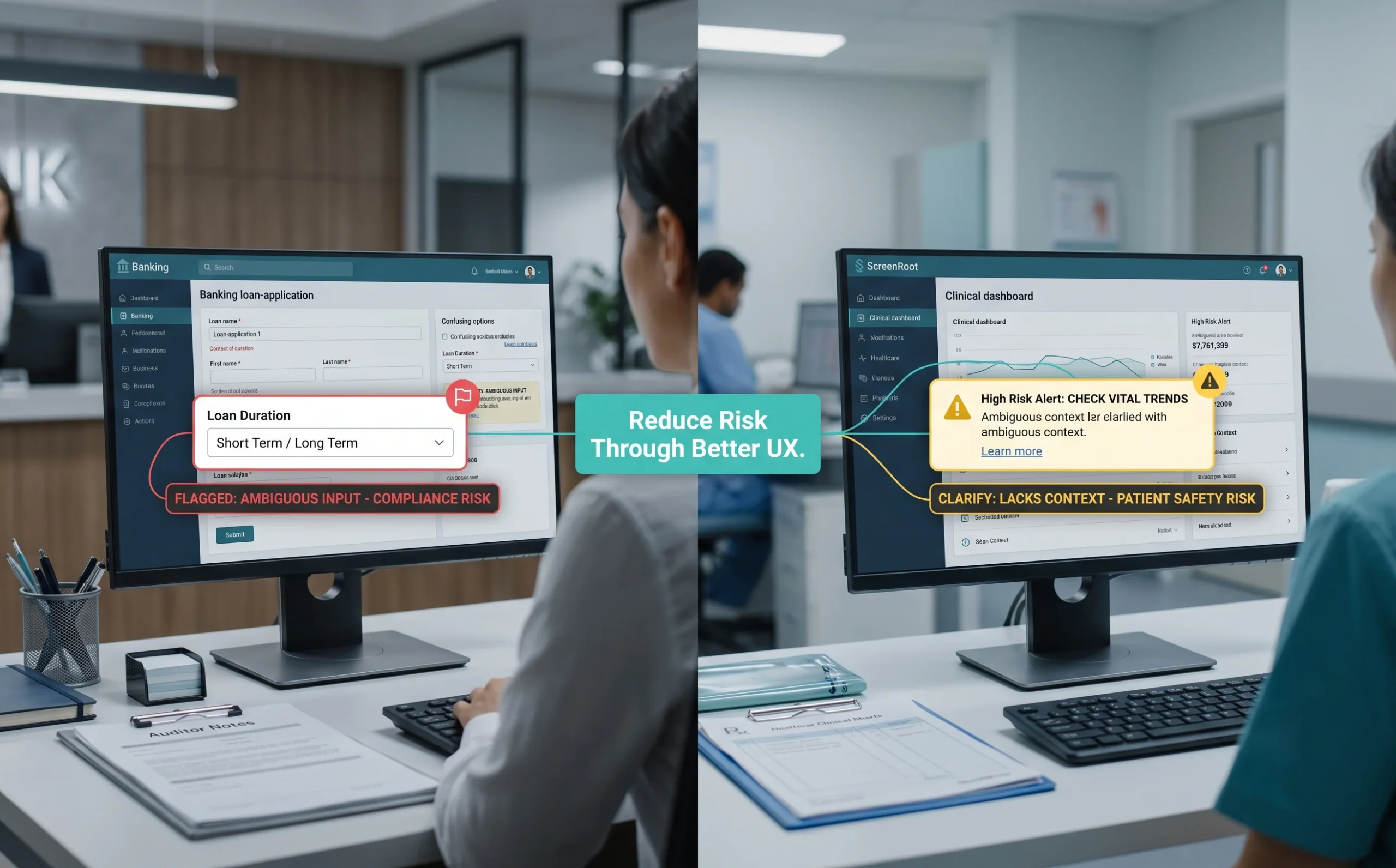
In regulated industries, poor UX isn’t just a usability problem; it’s a compliance risk, a financial liability, and a direct threat to user trust.
Banking and healthcare environments operate under strict regulatory frameworks where every interface decision carries consequence. A confusing form field in a loan application can trigger data entry errors that cascade into compliance failures. An ambiguous alert in a clinical dashboard can delay critical care decisions. In these contexts, aligning UX goals with business KPIs isn’t optional; it’s a governance requirement.
Domain expertise is non-negotiable in regulated sectors, where generalist designers routinely underestimate the operational and legal weight of every design choice. Generalist designers often default to visual polish over functional precision. In enterprise BFSI and healthcare systems, that trade-off becomes costly. What practitioners call “UI creep” – the gradual accumulation of inconsistent design patterns, redundant form elements, and poorly labeled data fields, quietly erodes efficiency across large-scale platforms. For a bank processing thousands of daily transactions, even minor friction in an internal workflow compounds into measurable productivity loss and audit exposure.
ScreenRoot’s work for Karnataka Bank and Suryoday Small Finance Bank reflects what’s possible when domain-specific UX strategy is applied with discipline. Both engagements focused on improving digital journeys that had real operational stakes by reducing drop-offs, simplifying onboarding, and making complex financial data navigable for end users. That kind of outcome requires more than design talent; it requires over 16 years of research-driven product strategy built specifically for high-stakes sectors.
Understanding where UX risk is highest is only part of the equation. Knowing how to validate design decisions before they reach production, and what it costs when you don’t; is where the next layer of ROI comes into focus.
The ROI of Design QA and Research-First Methodologies
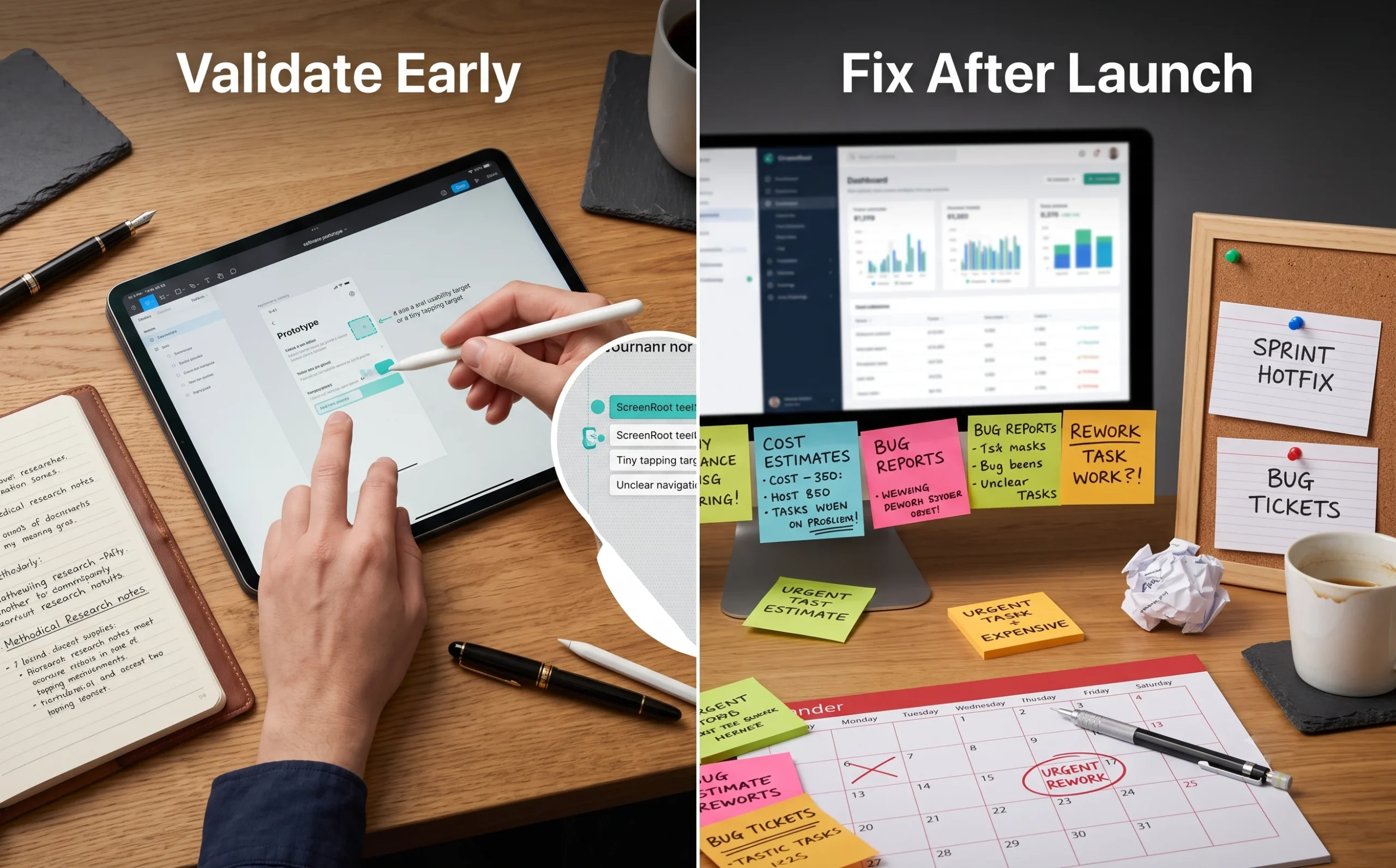
Skipping UX research doesn’t save money; it defers costs to the most expensive point in the product lifecycle: after launch.
Most organizations treat UX research as optional, a line item that gets cut when timelines tighten. But that tradeoff has a real financial consequence. Fixing a usability problem after a product ships can cost dramatically more than catching it during the research phase, and for enterprise teams evaluating the ROI of UX for enterprise SaaS, that gap compounds fast across complex, multi-stakeholder platforms.
Design QA is one of the most underutilized safeguards in the product development process. By systematically validating that the built experience matches the designed intent before users ever touch it, teams catch implementation drift, accessibility gaps, and interaction inconsistencies that would otherwise require expensive sprint cycles to fix. As Overlay QA notes, investing in Design QA significantly impacts the ROI of design by reducing development rework. That’s not a marginal gain; it’s structural cost prevention.
Usability testing, when run before development begins, does something equally valuable: it pressure-tests business hypotheses against real user behavior. You get signal on whether your assumed user journey actually holds, before engineering resources are committed. And that’s where research-first design earns its place; not as a creative exercise, but as a risk reduction mechanism.
Future-proofing a digital product means building on validated assumptions rather than internal consensus. Research surfaces the gaps between what stakeholders believe users want and what those users actually do. Products built on that evidence tend to require fewer post-launch pivots, adapt more cleanly to evolving user needs, and deliver more durable ROI.
This matters even more in SaaS environments, where the compounding effect of friction; subtle but persistent, quietly drives churn over time.
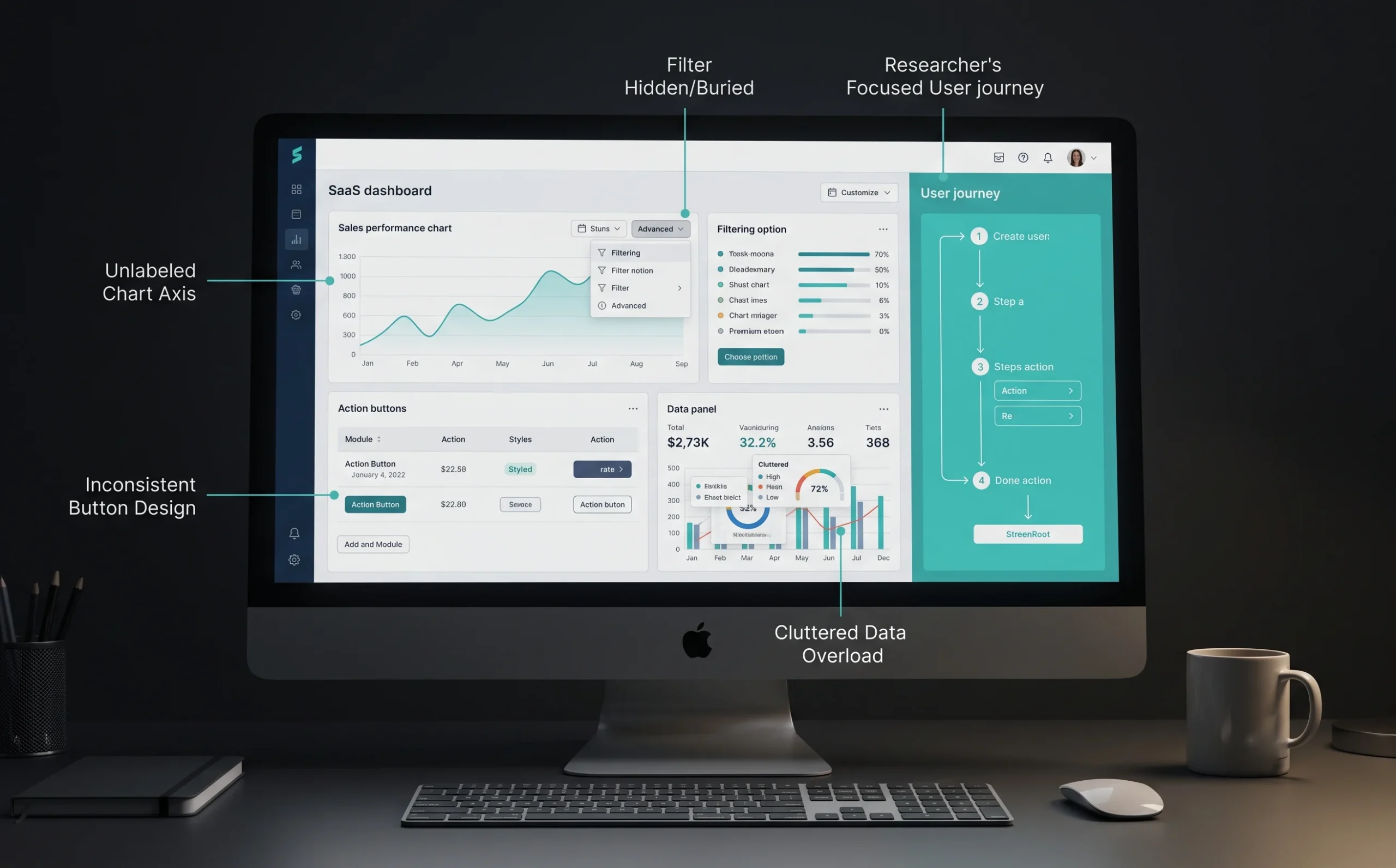
Solving the ‘Slow Creep’ of UI Problems in SaaS
In enterprise SaaS, UI problems rarely announce themselves; they accumulate quietly until a power user churns, a support ticket spikes, or a renewal conversation turns awkward.
UI friction and churn are more tightly linked than most product teams realize. A confusing dashboard, a buried filter, an unlabeled chart axis; none of these feel catastrophic in isolation. But across thousands of daily sessions, they erode confidence in the product. Enterprise buyers are particularly unforgiving; when a tool fails to make complex data actionable, teams default to workarounds or, eventually, alternatives.
This pattern is especially visible in AI and ML products, where the underlying technology is sophisticated but the interface can make or break adoption. AI/ML and analytics product leaders increasingly invest in UX specifically to prevent this slow creep, recognizing that a model’s output is only as useful as the interface that surfaces it. The same logic applies to UX for regulated industries like BFSI and healthcare, where data complexity and compliance requirements make clarity non-negotiable.
The Flow-First Mandate is the practical response to this challenge. Rather than designing around features, outcome-led teams map the critical user journeys first; what does a data analyst need to accomplish in under three clicks, and what’s currently standing in the way? This reframes design from a cosmetic layer into a structural business decision.
Moving from feature-heavy to outcome-heavy product design isn’t just a philosophy shift. It requires ongoing research, friction audits, and a willingness to deprioritize capabilities that impress in demos but confuse in daily use. The teams that get this right don’t just reduce churn, they build the kind of product stickiness that shows up in retention metrics and renewal rates. That connection between UX discipline and measurable business outcomes is exactly what the next section brings into focus.
The Bottom Line: Strategic UX Takeaways
UX is not a line item to be trimmed; it’s a strategic investment that directly shapes retention, conversion, and competitive positioning.
The previous sections have made the case from multiple angles: research prevents costly rework, QA closes the gap between design intent and delivered experience, and UI debt compounds quietly until it becomes a churn problem. What ties those arguments together is a simple reframe, design is a business function, not a production task.
As UX consulting reports consistently show, organizations that treat design as a strategic partner see measurable ROI across product and revenue metrics. That outcome isn’t accidental. It’s the result of aligning UX work to the KPIs that leadership actually tracks – activation rates, task completion, support deflection, and net revenue retention.
Here’s what that strategic alignment looks like in practice:
- UX is a revenue driver: When design decisions are tied to business outcomes, every research sprint and usability test has a defensible return, and a clear owner in the boardroom.
- Regulated industries require specialization: Healthcare, fintech, and compliance-heavy SaaS products carry risk that generic design approaches can’t mitigate. Research-first methodologies aren’t optional in these contexts, they’re essential.
- KPI alignment is the only honest measurement: Design success that isn’t connected to business metrics is just aesthetic opinion. Tying UX decisions to measurable outcomes is what earns a seat at the product strategy table.
- High UX maturity is a competitive moat: In the SaaS market, where switching costs are low and alternatives are abundant, a consistently intuitive product experience is one of the few durable advantages available to a product team.
Future-Proofing Your Digital Product Strategy
Research-driven design isn’t a one-time project; it’s the operational discipline that separates SaaS products with compounding growth from those fighting constant churn.
The earlier sections made one thing clear: UX debt accumulates silently, and by the time it surfaces in your metrics, recovery is expensive. The antidote is building research into your product cycle as a standing practice, not a reactive audit triggered by a dip in retention. Decision-makers who treat UX maturity as a strategic KPI, rather than a design department concern, consistently build products that adapt faster and retain users longer.
A useful starting point is an honest assessment of where your product stands today. Nielsen Norman Group’s UX maturity framework offers a structured way to identify gaps, from whether user research informs roadmap decisions, to how closely design and product leadership collaborate. If you haven’t run that audit yet, it’s worth doing before your next planning cycle. You might be surprised how much invisible friction is already costing you.
That’s precisely the kind of transformation ScreenRoot is built for, crafting intuitive digital interfaces for leading global brands, with a mission to drive success for progressive businesses. And the work ScreenRoot delivers has earned strong validation from clients across industries, which matters when the stakes are high.
If your product roadmap doesn’t currently include a UX strategy review, schedule one, a focused design workshop or consultation is the fastest way to surface the friction you can’t yet see.
Frequently Asked Questions
- How does UX design directly impact business KPIs in enterprise SaaS?
UX design impacts SaaS KPIs by removing friction in key user journeys, accelerating onboarding time-to-value, reducing cart/form abandonment, deflecting support tickets, and directly lowering churn rates.
- What is the difference between UX expense and UX investment ROI?
UX expense treats design as cosmetic polish applied at the end of development. UX investment aligns design goals upfront with trackable metrics (conversion, retention, support costs), delivering measurable financial returns.
- Why is research-first UX critical in regulated sectors like BFSI and Healthcare?
In regulated industries, a confusing workflow causes user error, compliance failures, and legal liabilities. Research-first design ensures complex data structures remain compliant without sacrificing usability.
- How does Design QA protect the commercial ROI of digital products?
Design QA validates that engineered code matches the validated design intent prior to release. This catches visual drift, accessibility gaps, and interaction errors early, preventing costly engineering rework.
Written by Team ScreenRoot. 16+ years leading enterprise UI/UX research for BFSI, SaaS, and Healthcare clients.
When you’re ready, let’s talk.
📞 Call us (Toll-Free): 1800 121 5955 (India)
✉️ Email us: [email protected]