1800 121 5955

Key Takeaways
- The Investment Adviser Association reports advisory client counts grew 7.7% to 73.7 million in 2025, yet advisors still toggle across six or seven disconnected apps to prepare for a single review.
- Experience defragmentation consolidates CRM history, custodial holdings, planning drift, and compliance sign-offs into one advisor operating system without replacing legacy cores.
- 84% of retail investors cite full fee disclosure as a primary driver of trust in their financial advisor (CFA Institute), elevating fee visualization to a primary screen requirement.
- With 67% of finance managers ranking soft skills as the top factor for employability (CFA Institute), agentic AI should automate pre-meeting briefs and post-call CRM logging so advisors can focus on human judgment.
- Compliance-by-design embeds automated archiving, process navigators, and pre-approved content libraries as workflow guardrails rather than end-of-process gates.
Financial advisory platform UX is the architecture of how wealth managers, operations teams, and clients interact with portfolio, planning, and compliance systems across the advisory lifecycle. Right now, the advisory business is growing faster than the software holding it together. The Investment Adviser Association reports that the number of investment advisory clients increased by 7.7% to reach 73.7 million in 2025—a client base serviced by advisors who routinely toggle across six or seven disconnected applications to complete a single review meeting.
That gap between client growth and platform coherence is the defining operational problem for financial advisory platforms 2026. Forrester projects the overall software market will grow by 11.5% in 2026, with cloud and AI growing at double that rate. Technology spending is not the constraint; coherence is. Generic dashboards fail high-net-worth advisory teams because they are designed around database categories rather than around the advisor’s actual decision sequence.
The firms pulling ahead treat their platform as an advisor operating system rather than a portal. The CFA Institute found that 67% of finance managers believe soft skills are the most important factor for professional employability today, and software should clear the runway for those skills rather than consuming the hours they require. Combined with CFA Institute investor trust research showing that 84% of retail investors cite full disclosure of fees as a primary driver of trust in their financial adviser, research-first wealth management software development has become a direct driver of advisor retention and AUM growth.
How does experience defragmentation end the swivel-chair workflow?
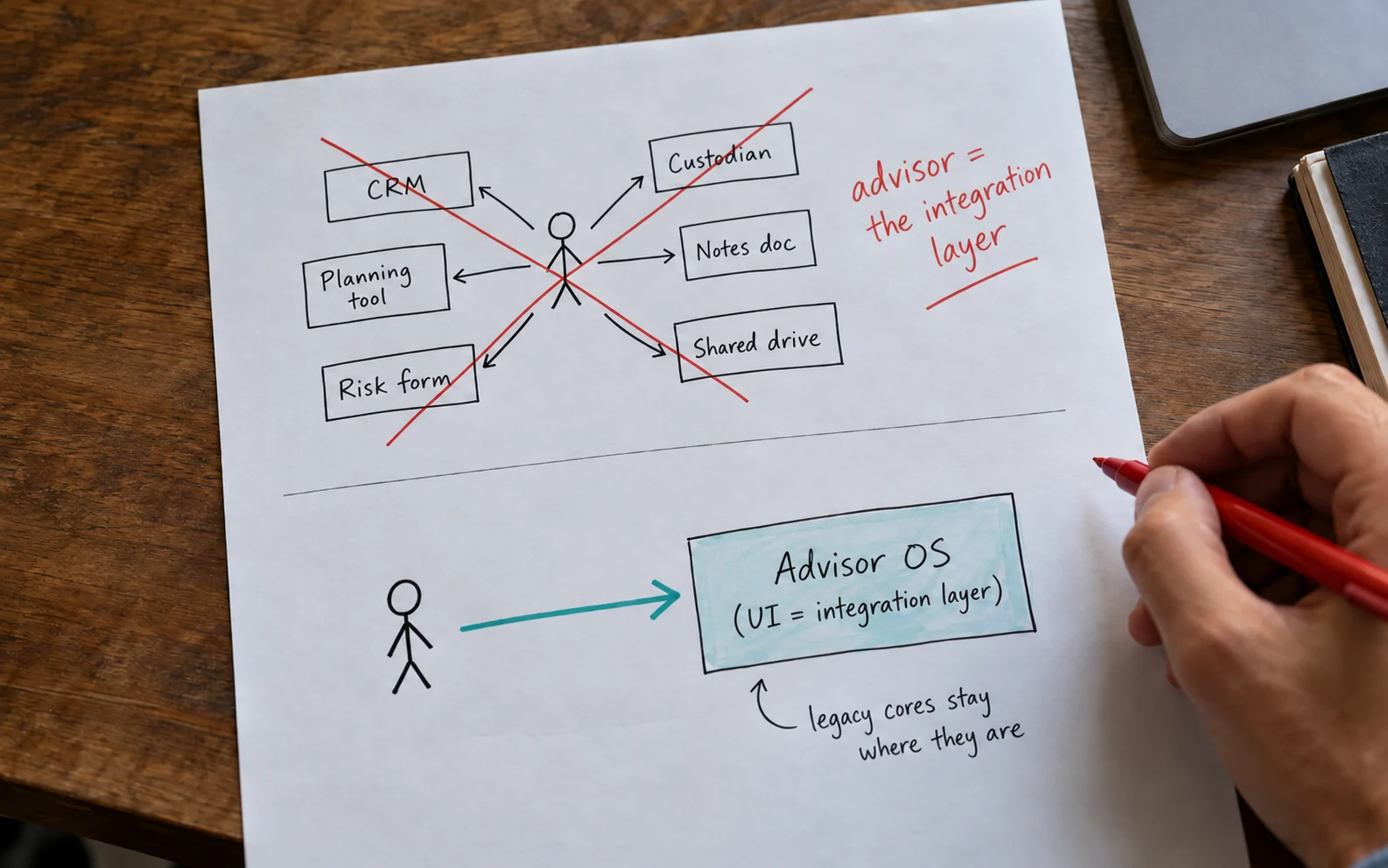
Experience defragmentation ends the swivel-chair workflow by consolidating an advisor’s working context into a single interface surface, making the UI—rather than the human advisor—the integration layer across back-end systems. It is a UX strategy rather than a risky core data-migration project.
Watch an advisor prepare for a quarterly review and the fragmentation is physical: client history lives in the CRM, positions and performance live on the custodial platform, the plan lives in the planning tool, meeting notes sit in a document, the risk questionnaire lives in a third-party form, and approved talking points sit in a shared drive. The advisor swivels between them, copying numbers by hand, reconciling mismatched timestamps, and rebuilding the same client picture every time. Manual consolidation introduces transcription errors into client-facing material, creates version ambiguity, and burns the advisor’s best cognitive hours on clerical assembly.
| Advisory Task | Swivel-Chair Workflow (Fragmented) | Defragmented Advisor Operating System |
| Pre-meeting preparation | Manual copying across CRM, custodian, planning tool, and shared drives | Single household surface assembling recent activity, drift, and agenda |
| Portfolio & fee review | Performance in one portal; fee disclosures buried in a separate PDF | Unified waterfall view pairing gross return, itemized fees, and net outcome |
| Post-meeting documentation | Manual typing of call notes into CRM and separate ticket creation | Agentic AI transcript capture with one-click advisor approval and routing |
| Regulatory compliance | End-of-workflow approval gates that stall client execution | Embedded guardrails with silent archiving and inline suitability checks |
A defragmented dashboard presents the next action alongside the evidence needed to take it: today’s meetings sit next to the relevant household’s recent activity, open service tasks, flagged allocation drift, and items awaiting compliance sign-off. Good fintech dashboard design protects the advisor’s cognitive reserve so they can read a client’s hesitation about a liquidity event rather than hunt for a spreadsheet tab.

Why must fee transparency live on the primary screen in financial advisor website design?
Fee transparency belongs on the primary performance screen because 84% of retail investors cite full disclosure of fees as a primary driver of trust in their financial adviser, according to the CFA Institute’s Next Generation of Trust study. Burying fee schedules in a PDF, a footnote, or a settings page three clicks deep no longer survives contact with modern investor expectations.
Practically, designing for trust means fees appear in the same view as portfolio performance, not in a parallel document the client must reconcile alone. It means showing the advisory fee, underlying fund expenses, and platform charges as distinct line items with plain-language labels rather than a single blended figure that invites suspicion—and pairing every cost with the service it funds so the client reads a value statement instead of a deduction.
- Use waterfall visualizations over scattered tables. A clear waterfall chart showing gross return, itemized costs, and net outcome tells a complete story in one glance. Clients interpret legibility as honesty and ambiguity as something being managed around them.
- Design mobile fee views with progressive disclosure. Complex fee tiers resist narrow smartphone columns, and horizontal scrolling or pinch-to-zoom tables signal that the disclosure was not built for the reader. Lead with the net impact in dollars and let the client expand into tiers, breakpoints, and effective rates. Modern financial advisor website design treats the fee screen as a conversion and retention surface rather than a legal annex.

How does agentic AI outperform chatbots in advisory meeting preparation?
Agentic AI outperforms sidebar chatbots by proactively monitoring the advisor’s calendar, assembling cross-system pre-meeting briefs, and drafting post-call CRM records and follow-up tasks without waiting for a prompt. First-generation chatbots required the advisor to initiate every interaction and know what to ask, making them structurally incapable of removing clerical assembly work.
An agentic workflow inverts that relationship. Before a review, the agent gathers the household’s recent transactions, open service items, plan deviations since the last meeting, and a suggested agenda. After the meeting, it drafts the CRM record from the call transcript, routes follow-up tasks to operations, and flags any commitment that triggers a documentation requirement. The advisor reviews and approves rather than assembles and types.
The essential advisor experience design constraint is keeping human approval substantive rather than ceremonial. An agent that surfaces its reasoning and source links lets an advisor catch a misread transcript or mischaracterized client objective immediately; an agent that presents unverified conclusions trains people to rubber-stamp output. With 67% of finance managers ranking soft skills as the top employability factor, agentic automation reclaims preparation hours for the conversations clients actually pay for: a family business sale, a divorce, or caring for an aging parent.

How does compliance-by-design replace workflow gates with guardrails?
Compliance-by-design moves regulatory rules upstream into the interface itself so the compliant path is also the easiest path, replacing workflow-stopping gates with quiet structural guardrails. In high-performing financial advisory platform UX, three architectural patterns eliminate compliance friction before it forms:
1. Automated archiving
Every client communication, document version, and material portfolio change is captured automatically as a byproduct of the work rather than through a separate archiving step. When retention happens silently and completely, advisors stop deciding what to save and auditors stop reconstructing timelines from fragments.
2. Process compliance navigators
A process navigator embeds regulatory sequence directly into the task flow, revealing required disclosures, suitability checks, and sign-offs at the exact moment each becomes relevant. Instead of consulting a policy manual, the advisor follows an interface that already encodes the policy, converting compliance knowledge from something memorized into something structural.
3. Pre-approved content libraries
Marketing language, illustration templates, and client-facing explanations live in a reviewed, versioned library the advisor can pull from without initiating a new approval cycle. Approval moves from per-instance to per-asset, collapsing turnaround time while tightening control over what reaches clients.
A gate stops work and asks permission; a guardrail shapes work so permission is rarely in question. When the system records decisions in context, the audit trail is a live reporting view rather than an excavation, and advisors pay zero speed penalty for being examinable.

What is the ROI of research-first wealth management software development?
The ROI of research-first wealth management software development comes from preventing design debt, accelerating advisor time-to-task, and protecting advisor retention. When engineering teams ship against internal assumptions, they build data models around screens nobody uses and navigation hierarchies that fight the real workflow—producing quiet advisor frustration that becomes a recruiting liability when competitors offer cleaner tools.
ScreenRoot’s financial services portfolio (documented at screenroot.com/work/) reinforces a core rule of regulated UX: the expert user’s mental model is the specification. Trading consoles, risk dashboards, and advisory workstations are operated by professionals whose domain knowledge exceeds the designer’s. Contextual inquiry—observing an advisor compile a review or a dealer monitor exposure—surfaces the spreadsheet workarounds that define the real design brief.
Usability testing in wealth management must also test under realistic stakes: error states, ambiguous data, and tight deadlines, where trust in the platform is won or lost. As cloud and AI capabilities expand at double the rate of the broader 11.5% software market growth in 2026, research-first UX is the mechanism that converts software spend into advisor capacity.
What are the five decisions that future-proof financial advisory platforms in 2026?
Five strategic decisions separate advisory platforms that compound value from platforms that merely accumulate modules:
- Defragment before you build. Eliminate the swivel-chair workflow by making the interface the integration layer across CRM, custodial, and planning systems.
- Treat fee transparency as a primary screen. With 84% of retail investors citing full fee disclosure as a primary trust driver, place itemized costs alongside performance using clear waterfall views.
- Deploy agents, not chatbots. Use agentic AI to assemble pre-meeting briefs, draft CRM notes from transcripts, and route follow-ups while keeping advisor approval grounded in visible sources.
- Embed compliance as guardrails, not gates. Use automated archiving, inline process navigators, and pre-approved content libraries so the compliant path is the fastest path.
- Fund contextual research before design. Observe expert users in real workflows before wireframing so you subtract steps while competitors add clutter.
Frequently Asked Questions
What is the advisor experience gap in wealthtech?
The advisor experience gap is the operational disconnect between growing client demand—reaching 73.7 million investment advisory clients in 2025—and fragmented software stacks that force advisors to toggle across six or seven disconnected applications to prepare for a single client meeting.
How do you eliminate the swivel-chair workflow in financial advisory platforms?
You eliminate the swivel-chair workflow through experience defragmentation: designing a unified interface layer that assembles CRM history, custodial holdings, financial plan deviations, and pending compliance tasks on a single screen without requiring a full legacy backend migration.
How does fee presentation affect investor trust on financial advisor platforms?
Research from the CFA Institute shows that 84% of retail investors cite full fee disclosure as a primary driver of trust in their advisor. Displaying itemized advisory fees, fund expenses, and net returns together via clear waterfall charts and mobile progressive disclosure builds immediate credibility.
What is the difference between chatbots and agentic AI in wealth management software?
Chatbots sit passively in a sidebar waiting for an advisor to type a query. Agentic AI monitors the advisor’s calendar, automatically compiles cross-system pre-meeting briefs, drafts post-meeting CRM notes from call transcripts, and routes follow-up tasks with source links for human approval.
How does compliance-by-design improve financial advisory platform UX?
Compliance-by-design replaces workflow-blocking approval gates with embedded UI guardrails—such as silent background archiving, inline suitability navigators, and pre-approved content libraries—making regulatory compliance an automatic byproduct of the advisor’s daily workflow.
Building the next generation of wealthtech with ScreenRoot
If you are responsible for platform ROI, advisor retention, or a transformation roadmap that has to survive the next regulatory cycle, start by identifying which steps to remove from your advisors’ day. Explore ScreenRoot’s financial services portfolio at screenroot.com/work/, and bring us the workflow that frustrates your advisory teams most.
Written by Team ScreenRoot. 16+ years leading enterprise UI/UX research for BFSI, SaaS, and Healthcare clients.
When you’re ready, let’s talk.
📞 Call us (Toll-Free): 1800 121 5955 (India)
✉️ Email us: [email protected]