1800 121 5955

UI UX design cost in India depends on the work required to make a product usable, testable and ready for implementation. A useful estimate accounts for user journeys, business rules, research, interaction states, team responsibilities and delivery support. Screen count alone cannot describe that scope.
For enterprise buyers, the first decision is what the budget must cover. A visual refresh of an established product needs a different engagement from a new lending application with multiple applicants, document review and exception handling. Both may produce a similar number of screens. Their research and design effort can be very different.
This guide explains how to build an estimate, compare proposals and control costs without pretending that one market average can price every project.

What should a UI UX design estimate include
Ask suppliers to separate discovery, research, information architecture, interaction design, visual design, validation and implementation support. Each phase should have an output and an acceptance decision. This makes it easier to understand both the fee and the consequences of removing work.
| Cost area | What to specify in the brief |
| Research | User groups, recruitment responsibilities, methods, languages and access to participants |
| Journeys and rules | Priority tasks, user roles, permissions, dependencies and exception paths |
| Interface design | Platforms, responsive behaviour, content, states and existing brand assets |
| Validation | Test rounds, accessibility scope, participant needs and time for revisions |
| Reusable assets | Components, documentation and whether production code is included |
| Delivery support | Engineering reviews, design QA, handover and post-launch responsibilities |
Do not assume that a design fee includes development, recruitment incentives, research travel, paid software or ongoing maintenance. Put exclusions beside the headline price. Otherwise, the cheapest proposal may simply leave the most work for your internal team.
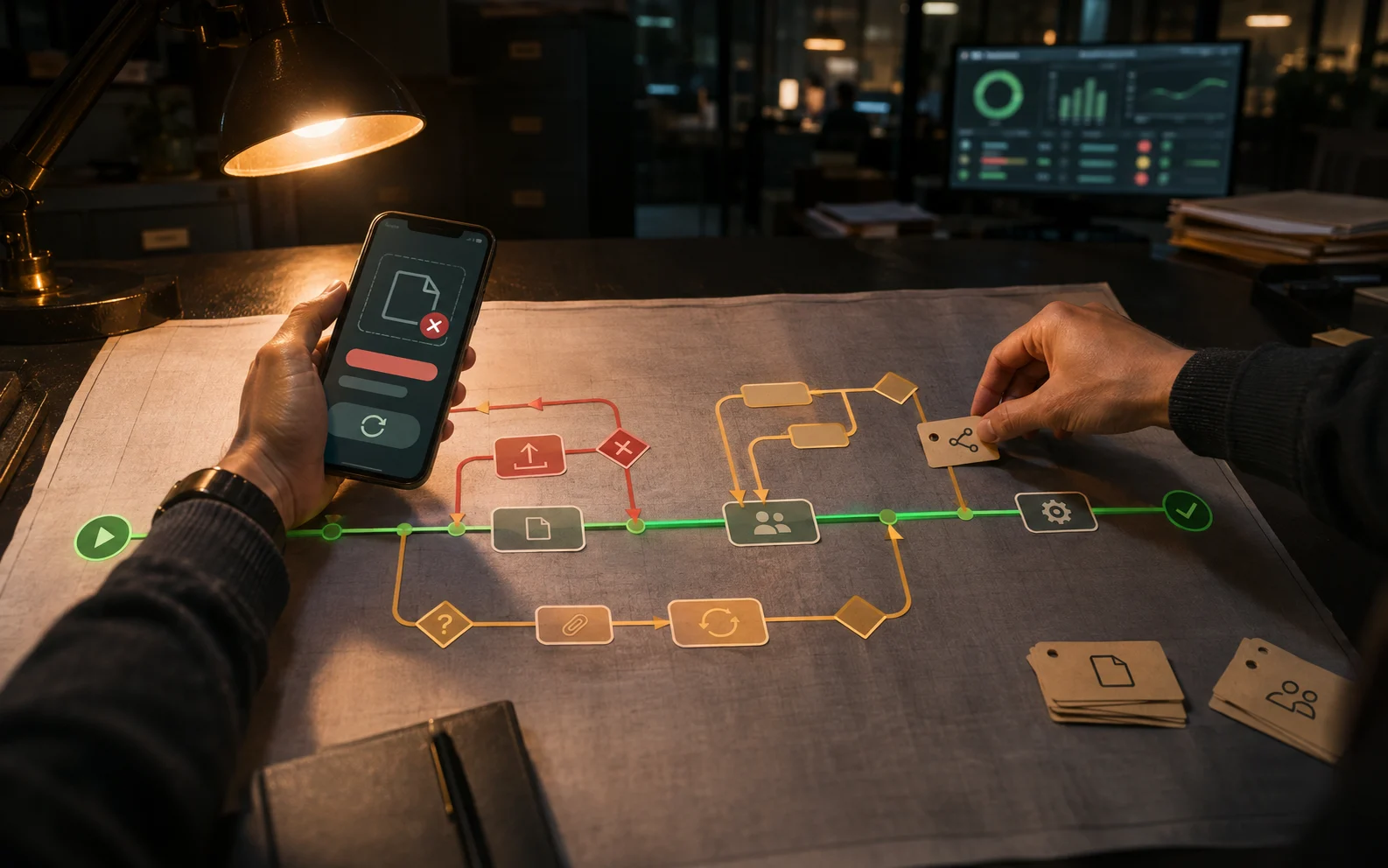
Why complexity changes the price
Consider an illustrative loan application. The happy path includes eligibility, identity details, document upload and submission. Real customers may upload an unreadable document, leave halfway through, need a co-applicant or receive a request for more information. Operations staff may need to review, return or approve the application.
Those decisions create design work even when they do not create a new page. The brief should identify who makes each decision, which system provides the information and what the user sees when that information is unavailable.
Research access also affects effort. Recruiting specialist users or coordinating several stakeholder groups can take more work than testing a familiar consumer task. Ask the agency to show which assumptions it can validate within the proposed budget and which remain unresolved.
Accessibility needs a defined scope too. Specify the target standard, platforms and testing responsibilities. A prototype review can identify design issues, but the built experience needs its own evaluation. W3C explains that WCAG testing combines automated checks and human evaluation.
Build a budget from effort and assumptions
A practical estimating model is:
Design fee = sum of agreed effort for each role × that role’s quoted rate.
Add separately priced expenses, implementation support and a contingency linked to named uncertainties. Record whether rates are hourly, daily or monthly and how much delivery capacity each unit buys. A retained team member who is available part-time should not be budgeted as full-time capacity.
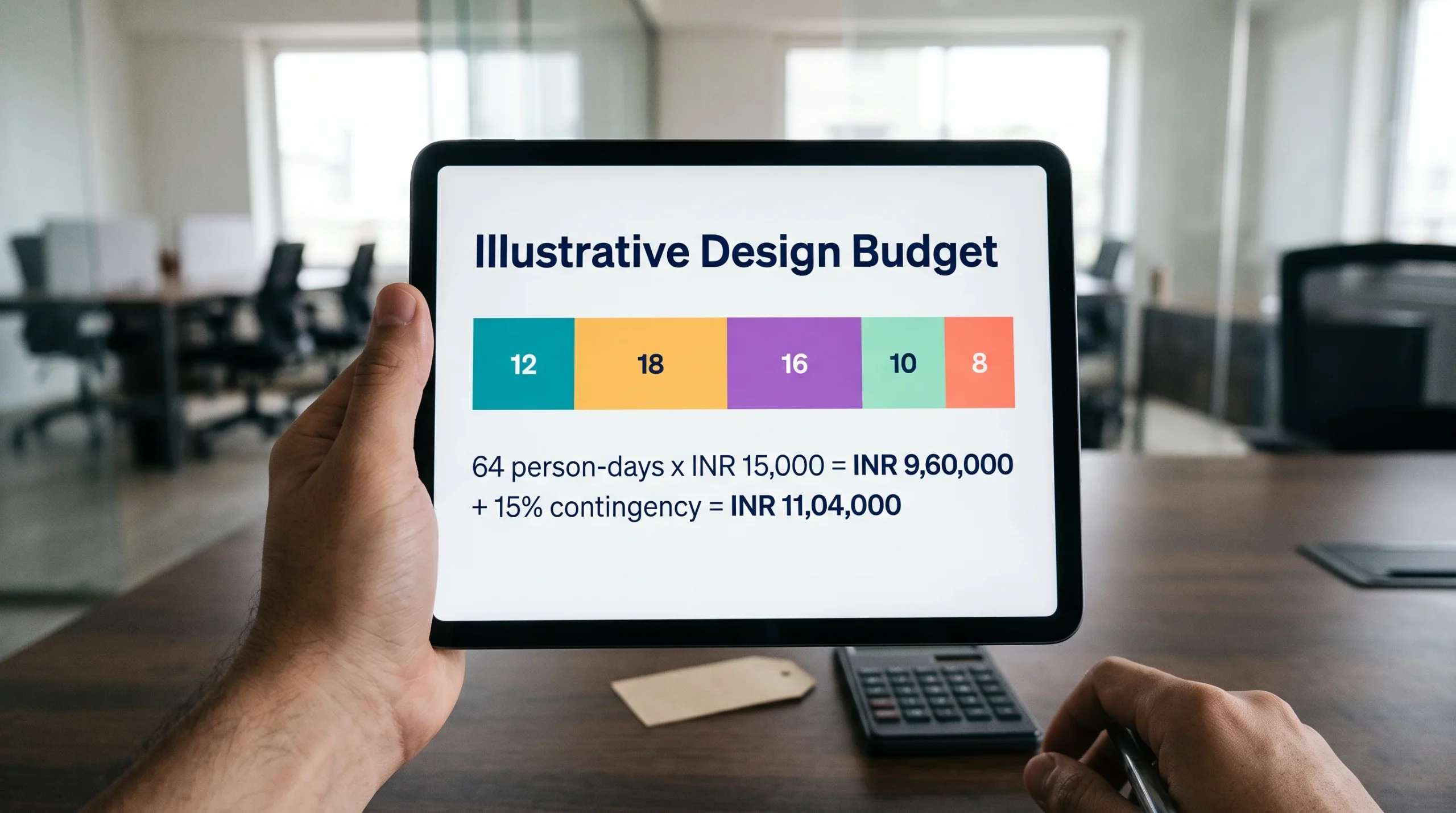
The following calculation is fictional. It demonstrates the arithmetic; it is neither an Indian market benchmark nor a ScreenRoot quotation.
| Illustrative work package | Person-days |
| Discovery and research | 12 |
| Journeys and interaction design | 18 |
| Visual design and reusable components | 16 |
| Testing and revisions | 10 |
| Handover and implementation reviews | 8 |
| Total | 64 |
At an assumed blended rate of INR 15,000 per person-day, the base fee is INR 9,60,000. An illustrative 15% contingency adds INR 1,44,000, giving a planning allowance of INR 11,04,000 before applicable taxes and separately agreed expenses. These inputs must be replaced with a supplier’s estimate and your own risk assessment.
Person-days describe effort, not elapsed duration. Several people can work concurrently, while recruitment or approvals can extend the calendar without adding the same amount of production effort. Ask for both an effort estimate and a delivery schedule.
Choose a commercial model that fits the uncertainty
| Model | Useful when | What to agree |
| Fixed scope and fee | Journeys, outputs and acceptance criteria are sufficiently clear | Included revisions, assumptions and change-control rules |
| Time and materials | Research or product decisions may change the scope | Rates, spending cap, reporting and approval thresholds |
| Retainer | An ongoing roadmap needs recurring design capacity | Named capacity, priorities, carry-over rules and exit terms |
A short discovery phase can help when the core scope is uncertain. Its output should be a prioritised problem definition and a clearer delivery estimate. Discovery is less useful if it merely delays decisions that the client could already make.
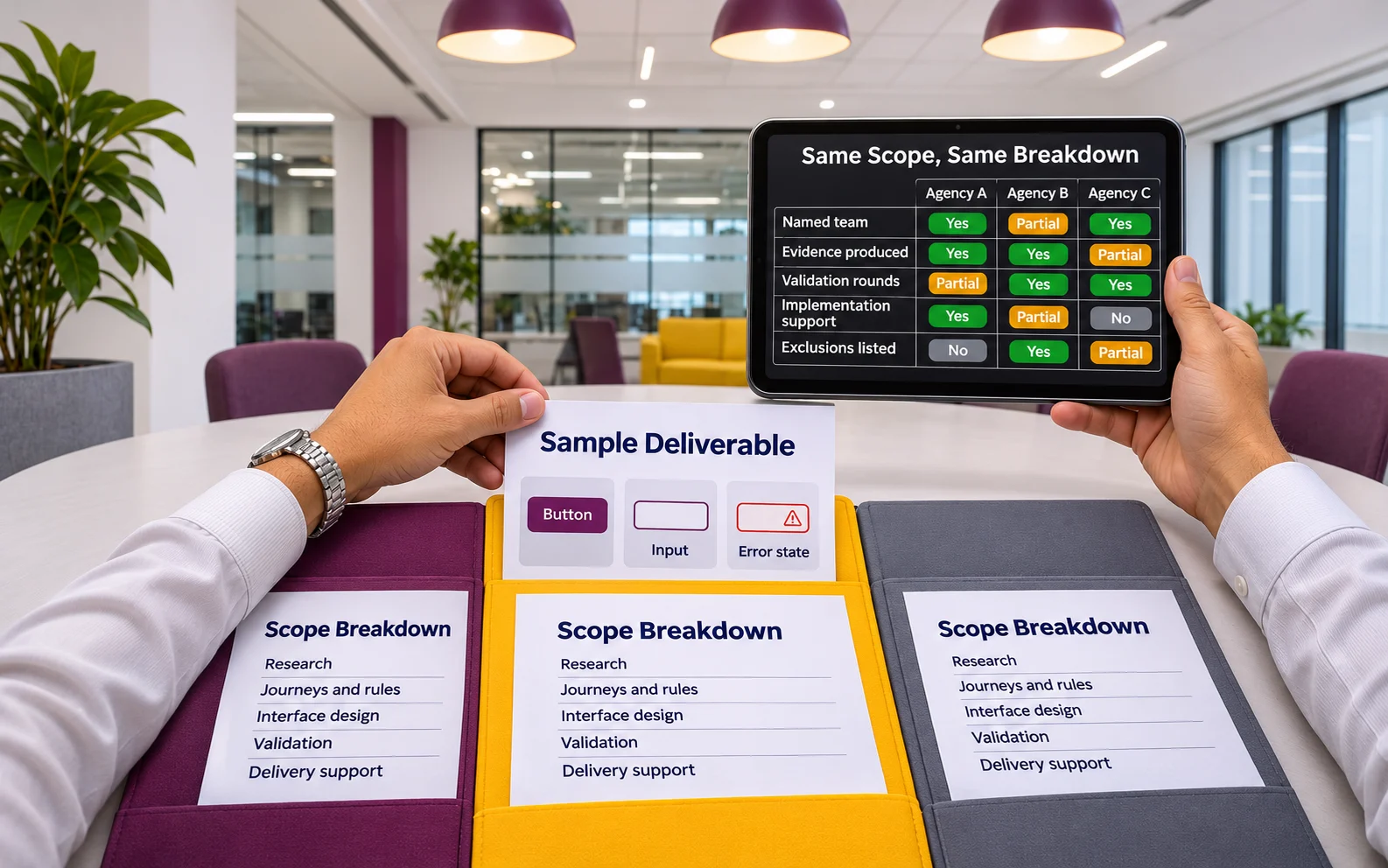
Compare proposals on the same scope
Give shortlisted agencies the same brief and request the same breakdown. Compare who will perform the work, the evidence they will produce, the rounds of validation and the support available during implementation. Review a sample deliverable to check whether the proposed documentation is useful to your engineering team.
Relevant case studies help explain differences in scope. In ScreenRoot’s Experian portal project, the work included a credit-factor dashboard, a simulator and monitoring functionality. These are distinct interaction problems, not interchangeable screens. The published case study does not disclose a project price, so it cannot establish a pricing benchmark.
Avoid using an employee salary as an agency rate. A salary describes employment compensation; an agency proposal prices a contracted scope, delivery capacity and commercial responsibilities. Neither a high fee nor a low fee proves the quality of the proposed team.
Keep tax and payment assumptions separate
Ask for a written statement of the invoicing entity, applicable taxes, payment milestones and any cross-border payment requirements. Your finance team should confirm withholding treatment, credit eligibility and accounting classification for the actual contract.
Do not automatically deduct all GST from the cost forecast. Section 17 of the CGST Act restricts credit in specified circumstances, including use attributable to exempt supplies. Treat recoverability as a finance-approved assumption. Likewise, describe design as a business investment without assuming that all design expenditure qualifies for capitalisation.
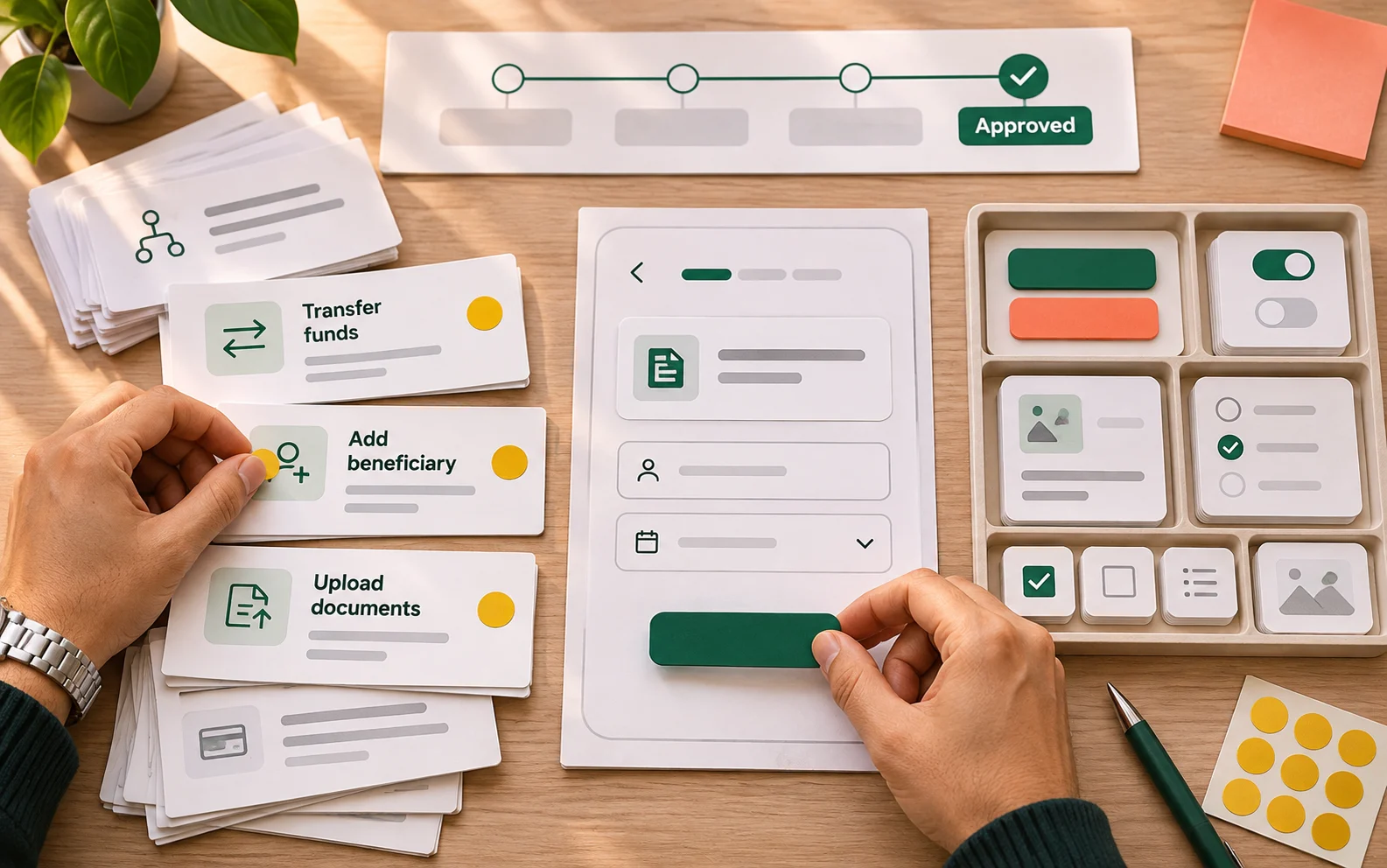
Reduce cost by reducing uncertainty
Start with a smaller set of important journeys. Reuse suitable existing components. Provide access to users, analytics, content and technical constraints early. Nominate an approver who can reconcile stakeholder feedback and make decisions within the agreed schedule.
When negotiating, ask what changes if a phase is reduced. Removing one research round, for example, should come with an explicit description of which assumptions will remain untested. That is a more useful discussion than an unexplained percentage discount.
Questions buyers ask about UI UX design pricing
Can an agency quote from a screen count ?
It can provide an initial estimate, but the quote needs assumptions about journeys, states, platforms, content and validation. Treat it as provisional until those assumptions are agreed.
How much should an enterprise allocate to research ?
There is no universal percentage that fits every product. Scope research around the decisions with the greatest uncertainty and the consequences of getting them wrong.
Should development be included in a design proposal ?
Only when it is explicitly contracted. Ask who supplies production code, conducts accessibility testing and reviews implementation quality. Separate those responsibilities even if one partner performs them all.
Turn the brief into a defensible estimate
ScreenRoot’s UI UX design service describes research, wireframing, prototyping and iterative testing. Share your priority journeys, platforms and delivery constraints to discuss a scope and estimate grounded in the work your product needs.
Written by Team ScreenRoot. 16+ years leading enterprise UI/UX research for BFSI, SaaS, and Healthcare clients.
When you’re ready, let’s talk.
📞 Call us (Toll-Free): 1800 121 5955 (India)
✉️ Email us: [email protected]