1800 121 5955
Key Takeaways
- An enterprise website redesign rebuilds the structure, content, and technology behind a site so it converts, complies, and scales. A new visual layer on old architecture is not a redesign.
- The clearest signs you need one: marketing spend rises while conversions stay flat, mobile journeys break, accessibility gaps create legal exposure, and a legacy CMS eats developer time.
- A research-first, four-phase process (research, information architecture and testing, UI design, build and compliance audit) is what de-risks the budget.
- Enterprise projects cost far more than the market average. The average web design project reviewed on Clutch is about $38,000; integrations, security testing, and compliance work push enterprise redesigns well beyond that.
- In healthcare and banking, accessibility now has legal deadlines attached: WCAG 2.1 AA under the HHS Section 504 rule and the European Accessibility Act, which has applied to banking services since June 2025.
An enterprise website redesign is worth the investment when your site has become the bottleneck between demand you already pay for and revenue you never see. Your website is no longer a digital brochure. It is the highest-stakes sales rep your organization has, and it is working every hour a prospect is awake.
In banking, insurance, and healthcare, where trust is both fragile and foundational, friction does not produce a support ticket. It produces an exit. A loan application that stalls on mobile or a patient intake form that resets on timeout sends the user straight to a competitor who made the smarter investment. Professional website redesign services today go well beyond refreshed visuals: they rebuild the acquisition engine underneath.
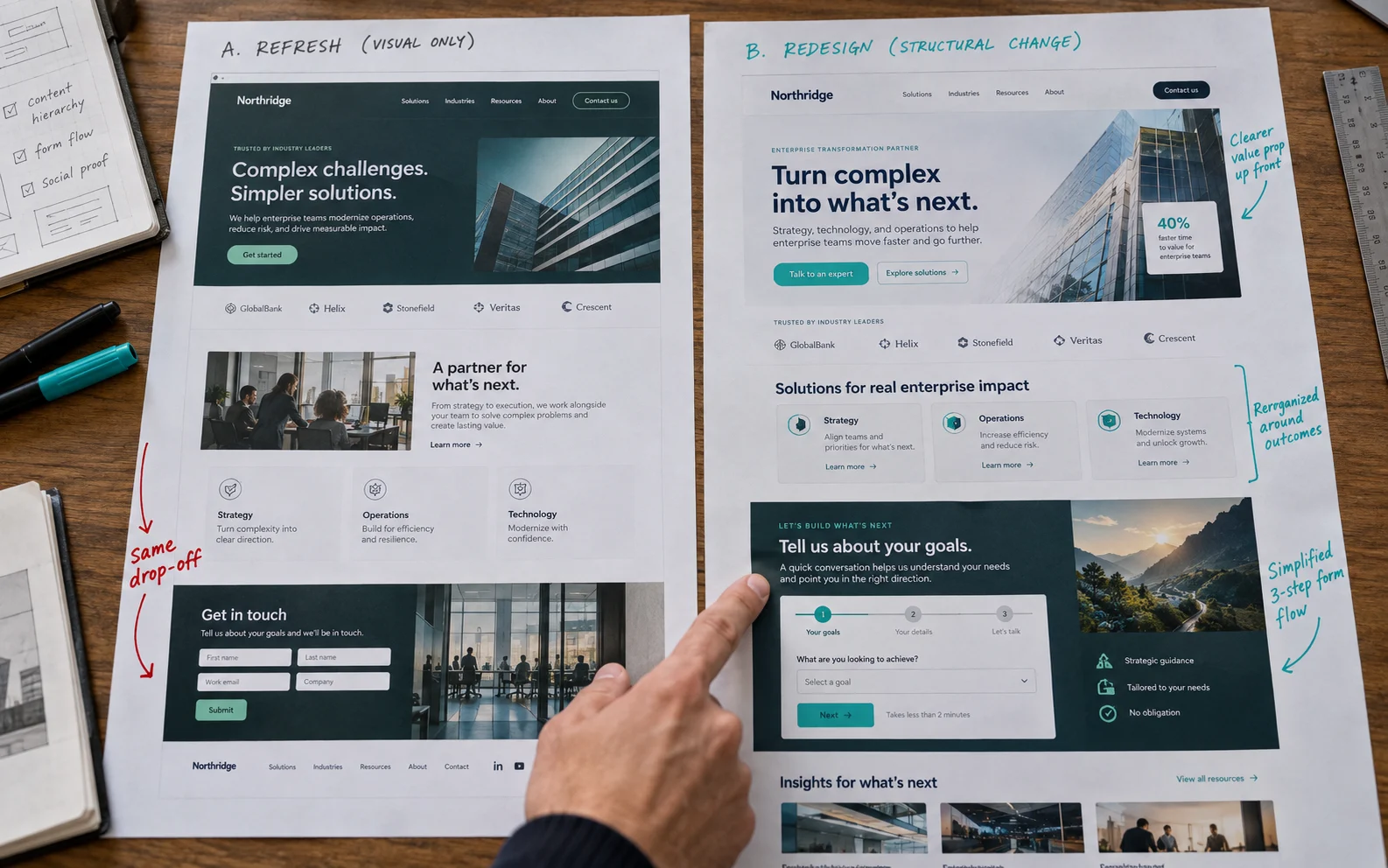
What is an Enterprise Website redesign?
An enterprise website redesign is a structured rebuild of a large organization’s website: its information architecture, content, user journeys, integrations, and underlying platform, not only its visual design. The goal is measurable business outcomes such as higher qualified conversion, lower maintenance cost, and regulatory compliance, validated with user research before and after launch.
The distinction matters because the two projects fail in different ways. A visual refresh changes how the site looks and leaves the problems that cost money in place. A redesign starts from evidence about where users stall and why, then changes whatever is responsible, whether that is a navigation model, a form, a CMS, or an integration with a core system.

What are the Signs your Enterprise Website needs a Redesign?
Your enterprise website needs a redesign when the symptoms are systemic rather than cosmetic. The five most reliable signs are conversion rates that stay flat while marketing spend climbs, mobile journeys that break, accessibility and compliance gaps, a legacy CMS that absorbs developer time, and content that no longer matches how buyers search.
1. Conversion stagnation despite rising spend.
When paid and organic traffic grow but qualified leads or applications do not, the website is not a passive bystander. It is the bottleneck. A capable website redesign agency starts by diagnosing the gap between traffic volume and revenue outcomes.
2. Mobile failures.
Mobile-first acquisition now defines the top of most funnels. A desktop-era architecture repels the customers most likely to convert, which is why a responsive website redesign (see our responsive design guide) is usually the first structural fix, not a nice-to-have.
3. Accessibility and compliance gaps.
A platform built before current accessibility standards will almost always fall short of WCAG 2.1 AA, and in regulated sectors that gap now carries legal deadlines (covered below).
4. Legacy CMS drag.
Patches, workarounds, and developer hours spent keeping outdated systems alive quietly consume budget that could fund growth. If publishing a page needs a ticket, the CMS is costing you speed as well as money.
5. Content and structure drift.
Years of additions leave navigation that mirrors the org chart rather than the customer’s task. Users cannot find what they came for, and neither can search engines.
Taken together, these signals point to a structural problem, and structural problems need a methodical, research-driven process rather than a new skin.
How does a research-first redesign process reduce risk?
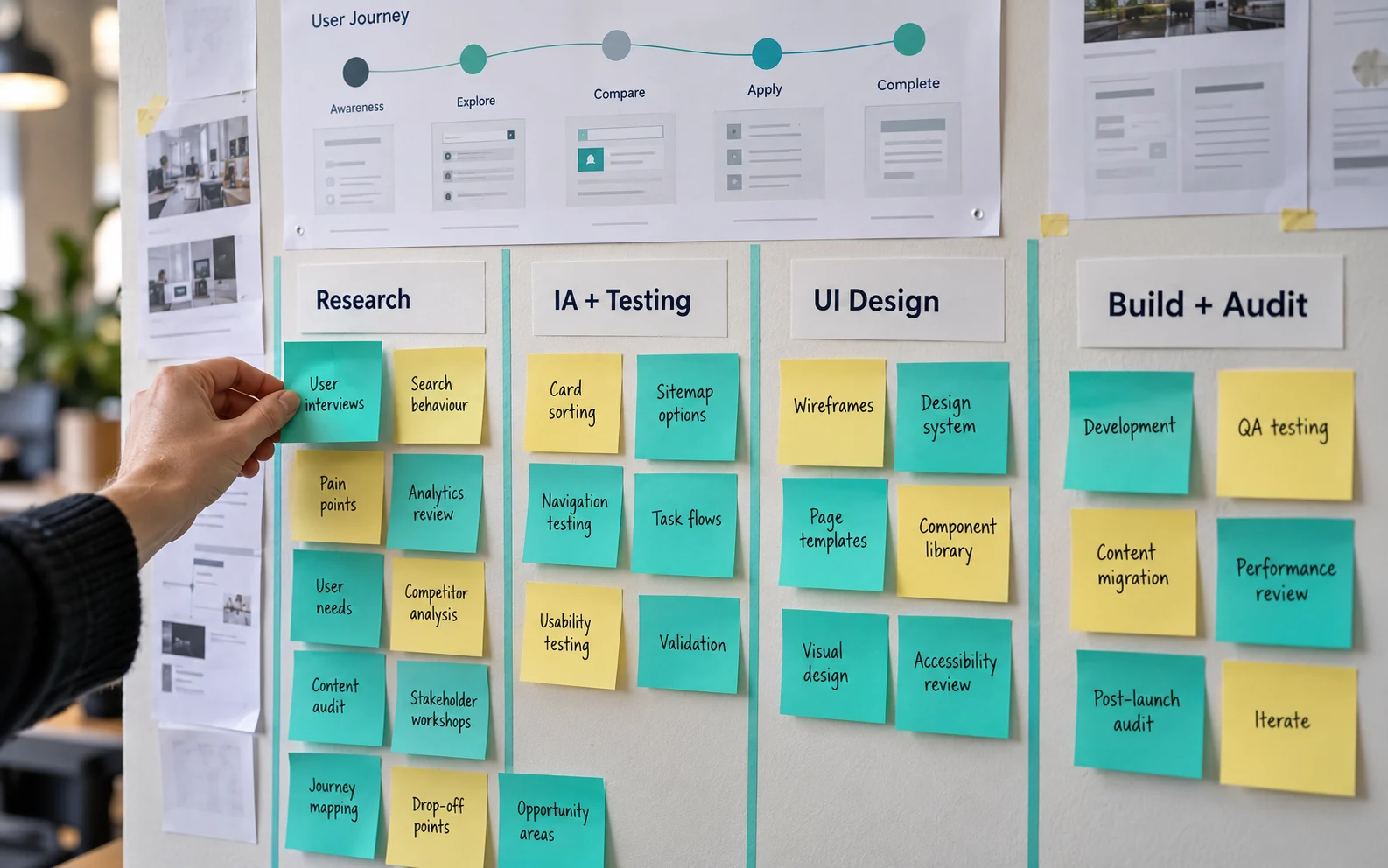
A research-first process reduces risk by validating every major decision with evidence before it becomes expensive to change. Research and information architecture come before visual design, and prototypes are tested with real users before development starts, so budget is spent building the right thing rather than rebuilding the wrong one.
At ScreenRoot we run enterprise redesigns in four phases:
| Phase | What happens | What it de-risks |
| 1. UX research and stakeholder alignment | User interviews, analytics review, journey mapping, and agreement on business objectives before any wireframe | Conflicting internal priorities surfacing mid-build and causing scope changes |
| 2. Information architecture and usability testing | Content hierarchy and navigation validated against users’ mental models; low-fidelity prototypes tested | Expensive revision cycles once visual design and code exist |
| 3. High-fidelity UI design and prototyping | Brand expression applied to a validated structure; decisions traced back to research | Subjective design debates that stall stakeholder sign-off |
| 4. Development and compliance auditing | Code quality, accessibility, security, and performance verified systematically | Legal exposure and trust erosion after launch |
Skipping Phase 1 is where most failed redesigns begin. When competing priorities are not resolved up front, they surface during the build, when every change costs more. Phase 4 is where cost complexity accelerates, which is why budgeting deserves its own conversation.
ScreenRoot’s Tata Capital website redesign shows why this order matters. Analysis of user journeys led the team to rebuild the information architecture, replacing navigation organized by business vertical with product categories based on customer needs. Page speed was treated as a UX requirement from the start, and the finished site scores 80+ on desktop and 60+ on mobile.

How much does an enterprise website redesign cost in 2026?
There is no reliable public benchmark for enterprise-grade redesign pricing. As a reference point, the average web design project reviewed on Clutch costs about $38,100, and most projects fall under $10,000. Enterprise redesigns sit far above that, because integrations, security testing, and compliance auditing add hundreds of hours of work.
Scale is the clearest driver. ScreenRoot’s Karnataka Bank website redesign, for example, spans 296 pages built from 60 templates in three languages. Every template, language, and integration adds design, content, QA, and accessibility testing effort.
The website redesign cost for an enterprise project is driven by scope, not by page count. These factors push budgets up most reliably:
| Cost Driver | Why It Adds Cost |
| Custom CMS architecture | Off-the-shelf platforms rarely fit enterprise content workflows and approval chains without significant customization |
| ERP, CRM, and core-system integrations | Connecting a new front end to back-office systems adds data mapping, API work, and long QA cycles |
| Security and performance testing | Load testing, penetration testing, and audit cycles are not included in lower-tier engagements |
| Accessibility conformance | Designing, building, and testing to WCAG 2.1 AA across every template and component |
| Regulated-data handling | HIPAA, PCI DSS, and similar requirements shape architecture, hosting, and form design |
Cutting cost by choosing an under-resourced vendor usually backfires. Under-built platforms accumulate technical debt quickly, and in regulated environments a redesign that skips compliance auditing or integration testing does not save money. It creates liability. Retrofitting almost always costs more than building it right the first time.
What changes for Healthcare and BFSI website redesigns?
Healthcare and BFSI redesigns face a different design problem, not just a bigger budget. Accessibility, data protection, and authentication rules shape front-end decisions from the first wireframe, and several now carry firm legal deadlines. Compliance has to run in parallel with design and development rather than as a final checklist.
Healthcare. In the US, HHS’s Section 504 rule requires recipients of HHS funding to make websites and mobile apps conform to WCAG 2.1 AA. In May 2026 HHS extended the compliance deadline to May 11, 2027 for organizations with 15 or more employees and May 10, 2028 for smaller ones. A healthcare redesign also has to account for:
- HIPAA-compliant handling of protected health information across every patient-facing touchpoint
- Secure integrations with EHR and scheduling platforms
- Audit trails and session controls built into the CMS and portal architecture
Banking, financial services, and insurance. In the EU, the European Accessibility Act has applied to consumer banking services and e-commerce since June 28, 2025. BFSI platforms also have to deliver multi-factor authentication without creating the friction that drives users to abandon account flows, and PCI DSS, SOC 2 controls, and fraud-detection integrations all shape front-end decisions. Security review here runs alongside every design and development phase.
What separates agencies that can deliver in these sectors is documented experience with the tradeoffs. ScreenRoot’s work in complex, regulated environments is built on that principle: every UX decision has a compliance counterpart.
How do you choose a website redesign agency for a regulated enterprise?
Choose a website redesign agency on domain experience, research methodology, and accountability for outcomes, not on visual portfolio alone. The right partner has shipped inside regulatory constraints before, can explain how compliance shaped past design decisions, and measures success in business metrics rather than milestones delivered.
Domain expertise does not transfer as easily as it seems. An agency that excels at consumer e-commerce builds intuition around product discovery and checkout. An agency with deep experience in regulated environments understands how compliance requirements, multi-system integrations, and enterprise content architecture interact with each other and with the user. When the stakes include regulatory exposure, that difference shows up fast.
Ask every shortlisted agency:
- Which regulated projects have you shipped, and what did compliance change about the design?
- How do you run research before design starts, and who do you recruit?
- How do you test accessibility, and at which phases?
- Which business metrics did your last three redesigns move, and by how much?
- Who on your team has worked with our core systems or integration patterns before?
ScreenRoot has designed human-screen interactions since 2008, for clients including Karnataka Bank, Yes Bank, Tata Capital, Experian, Future Generali, and Medanta. That pattern recognition is what you are buying: knowing which UX tradeoffs create downstream compliance problems and which integration approaches fracture under real traffic.

Enterprise website redesign checklist for 2026
Use this website redesign checklist before you approve a budget or a vendor. Each item should have an owner and evidence attached.
- Define the one or two business outcomes the redesign must move, with current baselines.
- Audit current analytics: where do users drop out, and on which devices?
- Interview users and internal stakeholders before any wireframe is drawn.
- Map applicable regulations (WCAG 2.1 AA, HHS Section 504, the European Accessibility Act, HIPAA, PCI DSS) to specific pages and components.
- Validate information architecture and navigation with users before visual design.
- Budget explicitly for integrations, security testing, and accessibility testing.
- Test prototypes with real users from each key segment.
- Run a pre-launch compliance, accessibility, and performance audit.
- Plan redirects and search-engine migration to protect existing rankings.
- Measure the agreed outcomes at 30, 60, and 90 days after launch.
Frequently Asked Questions
How often should an enterprise website be redesigned?
There is no fixed cycle. Redesign when the signs are structural: conversions flat despite rising traffic, broken mobile journeys, accessibility gaps, or a CMS that slows every change. Between redesigns, continuous improvement based on analytics and usability testing keeps a site from drifting into the condition that forces an expensive rebuild.
How long does an enterprise website redesign take?
Timelines depend on scope, integrations, and approval chains rather than page count. Research, information architecture, design, development, and compliance auditing each need dedicated time, and core-system integrations or regulated-data handling extend testing. Agree on a phased plan with milestones tied to validated decisions, not just deliverable dates.
What is the difference between a website redesign and a website refresh?
A refresh changes the visual layer: colors, typography, imagery. A redesign changes the structure behind it, including information architecture, user journeys, content, integrations, and often the platform. If your problems are conversion, compliance, or maintenance cost, a refresh will not fix them, because none of those problems live in the visual layer.
Is WCAG compliance mandatory for bank and healthcare websites?
It depends on jurisdiction and who funds you. US recipients of HHS funding must meet WCAG 2.1 AA under the Section 504 rule, with deadlines in 2027 and 2028. In the EU, the European Accessibility Act has applied to consumer banking services since June 2025. Confirm your specific obligations with legal counsel.
What should a website redesign agency deliver?
Expect research findings, a validated information architecture, tested prototypes, a production-ready design system, accessibility and performance audit results, and a measurement plan tied to business outcomes. For regulated organizations, add documentation showing how compliance requirements were addressed in design and development decisions.
Ready to find out where your site is losing customers?
If your enterprise platform is overdue for transformation, the next step is a conversation, not a quote request. Talk to ScreenRoot about a research-led assessment of where your website is getting in the way of growth, or explore related guides on running a UX audit and using UX to improve lead quality.
Written by Team ScreenRoot. 16+ years leading enterprise UI/UX research for BFSI, SaaS, and Healthcare clients.
When you’re ready, let’s talk.
📞 Call us (Toll-Free): 1800 121 5955 (India)
✉️ Email us: [email protected]