1800 121 5955

Choose a UI UX design agency by examining how it investigates user problems, handles constraints, works with engineering and supports delivery. A portfolio establishes relevance; a credible selection process also checks the people, methods and responsibilities behind the work.
For a bank, healthcare organisation or enterprise software business, the consequences of a poor choice can extend beyond an unattractive interface. Unclear workflows may increase assistance needs, slow operations or create mistakes that require investigation. The agency should help you understand those risks while your own product, legal and technology teams retain their responsibilities.
The aim is to select a partner for a defined problem. There is no universally best agency for every budget, domain and delivery model.
Define the engagement before building a shortlist

Write a brief that identifies the product, priority users, business problem and next important decision. Include known technical constraints, existing research, required platforms and the internal people available to collaborate.
Distinguish a diagnostic engagement from a redesign. If you do not know why users abandon a process, asking for a complete set of redesigned screens may commit the team to a solution too early. A focused investigation can help determine whether the problem lies in interaction design, eligibility rules, performance, content or the offer itself.
Name the success measures and where the baseline will come from. For example, measure successful completion of a particular onboarding journey, alongside support contacts and application errors. Avoid a brief that asks an agency to “improve engagement” without defining whose behaviour should change.

Ask for evidence of research decisions
A useful research discussion covers recruitment, methods, analysis and what changed as a result. Ask for an anonymised example linking a finding to a design decision. The team should be able to explain why a method fits the question and what it cannot establish.
ISO 9241-210:2019 provides requirements and recommendations for human-centred design across the lifecycle of interactive systems. It is a useful process reference, but mentioning the standard is not evidence that an agency follows it on your engagement.
Avoid treating session recordings as a compulsory proof of research quality. Confidentiality, consent or organisational policy may restrict recording and sharing. Redacted notes, a research plan, a synthesis example and a discussion of limitations can provide useful evidence without exposing participants.
Ask how the team will include relevant user groups. A relationship manager can explain operational constraints, but may not represent a first-time banking customer. Both perspectives can matter; the research plan should distinguish them.
Inspect comparable problems in the portfolio
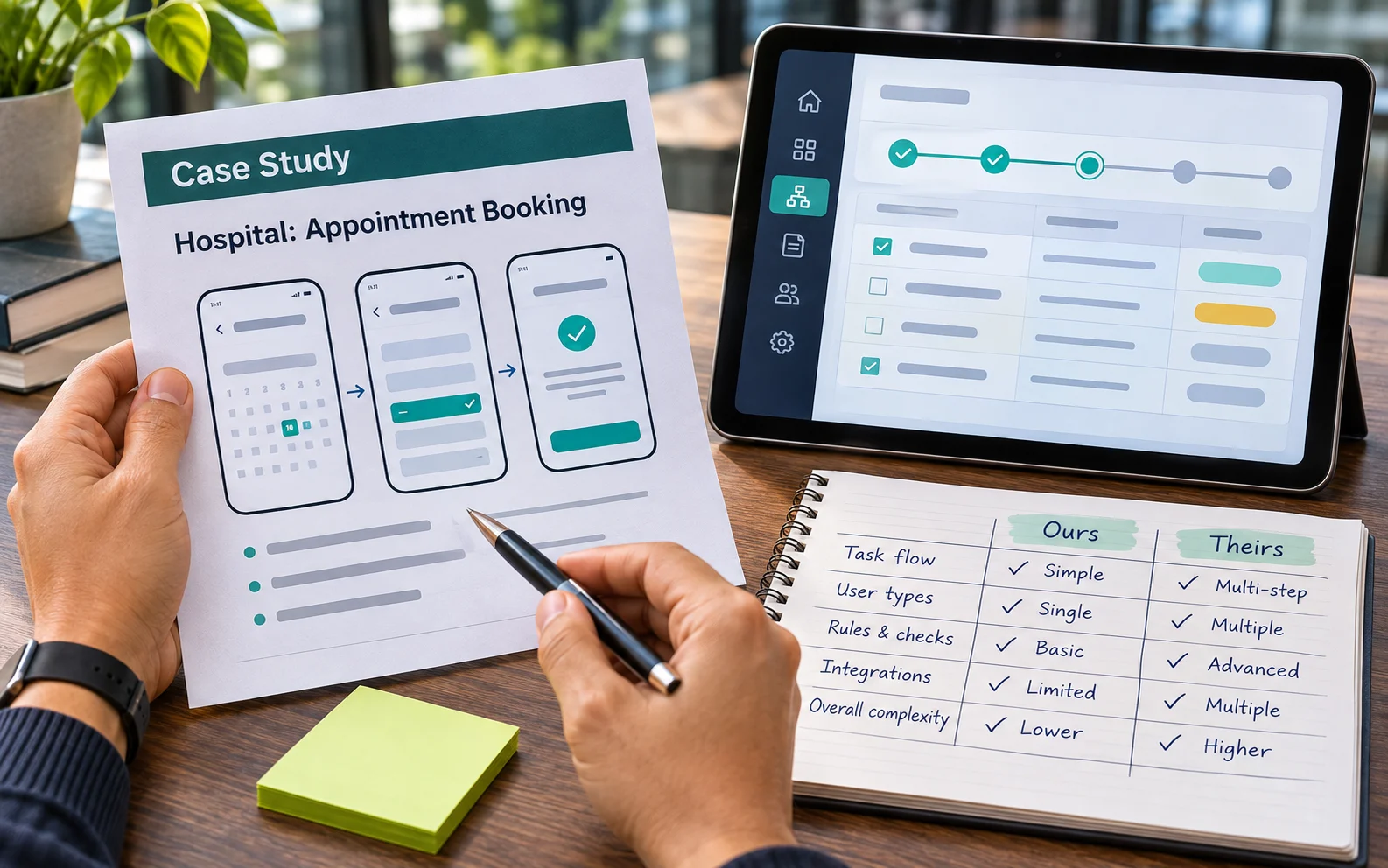
Look beyond whether an agency has worked in the same industry. Examine task complexity, user roles, device constraints and the kind of product delivered. A hospital website is not evidence of experience designing a clinical decision-support system.
For example, ScreenRoot’s Medanta case study describes doctor discovery and appointment-related interactions. Its DIGO case study describes organising communication services around audience needs. Each helps assess a different design problem. Neither should be read as proof of an unreported commercial result.
During a case-study discussion, ask what the agency owned, what the client supplied and which constraints changed the solution. Then ask for an example of a rejected approach. This reveals judgment more clearly than a walkthrough of final screens alone.

Evaluate accessibility and implementation together
Accessibility should have a defined target, scope and owner. Ask how the agency handles keyboard interactions, focus, labels, errors, zoom and assistive-technology testing, and where implementation testing will happen.
In its February 2026 analysis of one million homepages, WebAIM detected WCAG 2 failures on 95.9%. That is an automated homepage study, not a complete audit of every website or enterprise product. Its practical relevance is the need to ask for evidence, rather than accepting an unsupported accessibility assurance.
Have engineering review the proposed handover. Useful deliverables include responsive behaviour, loading and error states, component guidance, content rules and interaction annotations. Agree who resolves discrepancies between approved designs and the built product, and how long that support lasts.
Use a scorecard to structure the decision
The following weights are an editorial starting point. Adjust them before proposals arrive so that the scoring reflects your actual priorities.
| Criterion | Weight | Evidence to request |
| Understanding of the problem | 20% | Clear questions, assumptions and scope boundaries |
| Research and validation | 20% | Recruitment plan, method rationale and decision examples |
| Relevant experience | 15% | Comparable workflows and clearly attributed responsibilities |
| Engineering and accessibility | 20% | Handover sample, testing scope and implementation review plan |
| Working team and governance | 15% | Named roles, availability and escalation process |
| Commercial clarity | 10% | Fees, exclusions, change control and ownership terms |
Score each criterion from one to five, record supporting evidence and calculate the weighted result. Keep a separate list of essential conditions, such as confidentiality or access requirements. A high aggregate score should not compensate for a failed requirement that prevents delivery.
The scorecard structures judgment; it does not turn limited evidence into certainty. Where two agencies are close, document the trade-off instead of manufacturing a precise distinction from decimals.
Consider a paid pilot when uncertainty remains
A contained audit or research assignment can show how the agency works with your team. Set a specific question, deliverable, budget and evaluation criteria. Avoid requesting extensive unpaid product work as a substitute for selection.
A useful audit explains the affected task, supporting evidence, severity and recommended next step. Distinguish expert observations from findings demonstrated through user testing or analytics. A long issue list has limited value if no one knows which decisions it should inform.
ScreenRoot’s UX audit service lists heuristic evaluation, accessibility review, competitor benchmarking and performance audit capabilities. Confirm the methods and deliverables included in your particular engagement.
Resolve the working relationship before signing
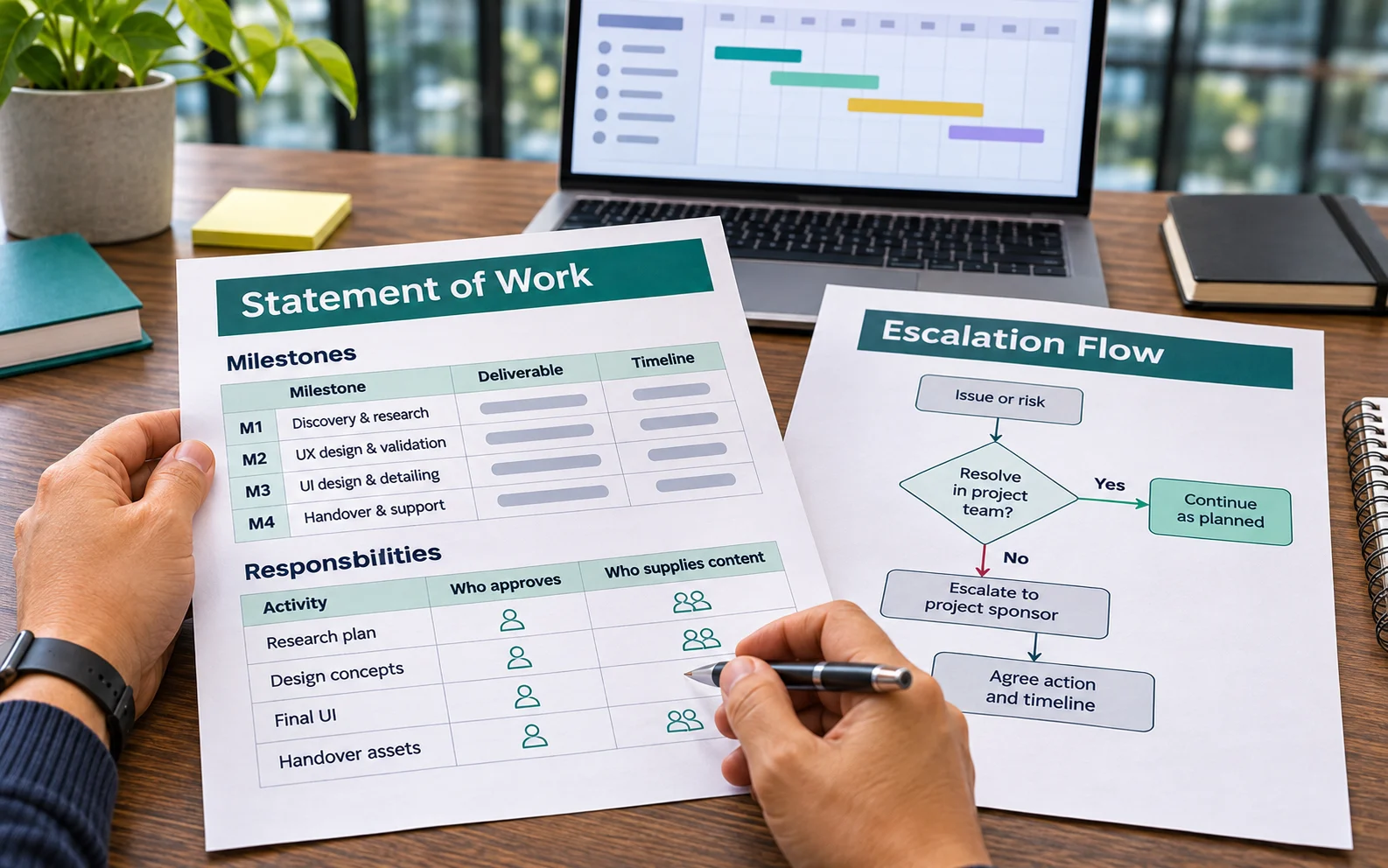
Meet the people who will do the work. Establish who approves scope, who supplies content, how disagreements are resolved and how unavailable participants or delayed decisions affect the schedule.
Review intellectual-property and file-access terms, confidentiality, third-party assets, subcontracting and the process for replacing team members. Agree milestones around decisions and usable outputs. Include an exit plan that lets your team continue with the work already completed.
Reference checks should focus on delivery: how the agency communicated uncertainty, responded to changed requirements and supported implementation. A candid account of a difficulty and its resolution is often more useful than general praise.
Questions to settle before appointing an agency
Is a specialist always better than a generalist?
No. Relevant evidence, the proposed team and the ability to understand your constraints matter more than the label. A specialist may bring useful domain knowledge, while a generalist may be suitable for a clearly bounded problem.
Does the design tool determine agency quality?
No. Tool compatibility matters for collaboration and ownership, but it does not establish research quality or delivery judgment. Check whether your team can access, inspect and extend the deliverables.
Does every engagement need a full design system?
No. An established product may need a targeted extension to an existing system. Agree the reusable assets needed for your roadmap and the capacity to maintain them.
Make the selection about your next product decision
Bring your shortlist back to the original brief. Choose the team that can explain its approach, show relevant evidence and make its commitments clear. To explore fit with ScreenRoot, review its enterprise application design service alongside your priority workflows and implementation needs.
Written by Team ScreenRoot. 16+ years leading enterprise UI/UX research for BFSI, SaaS, and Healthcare clients.
When you’re ready, let’s talk.
📞 Call us (Toll-Free): 1800 121 5955 (India)
✉️ Email us: [email protected]