1800 121 5955

Key Takeaways
- KYC drop-off is an orchestration failure, not a regulatory tax. Regulators require identity to be verified; they don’t require document uploads, manual queues or gesture tests.
- Abandonment is common and expensive. Signicat’s survey of 7,600 European consumers found 68% had abandoned a financial-services application in the previous year.
- Passive liveness and registry-backed verification are the two biggest levers. They remove the most failure-prone user steps and shrink the fraud surface at the same time.
- Consent must be scoped and in context. India’s RBI Digital Lending Directions, 2025 bar apps from contacts, call logs and media files, and allow one-time camera, microphone or location access only for KYC.
- Research finds what analytics can’t. Funnels show where applicants leave; moderated testing shows why.
A lender spends real money to get a borrower to the application screen. Paid acquisition, partner referrals, brand campaigns and pre-qualification logic all converge on one moment: the identity verification step. That’s where KYC drop-off in digital lending happens, and where a large share of hard-won applicants quietly disappear. No complaint, no support ticket. They just close the app.
The opportunity makes the loss harder to accept. The World Bank’s Global Findex 2025 reports that 79% of adults worldwide now have an account, up from 51% in 2011. Behavior has shifted alongside access: the IMF’s 2025 Financial Access Survey shows digital remittance flows rising from 13% of the total in 2019 to 46% by 2024. Borrowers already trust digital rails for money that matters to them.
KYC drop-off in digital lending is not an unavoidable cost imposed by regulators. It is an orchestration failure, and orchestration is a design discipline.

What is KYC drop-off in digital lending?
KYC drop-off is the share of loan applicants who abandon the journey during identity verification, the “know your customer” checks that confirm who a borrower is. Because acquisition spend is already sunk by the time verification starts, every abandoned applicant directly inflates customer acquisition cost.
Every control added to satisfy a risk committee is a step added to a funnel a product team is measured on. Those two mandates sit in the same org chart and pull in opposite directions. Operations treats verification as a pass/fail gate; growth treats it as a cost line. Neither framing captures what’s happening: drop-off raises the cost of every applicant who never completes the journey, because the money was spent before the camera-permission dialog appeared.
Why do applicants abandon KYC verification?
Applicants rarely abandon because they’ve decided the loan isn’t worth it. They abandon because verification interrupts a decision they’ve already made. Manual review delays, unexplained data requests, dense forms, device failures misread as fraud and dead ends with no recovery path are the five most common causes.
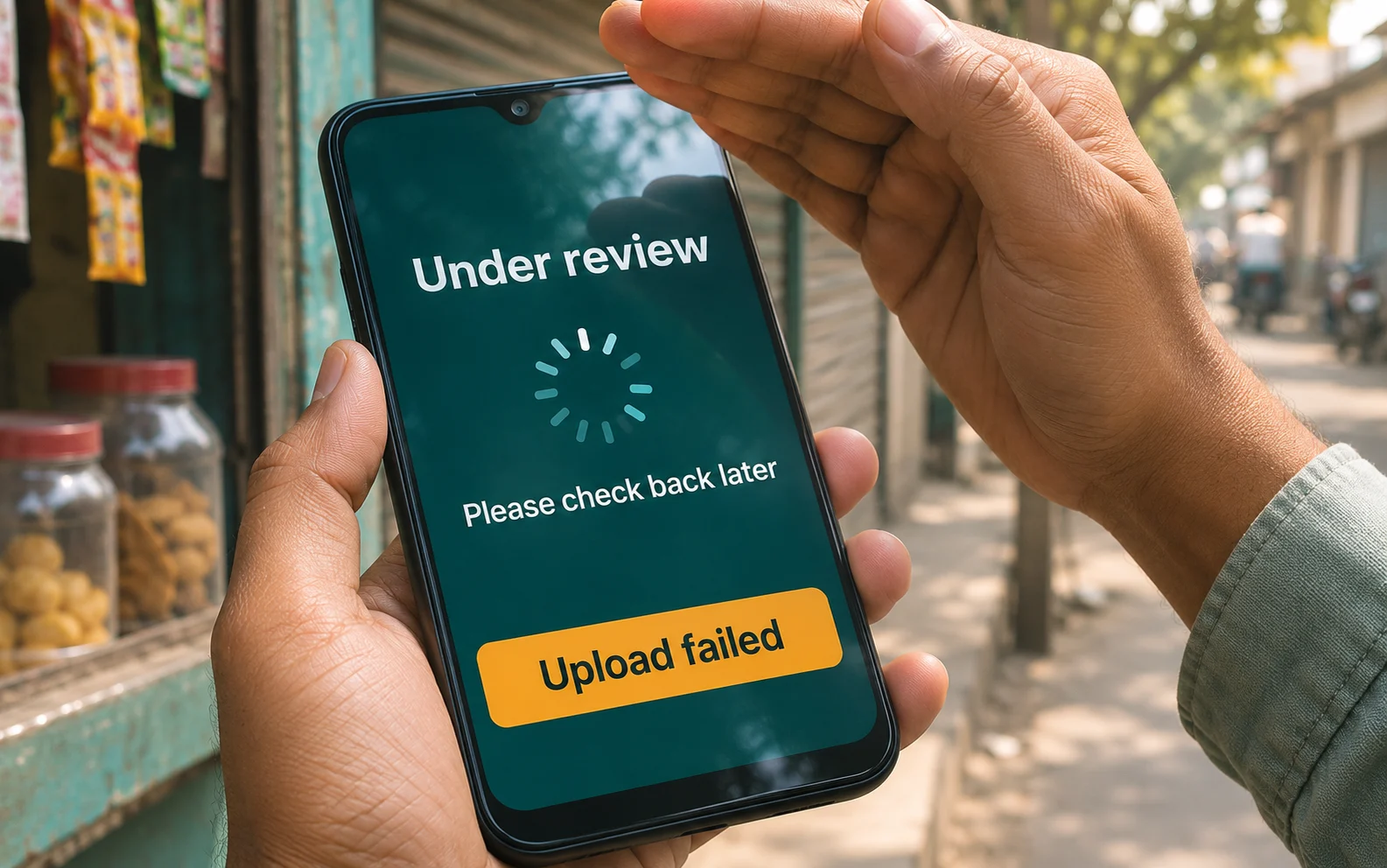
Signicat’s Battle to Onboard 2022 survey of 7,600 consumers across Europe found that 68% had abandoned a financial-services application in the past year, up from 63% in 2020 and 40% in 2016. Momentum is the scarce resource in a lending funnel. An applicant who uploads a PAN card or utility bill and then sees “under review, please check back” has been handed an exit, and most take it.
The common failure modes:
- Manual verification latency. A human reviewer between submission and approval turns a two-minute task into an open-ended wait with no visible progress.
- Unexplained data requests. Asking for a selfie, video or location without saying why triggers suspicion at the exact moment the user hands over their most sensitive information.
- Cognitive overload. Multi-field forms, legal copy and conditional branching stack up until users can’t tell how far they are from the end.
- Device failure read as fraud. Low-end handsets, poor lighting, slow uploads and dropped connections cause failed liveness attempts. Many systems treat repeated failures as a risk signal and lock the applicant out. The user wasn’t fraudulent; the phone was.
- No recovery path. A failed attempt with no alternative route, assisted channel or explanation ends the relationship.
The exclusion is systemic as well as commercial. Global Findex 2025 counts 1.3 billion adults who still lack an account. If verification friction keeps people out of the formal financial system, it is certainly keeping them out of your loan book.
What is the difference between active and passive liveness detection?
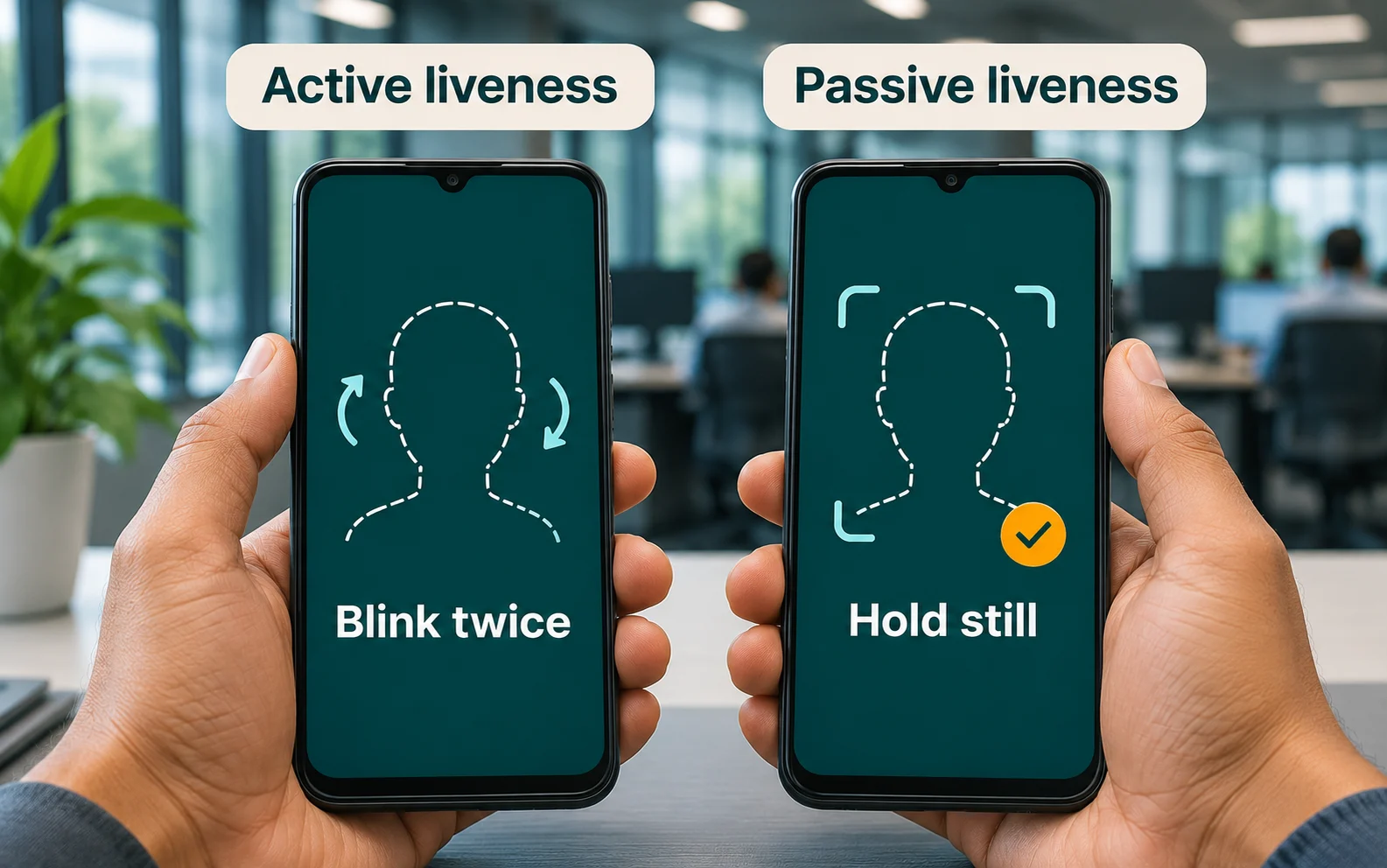
Liveness detection confirms the face on camera belongs to a live person, not a photo, screen replay or deepfake. Active liveness asks the user to blink, turn or speak on command. Passive liveness analyzes a single capture for signs of a live subject, with no gestures required. Passive checks remove the steps users most often fail.
Active liveness: the gesture tax
Active checks require the user to perform: blink twice, turn your head, read four digits aloud. Each instruction is a small test the user can fail, and failure feels personal. There’s also an embarrassment factor product teams underestimate. People apply for loans on trains, in offices and in shared rooms. Asking someone to make facial gestures into a phone in public is asking them to postpone, and postponement in a lending funnel is abandonment with extra steps.
Active checks compound their own failure. A user who misreads an instruction tries again. A second failure creates doubt about whether the app works. A third produces a lockout or a fraud flag, and the applicant leaves convinced the lender’s technology is broken.
Passive liveness: verification without performance
Passive detection analyzes one capture for signals that separate a live subject from a representation: skin texture, surface micro-variation, depth cues, reflection behavior and artifacts typical of screens and print. The user holds the phone up. That’s the whole interaction.
Passive capture still needs bandwidth management. Image and video checks are heavy, and a user on a congested connection will stall mid-upload. Detect degraded network conditions before capture and route those applicants to an assisted verification path, rather than letting them discover the failure themselves. A graceful handoff preserves the application. A spinning loader does not.
| Active liveness | Passive liveness | |
| User action | Blink, turn, speak on command | Hold phone up for one capture |
| Common failure | Misread instructions, public embarrassment | Poor bandwidth (manageable with routing) |
| Typical outcome of repeated failure | Lockout or fraud flag | Fallback to assisted path |
| Effect on completion | Adds failure points | Removes failure points |
How do government registry integrations reduce KYC friction?
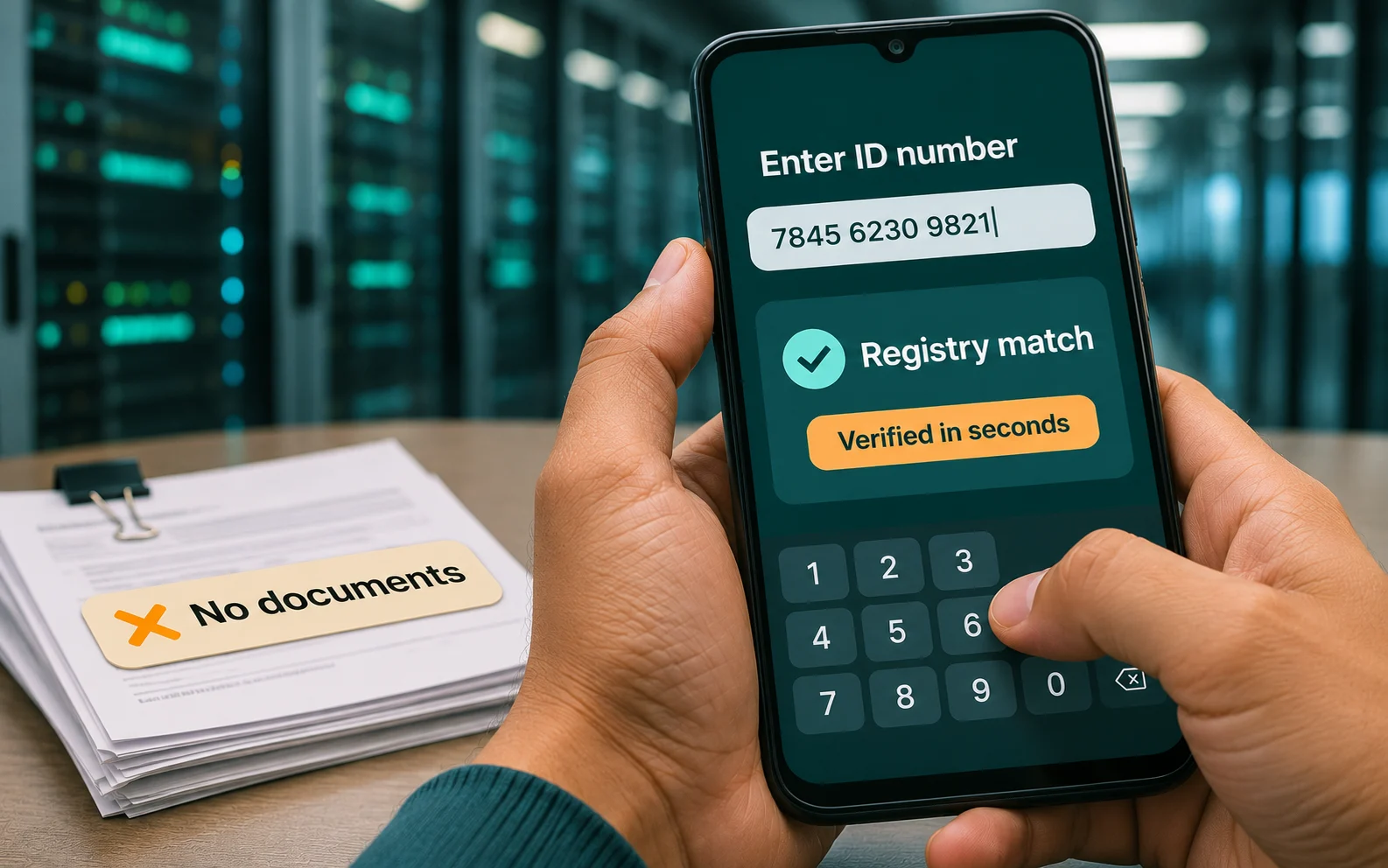
Registry-backed verification queries an authoritative identity database directly using the number the applicant types, and returns a match in seconds. It removes document photos, uploads and manual review queues, and it verifies against the source of record rather than an image that can be forged.
The cleanest way to remove document friction is to stop asking for documents. Where population registries exist, they become the backbone of this approach. In Kenya, for example, identity can be authenticated through the Integrated Population Registration System (IPRS), and the government’s Maisha Namba programme assigns each citizen a lifelong unique personal identifier. A lender submits the identifier, receives registration status and matched demographic fields, and the step ends.
The security case is as strong as the conversion case. Document-based KYC verifies an image, not a person. A photo of an ID card can be forged, borrowed, lifted from a breach or generated outright, and review depends on an operator noticing. A registry query verifies against the source of record, so a fraudster would need to compromise the registry itself rather than the lender’s upload form. Fraud controls and conversion goals stop competing.
The benchmark worth designing toward is a zero-document journey: identity confirmed by registry match, liveness confirmed passively, address derived from verified sources rather than scanned bills. Documents become the exception path for edge cases, not the route every applicant must survive. That inversion is the single largest structural change available to a digital lending UX strategy.
What data can digital lending apps collect under India’s 2025 rules?
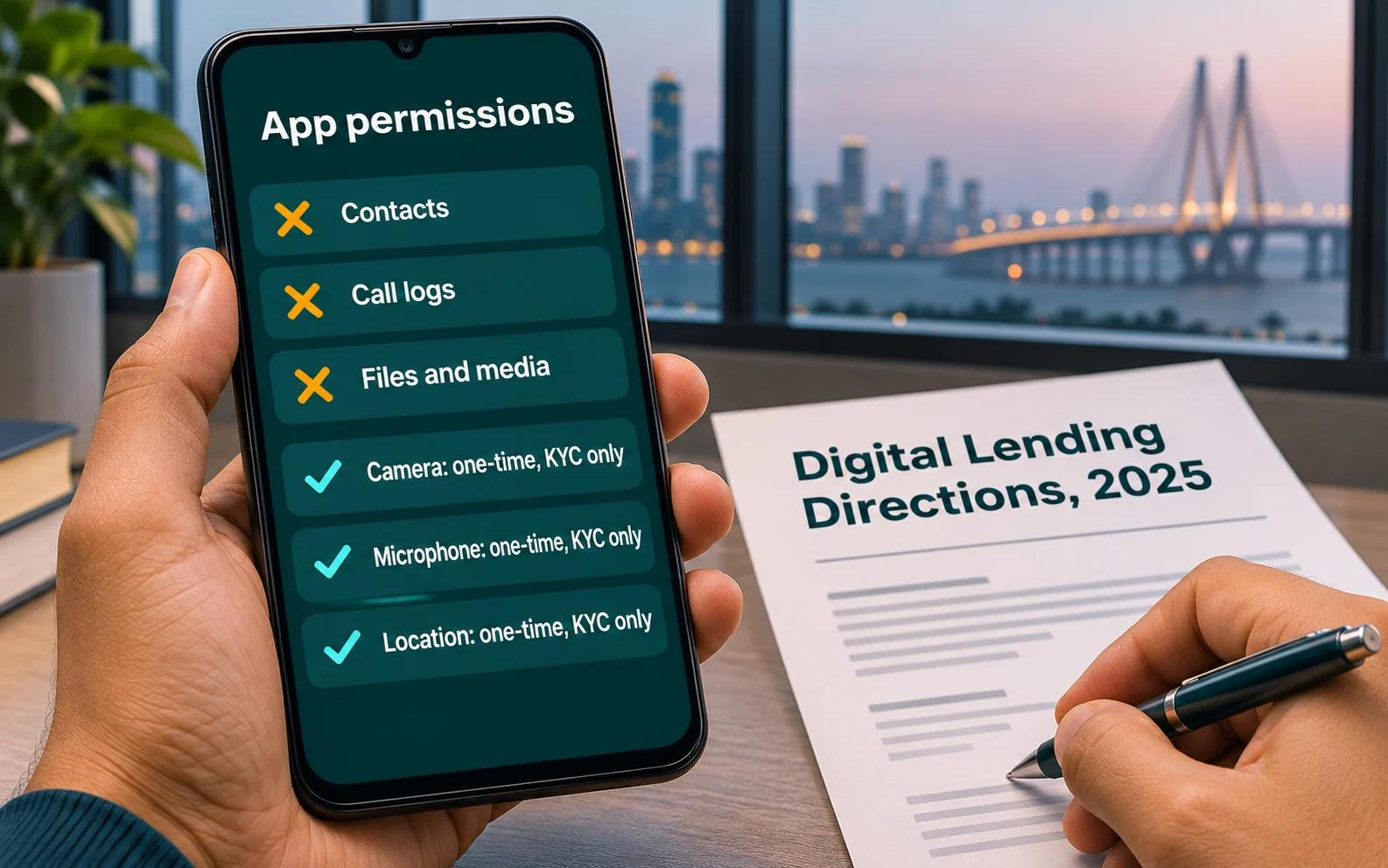
Under the RBI (Digital Lending) Directions, 2025, lending apps must not access phone resources such as files and media, contact lists, call logs or telephony functions. One-time access to the camera, microphone or location is allowed only for onboarding or KYC, with the borrower’s explicit consent. Collection must be need-based, and borrowers can revoke consent.
The permission model that defined early digital lending, broad install-time access to contacts and call logs, is gone. Law firm summaries of the Directions are consistent on the core rules:
| Device resource | Status under RBI Directions, 2025 | Permitted use |
| Contact list | Not permitted | None |
| Call logs | Not permitted | None |
| Files and media | Not permitted | None |
| Telephony functions | Not permitted | None |
| Camera | One-time, explicit consent | Onboarding / KYC only |
| Microphone | One-time, explicit consent | Onboarding / KYC only |
| Location | One-time, explicit consent | Onboarding / KYC only |
The design consequence: permission prompts can no longer be batched into a single onboarding wall. Each request should appear where its purpose is self-evident. Ask for the camera on the screen that explains the selfie check. Ask for location once, on the step that needs it. Users grant permissions they understand and deny the ones that arrive without context, which makes sequencing a conversion variable.
Account Aggregator frameworks deserve particular attention from product leaders. Through RBI-licensed Account Aggregators, lenders can receive read-only, user-consented financial data directly from the borrower’s bank, instead of asking for six months of PDF statements or net-banking credentials. Underwriting input improves while the user’s effort shrinks to a consent approval. Better data for less work is the pattern to replicate across the whole flow.
How does UX research reduce verification abandonment?
UX research reduces verification abandonment by showing why applicants stop, not just where. Moderated testing surfaces the exact screens where people hesitate, re-read or ask whether a request is legitimate. Those moments are invisible in analytics but usually fixable with copy, sequencing or a recovery path.
Passive liveness, registry APIs and consented data pipes are necessary but not sufficient. Technology determines whether a check can pass; the interface determines whether the user attempts it at all.
Verification is the most vulnerable moment in a lending journey. The applicant is being asked to point a camera at their face and hand government identifiers to a company they’ve known for perhaps four minutes. The emotional state is suspicion, not enthusiasm. An interface that withholds explanation, hides progress or puts legal copy where reassurance belongs will be abandoned however elegant the backend is.
Analytics show that a user dropped at step four. They never show that the user dropped because step four demanded a selfie without saying why. Research turns an unexplained funnel cliff into a specific, fixable problem.
ScreenRoot’s BFSI work, including an ongoing UI/UX engagement with a digital lending platform since 2023, centers on this translation: taking systems whose complexity is genuinely necessary and making them understandable to the person holding the phone. Simplifying an interface isn’t removing capability. It’s deciding what the user needs to understand at each moment and what can wait. See ScreenRoot’s case studies.
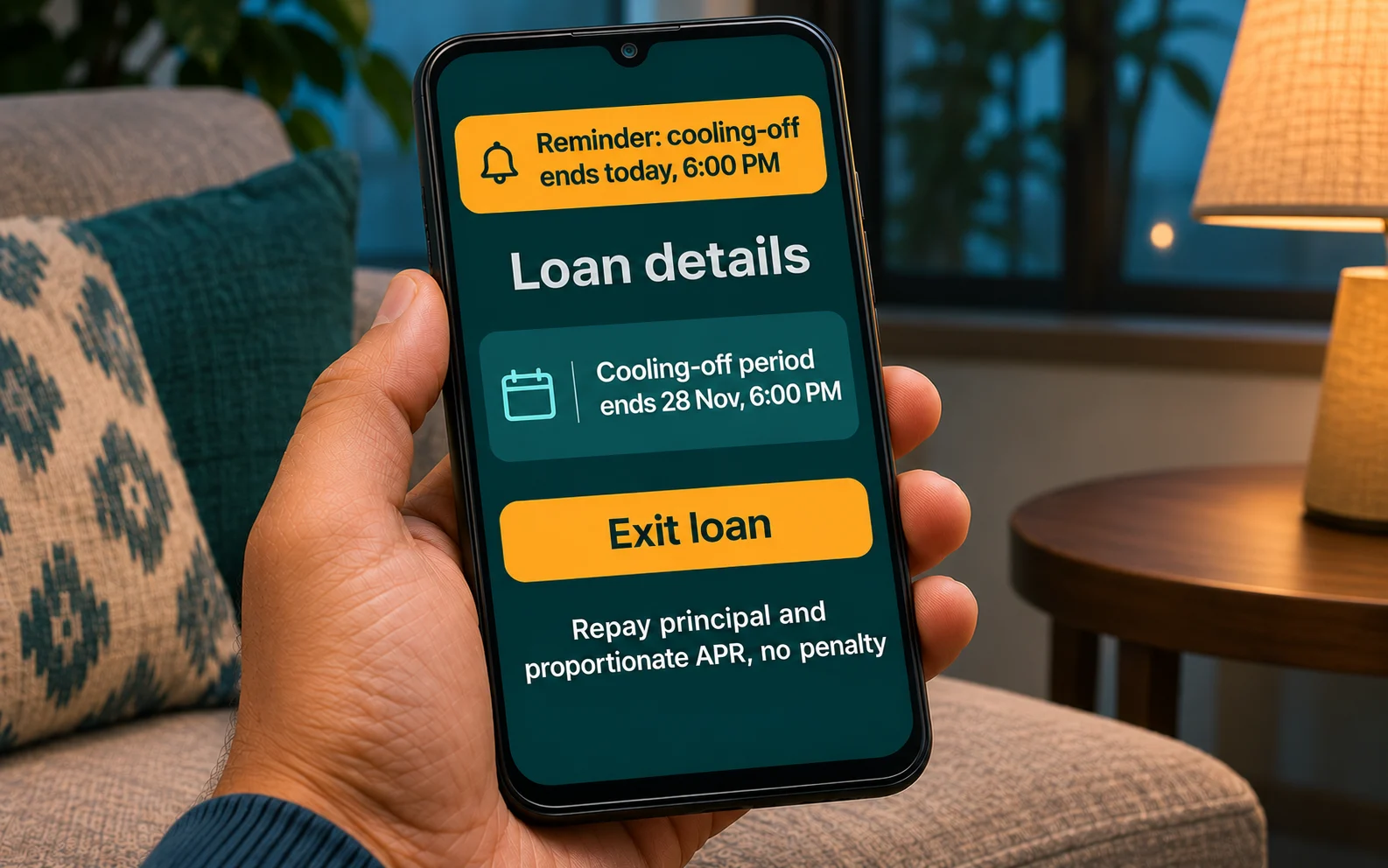
How should lenders design cooling-off and loan-exit workflows?
Design the loan exit as a visible, self-serve action. India’s RBI Directions require lenders to give borrowers an explicit option to exit a digital loan during a cooling-off period, set by the lender’s board at no less than one day and disclosed in the Key Fact Statement, by repaying principal and proportionate APR without penalty.
Lenders may keep a reasonable one-time processing fee if it is disclosed in the Key Fact Statement. Beyond the rule, how the exit is designed matters. Three implementation steps:
1. Surface the right as a primary action. Put the exit option in the loan detail view as a visible control, not in a help article. A borrower who has to search for it will assume it’s being hidden, which costs more trust than the exit costs revenue.
2. State the deadline explicitly and redundantly. Communicate the cooling-off window at disbursement by SMS and in-app alert, as a specific date and time rather than a relative duration, and send a reminder before it expires.
3. Execute without a human gate. The request should complete in-app, confirm immediately and trigger settlement automatically. A manual approval step reintroduces the delay the rule exists to prevent.
Product teams often read exit workflows as leakage. The rest of the funnel argues otherwise: a visible, working exit lowers the perceived risk of committing, which makes applicants more willing to proceed. Design tip: state the cooling-off terms during the application, before approval. Reassurance offered upfront converts; reassurance offered afterwards only limits complaints.
What should lending leaders do next?
Start with an honest audit of who your verification step rejects. Separate genuine fraud attempts from technical failures such as poor lighting, slow uploads, older devices and interrupted sessions. Then watch real applicants attempt the flow. Both steps recover qualified borrowers without loosening a single control.
The direction of travel is toward compliance the borrower never consciously experiences: identity confirmed against an authoritative record while the applicant types a number, liveness established from a single frame, financial data pulled through a consented channel. Controls stay fully intact and auditable; what disappears is the user’s awareness of them.
Five positions for the next onboarding budget cycle:
- Treat drop-off as a design failure wearing a compliance costume. Document uploads, manual queues and public gesture tests are product decisions, not regulatory requirements.
- Prioritize passive liveness and registry-backed verification. They remove failure-prone actions and narrow the fraud surface, which is why the KYC automation ROI case holds before conversion gains are counted.
- Make consent scoped and in-context. It’s the compliant model under the 2025 Directions, and it converts better.
- Build assisted fallbacks. Video KYC and agent-assisted paths for degraded conditions protect conversion rates where automated checks struggle.
- Fund research, not just analytics. With ITU estimating that 6 billion people, about 74% of the world, were online in 2025, digital-first verification is the only approach that scales; research is how you make it work for them.
ScreenRoot partners with BFSI and fintech teams to redesign high-stakes digital interfaces. If your onboarding funnel is losing qualified applicants at verification, start with a design audit of the flow.
Frequently Asked Questions
Why do so many applicants drop off during KYC?
Most drop-off comes from friction, not changed minds: manual review delays, requests for selfies or location with no explanation, dense forms, device or network failures that get flagged as fraud, and no recovery path after a failed attempt. Each interrupts a decision the applicant had already made.
Does passive liveness detection improve KYC completion?
Passive liveness removes the gesture instructions users most often fail or feel embarrassed performing in public, so it eliminates common failure points. It still needs good bandwidth handling: detect weak connections before capture and route those applicants to an assisted path instead of letting uploads stall.
What permissions can lending apps request in India?
Under the RBI (Digital Lending) Directions, 2025, apps must not access files and media, contact lists, call logs or telephony functions. They may take one-time access to the camera, microphone or location for onboarding or KYC only, with the borrower’s explicit consent, and collection must be need-based.
What is the cooling-off period for digital loans in India?
The RBI Directions require an explicit option to exit a digital loan during a cooling-off period set by the lender’s board, of at least one day, disclosed in the Key Fact Statement. The borrower repays principal and proportionate APR without penalty; a disclosed one-time processing fee may be retained.
How can lenders reduce KYC drop-off without weakening controls?
Replace document uploads with registry-backed verification, use passive liveness, request each permission in context with a clear reason, separate technical failures from fraud in your rejection logic, add assisted fallback paths, and run moderated usability testing on the verification flow to find hidden friction.
Written by Team ScreenRoot. 16+ years leading enterprise UI/UX research for BFSI, SaaS, and Healthcare clients.
When you’re ready, let’s talk.
📞 Call us (Toll-Free): 1800 121 5955 (India)
✉️ Email us: [email protected]