1800 121 5955
In short: Onboarding drop-off in web and mobile apps is caused by cognitive overload, misaligned user journeys, and a failure to deliver early value. The fix is not more tooltips. It is a research-led restructure of the first session using progressive disclosure, goal-based flows, and a clear path to the user’s first meaningful outcome.
Most users who abandon an app during onboarding never file a complaint. They simply leave. For product leaders investing heavily in acquisition, that silent exit is the most expensive UX failure in the funnel. This guide explains what causes onboarding drop-off, how to fix it in complex enterprise and BFSI environments, and what principles consistently reduce churn in the first session.

What Is Onboarding Drop-Off?
Onboarding drop-off is the rate at which new users abandon a product before completing the initial setup or reaching their first meaningful outcome. It is distinct from general churn because it occurs before the user has experienced core product value. In enterprise platforms, BFSI applications, and complex SaaS tools, drop-off rates during onboarding are significantly higher than in consumer apps because the interface complexity, compliance requirements, and multi-step verification flows create friction before value is ever demonstrated. A structured UX research process is often the most reliable way to identify where and why that friction is occurring.

The Drop-Off Crisis in Complex Systems
Enterprise and BFSI platforms share a common onboarding failure pattern. A new user encounters an unfamiliar interface, receives a generic welcome checklist that does not align with their actual goals, and quietly churns within the first session. There is no complaint. There is no feedback. There is only absence.
Three root causes drive the majority of onboarding drop-off in complex systems:
Cognitive overload in the first session. When users are presented with too much information, too many options, or too many required steps before they understand why any of it matters, they disengage. Applying solid UX principles from the first interaction is the most direct way to prevent this. The onboarding experience becomes a barrier rather than a bridge.
A disconnect between the user’s mental model and the product’s architecture. Users arrive with an expectation of how the product should work based on prior experience. When the interface contradicts that model without explanation, trust breaks down immediately.
Failure to reach the “aha moment” quickly. The aha moment is the specific instant a user first experiences the core value of the product. According to ProductLed, users who do not achieve a meaningful outcome in their first session rarely return for a second. Every minute of onboarding that precedes that moment is time the user is being asked to invest on faith.
The critical insight for product leaders: onboarding drop-off is an engineered problem. It has engineered solutions.
“The biggest onboarding mistake is not a clumsy UI. It is a process that fails to show users why they should stay.”

Why Enterprise and BFSI Complexity Makes Onboarding Harder
Reducing onboarding drop-off in a consumer app and reducing it in a regulated, enterprise-grade platform are fundamentally different challenges. The stakes, the constraints, and the user expectations are different at every layer. Teams working in these environments benefit from understanding enterprise UX design as a discipline distinct from general product design.
Enterprise and BFSI onboarding must simultaneously satisfy:
- Regulatory compliance requirements that mandate verification steps, consent flows, and disclosure screens before core functionality is accessible
- Multi-persona user bases where the same product serves administrators, end users, and compliance officers with different goals and different definitions of success
- Legacy system constraints that limit how flows can be restructured without breaking integrations
- Multi-lingual interfaces that must maintain clarity and hierarchy across languages with different text lengths and reading patterns
The temptation in these environments is to treat compliance as the reason onboarding cannot be improved. The reality is that compliance and conversion are not in conflict. The most effective enterprise onboarding flows treat verification steps as trust-building moments, not as hurdles. The structure of those steps, their sequencing, their language, and their visual hierarchy are all design decisions that significantly affect whether a user continues or exits. Running a UX audit on the existing onboarding flow is often the fastest way to identify which steps are causing the most unnecessary friction.

Case Study: Reducing Onboarding Friction at Karnataka Bank
The Challenge
Karnataka Bank, an institution with over 100 years of operational history, needed to modernise its digital onboarding process without discarding the trust signals its legacy represented. The existing journey was complex, multi-step, and designed around internal process logic rather than user goals. Drop-off was occurring before users reached the product’s core value.
The Approach
ScreenRoot restructured the onboarding experience around a goal-based product discovery model. Rather than presenting users with a linear checklist of required steps, the redesigned flow identified the user’s primary objective in the first interaction and built a three-step guided path toward it. Navigation was simplified. Compliance steps were reframed as trust markers rather than friction points. The visual hierarchy was reorganised to surface the bank’s value proposition before asking users to invest time in configuration. The process followed the same research-first design methodology applied across ScreenRoot’s BFSI engagements.
The Outcome
Users moved through onboarding faster and with measurably less friction. The transformation retained Karnataka Bank’s brand authority while repositioning the digital experience as modern, intuitive, and trustworthy. The case demonstrated a principle that applies across enterprise and BFSI platforms: even the most constrained onboarding environment can be restructured when the redesign begins with user goals rather than system logic.
Core Principles for Reducing Onboarding Drop-Off
Progressive Disclosure
Progressive disclosure is the practice of revealing information to users only when they need it, rather than presenting everything at once. This approach directly reduces cognitive load without sacrificing the complexity that regulated environments require. It shifts complexity to the appropriate moment in the user journey rather than eliminating it. Teams unfamiliar with the technique will find a detailed breakdown in ScreenRoot’s guide to best practices in user experience design.
In practice, progressive disclosure means:
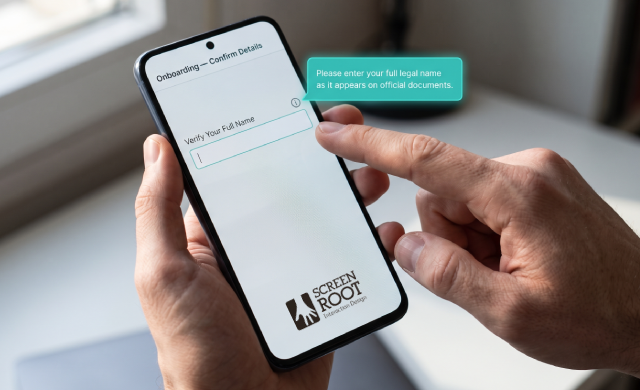
- Asking only for information that is required at each specific step
- Deferring optional configuration to after the user has experienced initial value
- Using contextual help and inline explanations rather than lengthy onboarding screens
Goal-Based User Journeys
A goal-based journey presents each user with a path tailored to their specific objective from the first interaction. Rather than routing every new user through an identical sequence, the onboarding flow branches based on what the user has indicated they want to achieve. This accelerates activation by reducing the distance between the user’s starting point and their first meaningful outcome. Understanding the distinct goals of each user type requires structured usability testing with real users before any flow redesign begins.
Personalisation at the onboarding stage is not a nice-to-have feature. It is a retention mechanism.
The First-Session Commitment
What a user achieves in their first session sets the expectation for everything that follows. Product leaders who review their onboarding experience from a new user’s perspective consistently identify the same gap: the first ten minutes ask too much and deliver too little.
The design goal for any first session should be a single, clear, achievable outcome that demonstrates why the product is worth returning to. Everything else should be deferred. Validating that outcome through desirability testing with target users ensures the moment lands the way it was intended.
Actionable Takeaways for Product Leaders
Onboarding is not a one-time feature release. It is a continuous optimisation point that directly influences retention, activation, and revenue.
- Start with user goals, not system logic. Restructure the onboarding sequence around what users want to achieve, not around what the system needs to collect.
- Treat compliance steps as trust moments. Reframe verification and consent flows with plain language, clear context, and visible progress indicators. In BFSI UX design, this reframing consistently reduces drop-off at the verification stage.
- Measure time to first value. Define what your product’s aha moment is and measure how long it currently takes a new user to reach it. That number is your primary onboarding metric.
- Apply progressive disclosure. Move optional complexity out of the first session and surface it contextually as users advance.
- Review the first ten minutes with fresh eyes. Retention is secured or lost in that window. A structured usability testing process with new users is the most reliable method for seeing what internal teams have stopped noticing.
In regulated contexts, the most durable competitive advantage is an onboarding experience that makes compliance feel like care. When users feel guided rather than processed, they continue.
Frequently Asked Questions
What is the main cause of onboarding drop-off in enterprise apps?
The primary cause is a failure to deliver meaningful value before asking users to invest significant time or effort. Cognitive overload, generic flows that ignore user goals, and poor sequencing of compliance steps all contribute to early abandonment.
How do you reduce onboarding drop-off in a regulated industry?
By treating compliance requirements as trust-building moments rather than friction, using progressive disclosure to sequence complexity appropriately, and restructuring the flow around user goals rather than internal process logic.
What is a goal-based onboarding journey?
A goal-based onboarding journey routes new users through a personalized sequence based on the objective they identify at the start of the flow, reducing the time between first login and first meaningful outcome.
How long should onboarding take?
There is no universal answer, but the design goal is to deliver the user’s first meaningful product outcome as early as possible in the first session. Every step that precedes that outcome should be evaluated for whether it is necessary at that moment.
Written by Team ScreenRoot, 16+ years leading enterprise UI/UX research for BFSI, SaaS, and healthcare clients.
When you’re ready, let’s talk.
📞 Call us (Toll-Free): 1800 121 5955 (India)
✉️ Email us: [email protected]