1800 121 5955
In the high-stakes world of enterprise finance, friction is more than a minor inconvenience; it’s a silent revenue killer. While many firms focus on expanding their feature sets, the real competitive advantage lies in a superior fintech user experience that builds institutional trust from the very first interaction. As organizations scale, the inherent complexity of mobile banking app design often leads to “design debt,” where aesthetic choices fail to account for regulatory nuances and user anxiety.
To mitigate this risk, forward-thinking leaders are moving away from surface-level polish in favor of a research-first fintech UX strategy. This methodology leverages full cycle app development to ensure that every touchpoint, from initial onboarding to complex cross-border transaction flows is validated against real-world user behaviors rather than stakeholder assumptions. This isn’t just about making apps look modern; it’s about identifying a strategic UX design partner who can bridge the gap between rigorous compliance and seamless customer journeys. In this fintech app design guide, we will explore how a research-driven foundation protects your product’s long-term performance and why the ROI of UX is stronger than ever.

Beyond Aesthetics: The Strategic Mandate for Fintech UX
Launching a financial app has never been easier, but keeping users on it is a different story entirely.
Building an app costs less than ever. However, trust isn’t included in the package. In the fintech space, the gap between a polished interface and a genuinely trusted product is where most enterprise investments quietly disappear. According to Signicat, 88% of users are less likely to return to a fintech platform after a single bad experience. This isn’t just a UX statistic: it’s a revenue statistic.
Fintech user experience is, at its core, a strategic business function, not a design deliverable. The platforms that succeed long-term aren’t simply better-looking; they’re built around a deeper understanding of user anxiety, regulatory constraints, and compliance-driven friction. This is where a Strategic UX Design Partner becomes essential, one who doesn’t just craft screens but navigates the overlapping demands of security requirements, accessibility standards, and institutional trust-building that define the fintech UX design challenges unique to regulated markets.
This is also where Full-Cycle design earns its place as a risk mitigation tool. Rather than handing off polished mockups and stepping away, a Full-Cycle approach spans discovery through post-launch iteration, catching compliance gaps, usability failures, and trust-eroding edge cases before they reach production. Think of it as enterprise-grade UX thinking applied at every stage of the product lifecycle, not just the visible ones.
The business case for this approach is compelling: the ROI of a research-first methodology makes it even harder to ignore.

The ROI of Research-First Methodology in Regulated Markets
Skipping UX research in fintech doesn’t save money: it just moves the cost downstream, where fixes are exponentially more expensive.
As the previous section established, retention is now the defining challenge for financial apps. The logical response isn’t more features: it’s deeper understanding of where users struggle before a single line of production code is written. Research-first methodology does exactly that: it surfaces friction points during discovery, when course corrections cost hours rather than months of rework. Forrester research puts a hard number on this discipline, every $1 invested in UX research and design returns $100, a 100:1 ratio that makes even the most skeptical finance executive pay attention.
The ROI case is practical: it directly influences revenue outcomes.
In practice, fintech UX design built on structured research has demonstrated conversion rate improvements of up to 400% for mobile banking apps, according to Forrester. That’s not marginal optimization; that’s a fundamental shift in business performance. A rigorous research process identifies the exact moments, a confusing onboarding step, an unclear error message, a buried CTA, that cause users to abandon a flow before completing a transaction. These aren’t guesses; they’re validated pain points. And in a regulated environment where re-engineering a compliant transaction flow post-launch carries both financial and legal exposure, catching those issues early isn’t just smart design practice. It’s risk management. Understanding that connection between research depth and measurable outcomes sets the stage for examining exactly how complex banking flows demand that level of rigor.
Navigating Complexity: Full-Cycle Design for Mobile Banking
Complex mobile banking flows don’t fail because of bad aesthetics: they fail because design and research operate in silos.
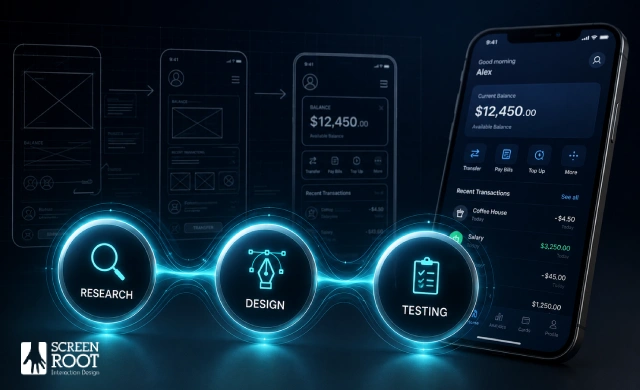
Full-cycle app development treats research, design, and testing as a continuous, interdependent process rather than sequential handoffs. In practice, that distinction is what separates fintech products that retain users from those that quietly lose them after the first transaction.
The three phases of a full-cycle approach each carry specific weight in regulated financial environments:
- Research phase: User interviews, behavioral analytics, and competitive audits establish where friction genuinely exists, not where stakeholders assume it does. Banking UX insights show that the most impactful discoveries come from observing real users inside transaction flows, not from assumption-driven briefs.
- Design phase: Brand identity and security requirements aren’t competing priorities: they’re co-dependent ones. Integrating compliance constraints (authentication steps, disclosure copy, session timeouts) directly into the design system prevents the last-minute compromises that degrade both trust and usability.
- Testing phase: Desirability testing alongside functional usability testing captures whether users trust an interface, not just whether they can navigate it. That emotional signal matters enormously in financial products.
Data-driven design changes, not intuition, drive churn metrics. According to User Testing and Forrester Consulting, full-cycle UX research and usability improvements can reduce customer churn by 10%: a meaningful figure when enterprise client lifetime values are measured in the hundreds of thousands of dollars. Design-only shops that skip the research and validation phases can’t reliably produce those outcomes because they’re optimizing surfaces without understanding the underlying behaviors driving abandonment.
As the landscape continues to shift, knowing what works now is only part of the challenge, anticipating what users will expect next is where the real competitive edge is built.
The 2026 Outlook: Future-Proofing Fintech Interfaces
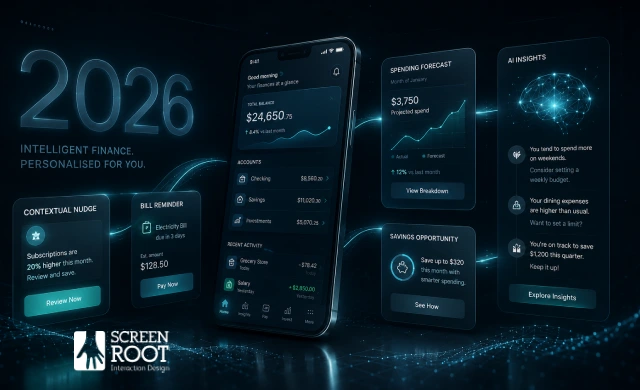
Fintech interfaces in 2026 won’t just display financial data: they’ll anticipate needs, adapt in real time, and make complexity feel effortless.
The next frontier is predictive UX, not just clean design. The shift toward hyper-personalization means users increasingly expect their mobile banking app design to surface relevant insights before they think to ask. AI-driven features, spending forecasts, proactive alerts, contextual nudges, are moving from differentiators to baseline expectations. As Qubstudio notes, future fintech growth is increasingly tied to adoption strategies that prioritize clarity over feature density. Piling on capabilities without a coherent information hierarchy creates friction, not value.
Predictive UX requires a deeper research foundation. Static personas and annual usability audits won’t keep pace with behavioral models that shift month to month. In practice, teams that embed continuous research loops, behavioral analytics, contextual interviews, accessibility audits, are far better positioned to evolve interfaces alongside user needs. A well-executed banking product demonstrates how sustained research investment translates directly into interface coherence at scale.
Accessibility can’t be an afterthought in complex mobile environments. As interfaces grow richer, biometric flows, embedded dashboards, AI-generated summaries, WCAG compliance and inclusive design principles become harder to maintain without deliberate process guardrails. The teams that treat accessibility as a design constraint from day one, rather than a QA checklist at the end, will build products that scale without excluding users.
Navigating all of this successfully depends heavily on who’s guiding the design process, which raises an important question about what to look for in a strategic UX partner.
Choosing a Strategic UX Partner vs. a Design Vendor
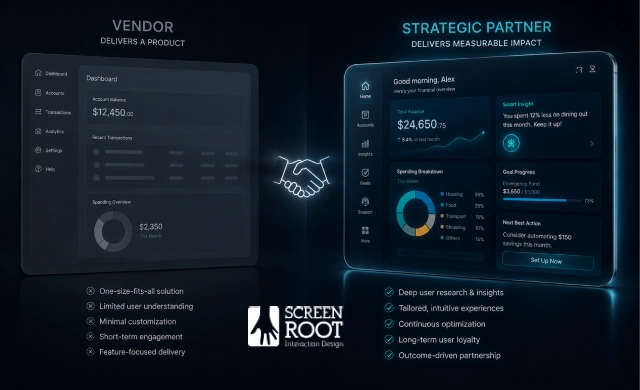
Not every agency that designs beautiful screens can navigate the compliance constraints, regulatory nuance, and institutional complexity that enterprise fintech demands. Choosing the right strategic UX design partner is one of the highest-leverage decisions a product leader makes.
Domain expertise isn’t optional. Agencies with 16+ years of experience in regulated industries bring pattern recognition that junior shops simply can’t replicate, they’ve already solved for edge cases like KYC friction, multi-step onboarding drop-off, and accessibility under WCAG standards. As ScreenRoot Strategy puts it, “The right partner doesn’t just design screens; they solve for the intersection of enterprise-grade transformation and high-stakes UX.”
Local presence shapes global outcomes. For fintech products scaling across South and Southeast Asia, a hub in Mumbai or another major India market means faster iteration cycles, deeper cultural fluency, and research pools that reflect your actual user base, not a proxy audience. That ground-level insight is what separates informed design decisions from assumptions.
When evaluating a partner, look for these signals:
- Demonstrated balance between user needs and measurable business outcomes
- Research methods embedded throughout the product cycle, not bolted on at the end
- Experience across mobile-first financial products and adjacent regulated domains
- Case studies showing reduced drop-off or improved task completion, not just visual redesigns
The distinction between a vendor and a true partner shows up when priorities conflict. A vendor ships screens. A partner pushes back, asks harder questions, and protects the user experience even under business pressure. That disposition is what the best fintech product leaders look for, and what the next section’s takeaways are built around.

The Bottom Line: Key Takeaways for Product Leaders
Every fintech product leader reading this article should walk away with one core conviction: UX is a financial performance lever, not a discretionary cost center.
The evidence throughout this article, from churn data to conversion benchmarks, reinforces that design decisions have direct revenue consequences. Whether you’re building your first institutional product or scaling an existing platform, any fintech app design guide worth following will anchor its recommendations in continuous user research, not assumptions.
Here’s what the data tells us clearly:
- UX research reduces churn by up to 10% in competitive BFSI markets, where users have more switching options than ever before.
- 88% of users won’t return after a poor first experience, making full-cycle design services, from discovery through post-launch iteration, non-negotiable for sustainable retention.
- Strategic partnerships outperform transactional vendor relationships when your product needs to be 2026-ready, compliance-aware, and built for diverse user segments. For context on designing for broader demographics, accessible banking UX principles apply across more use cases than many teams anticipate.
- Research-first design isn’t a phase: it’s an operating model that compounds returns over time.
The highest-risk decision a product leader can make is treating UX as something to “polish” after development. By that point, structural friction is already baked in. The next section explores how a research-driven foundation protects your product’s long-term performance, and why the ROI case for this approach is stronger than ever.

Securing Your Product’s Future with Research-Driven Design
A research-first UX strategy isn’t a design preference: it’s the most defensible investment an enterprise fintech product leader can make. Every section of this article has pointed to the same conclusion: friction isn’t a cosmetic problem. It’s a revenue problem, a retention problem, and increasingly, a competitive survival problem.
The 100:1 ROI argument isn’t hyperbole. According to human-centered design research, fixing usability issues after launch costs exponentially more than identifying them during discovery. Every dollar committed to research upstream eliminates dozens of dollars in post-release remediation, support overhead, and churn recovery. That math compounds over the product lifecycle in ways that no redesign budget can easily reverse.
The question product leaders need to ask isn’t “Can we afford a research-first approach?” It’s “Can we afford the alternative?” In practice, skipping research doesn’t save time: it borrows it against a future you’ll pay back at a steep premium. The fintech UX challenges explored at Phenomenon Studio reinforce exactly this pattern: products built without validated insights stall at scale.
ScreenRoot aims to transform that equation. Whether you’re redesigning a legacy platform or scaling a fintech product into new markets, the path forward runs through research, deep, structured, and connected directly to outcomes. If you’re ready to turn your human-screen interactions into experiences that drive measurable business results, start the conversation with ScreenRoot and take the first step toward a design workshop or strategic consultation.
👉 Explore our services and see how we approach enterprise-grade fintech UX design.
Then, when you’re ready, let’s talk.
📞 Call us (Toll-Free): 1800 121 5955 (India)
✉️ Email us: [email protected]
💬 WhatsApp: Reach out directly for a quick conversation here
📝 Contact Form: Fill in your details on our Website Form and we’ll get back to you promptly
Book a free discovery session today and let’s start building a fintech experience your users will trust, and your business will benefit from.