1800 121 5955
What is AEO? Answer Engine Optimization (AEO) is the practice of structuring content so AI-powered systems, large language models and featured snippets – select your brand as the definitive answer to a query, rather than one link among many. In the AI era, your content structure and UX are evaluated together as a single signal of authority.
The “click” is no longer the primary currency of the web. As search engines evolve into answer engines, the goal has shifted from earning a link to winning the citation. For enterprise brands, AEO isn’t just a technical SEO update, it’s a UX mandate. AI models prioritize factual density, logical hierarchy, and immediate clarity. If a human can’t locate your core insight within seconds, an AI crawler likely won’t surface it either. To thrive, organizations must treat content architecture and user experience as a single, unified signal of authority.
The Death of the Click and the Rise of AEO
Enterprise brands built entire strategies around earning the click and that currency is losing value fast. By 2026, roughly 68% of US Google searches end without a click to a website (SparkToro, 2026), accelerated by AI Overviews. That’s not a niche anomaly; it’s a structural shift. Search engines no longer act as directories pointing users elsewhere, they surface definitive answers directly. The SERP itself has become the new homepage: the place where a brand either earns the answer slot or effectively disappears from the conversation. AEO is the deliberate practice of structuring content so AI systems, including LLMs and featured snippets, select your brand as the authoritative source.
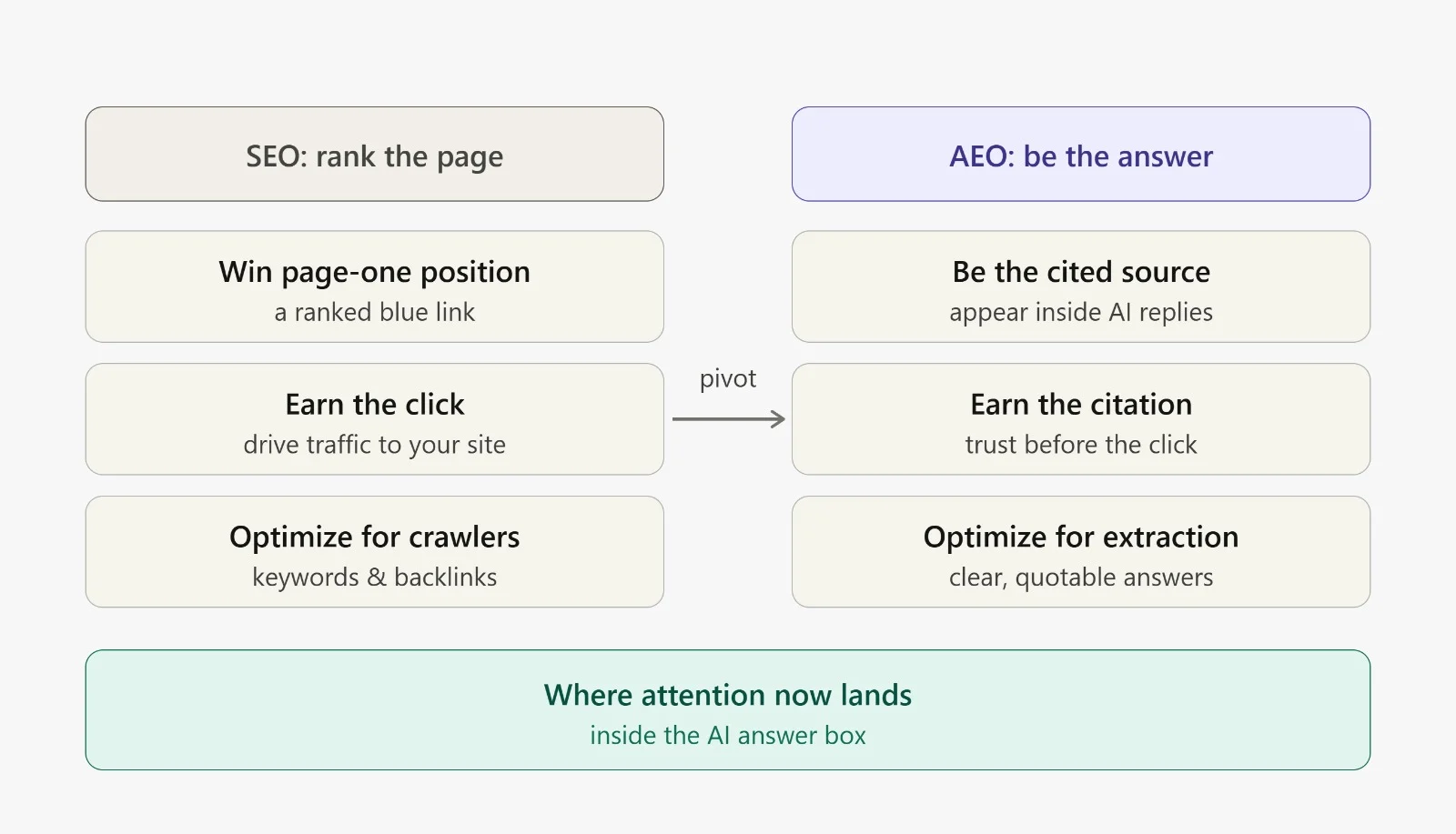
AEO vs. SEO: From Keywords to Entity-Based Authority
AEO isn’t a refinement of SEO, it’s a different game, one where relationships between concepts matter more than keyword density.
| Traditional SEO | The AEO Shift |
|---|---|
| Rank pages for targeted keywords | Provide the definitive answer for a specific entity |
| Optimize for crawlers reading text | Optimize for LLMs parsing structured relationships |
| Build backlink authority | Build entity consistency across the digital footprint |
| Meta descriptions drive click-through | Schema markup signals authoritative answers |
| Keyword frequency signals relevance | Conceptual clarity signals trustworthiness |
Where SEO rewarded pages that used the right words often enough, AI-driven systems reward brands with clear, consistent entity authority. Structuring content with Schema.org markup implemented as JSON-LD, is how an LLM understands that your brand, product, and expertise are definitively connected. Entity consistency means signaling the same facts everywhere your brand appears: your website, directories, press mentions, and social profiles. When those signals conflict, AI systems lose confidence and look elsewhere.
Why Enterprise UX is the Secret Weapon for AI visibility
AI crawlers parse a page the way a time-pressed executive does: they look for the clearest, most direct answer first. If a human can’t locate your answer within seconds, an LLM won’t surface it. Buried conclusions, nested navigation, and jargon-heavy intros all signal noise. The inverted-pyramid principle — front-loading the most critical information — maps directly onto how AI indexes content: placing the definitive answer at the top, before context and qualifications, dramatically increases the odds an answer engine extracts and cites it. This matters most in regulated industries, where dense, disclaimer-heavy content has been the norm. A research-first UX approach maps user needs to logical information flows before a single wireframe is drawn — which is exactly what AI needs to read a brand accurately.
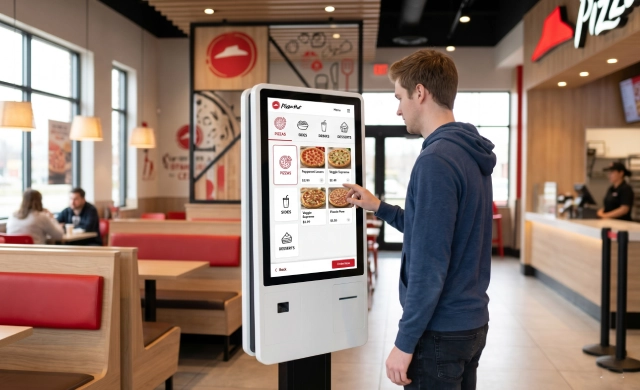
Case Study: Clarity-first UX, Applied
ScreenRoot’s redesign of the Pizza Hut experience centered on a research-first methodology — prioritizing user intent before any visual or architectural decision. Simplifying complex menu hierarchies wasn’t only a usability win; it was a structural decision that made the brand’s offerings legible to both human users and any automated system parsing the page. The parallel to AEO is direct: when engines encounter cluttered, deeply nested structures, the signal gets diluted and they struggle to extract authoritative answers. The same clarity-first discipline that makes a menu navigable for users is what makes content extractable for AI. Research-driven design produces assets that are structurally ready for AI — not through retrofitted schema, but because clarity was built in from the start.
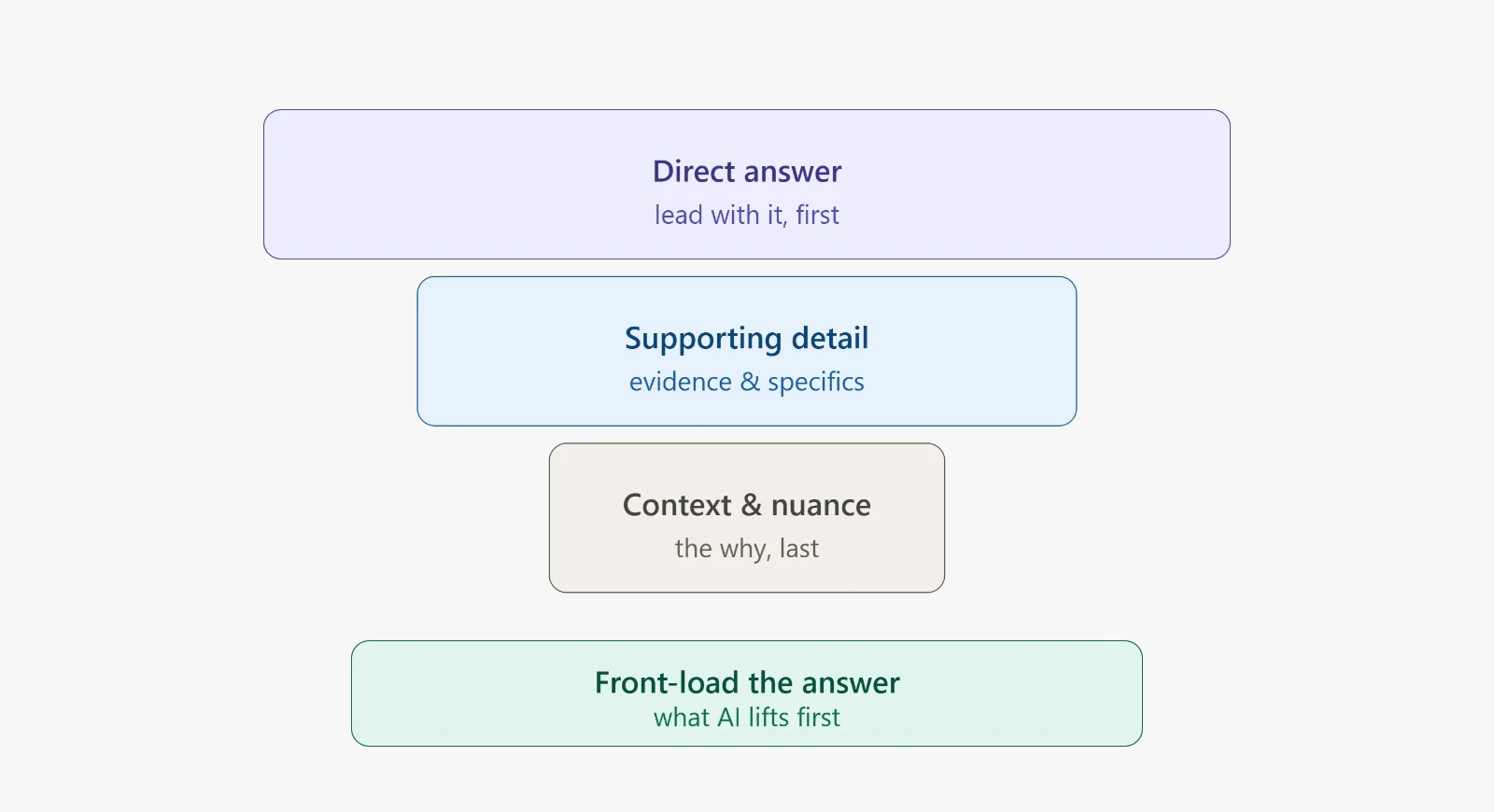
The AEO Content Strategy: 4 Rules For AI Citation
A strong AEO strategy is built on precision and structure, not volume:
1. Answer first. Lead with your core insight — ideally within the first 100 words. AI engines scan opening paragraphs for direct, citable answers; a point buried in paragraph four is effectively invisible.
2. Use semantic headers. Structure content around real user questions, not internal jargon. Headers that mirror natural-language queries help AI map your content to specific intent.
3. Data integrity over marketing fluff. AI prioritizes factual density. Specific statistics, named frameworks, and verifiable claims outperform brand superlatives every time.
4. Cross-platform consistency. Your brand’s answer should be consistent across your website, social profiles, and third-party platforms. Conflicting signals erode AI trust.

The Bottom Line: Future-Proofing Your Digital Presence
AEO is the structural bridge between traditional search and AI-driven discovery. As engines increasingly replace keyword results with cited responses, the gap between organizations structured for citation and those that aren’t will widen. In the AI era, UX and content are no longer separate disciplines — they’re a single, unified signal that engines evaluate together. A beautifully designed interface on top of unstructured content still fails the citation test. Regulated industries gain the most: BFSI and healthcare organizations with authoritative, well-structured content are disproportionately rewarded by engines that weight credibility heavily.
There’s a real trade-off worth acknowledging: AEO may reduce raw top-of-funnel click volume. What it returns is authority positioning — your brand cited as the answer, not just a result. A common pattern is that fewer clicks correspond with higher-intent engagements, because the audience arriving already trusts your expertise. The transition begins with an honest UX audit: your content architecture and on-page structure need to reflect how AI engines parse and extract answers, not just how crawlers index keywords.
Frequently Asked Questions
What is Answer Engine Optimization (AEO)?
AEO is the practice of structuring content so AI systems, LLMs and featured snippets – select your brand as the definitive answer to a query, rather than just one link among many.
How is AEO different from SEO?
SEO optimizes pages to rank for keywords; AEO optimizes content to be extracted and cited as the answer. It rewards entity consistency, structured data, and answer-first clarity over keyword frequency.
Does AEO reduce website traffic?
It can reduce raw top-of-funnel clicks, but the visitors who do arrive tend to be higher-intent — and your brand gains authority by being cited as the answer.
How do you get cited by ChatGPT or Perplexity?
Lead with the answer, use question-based headers, prioritize verifiable data over marketing language, implement schema, and keep your brand’s facts consistent across every channel.
Author: Written by Team ScreenRoot, 16+ years leading enterprise UI/UX for BFSI, SaaS and Healthcare clients.
When you’re ready, let’s talk.
📞 Call us (Toll-Free): 1800 121 5955 (India)
✉️ Email us: [email protected]