1800 121 5955
In short: In five years, UI/UX design has shifted from a craft of execution to a discipline of intent. AI now handles much of the production work — wireframes, layouts, first drafts, while human designers focus on strategy, research, and the contextual judgment that regulated, high-stakes systems demand. AI changed how design gets made; it did not change why good design works.
By 2026, AI tools have automated much of the pixel-level production that once defined a junior designer’s day, prompting a fair question: is AI the future of UI/UX design? The honest answer is more nuanced.
AI excels at pattern recognition and data synthesis, but it hits a hard ceiling against the emotional logic and contextual judgment that complex enterprise systems require. In regulated sectors like healthcare and finance, core design principles aren’t aesthetic choices, they’re risk-mitigation strategies AI cannot replicate. This article explains why the “compliance moat” and the rise of the strategist-designer keep human-centered design at the foundation of digital success.
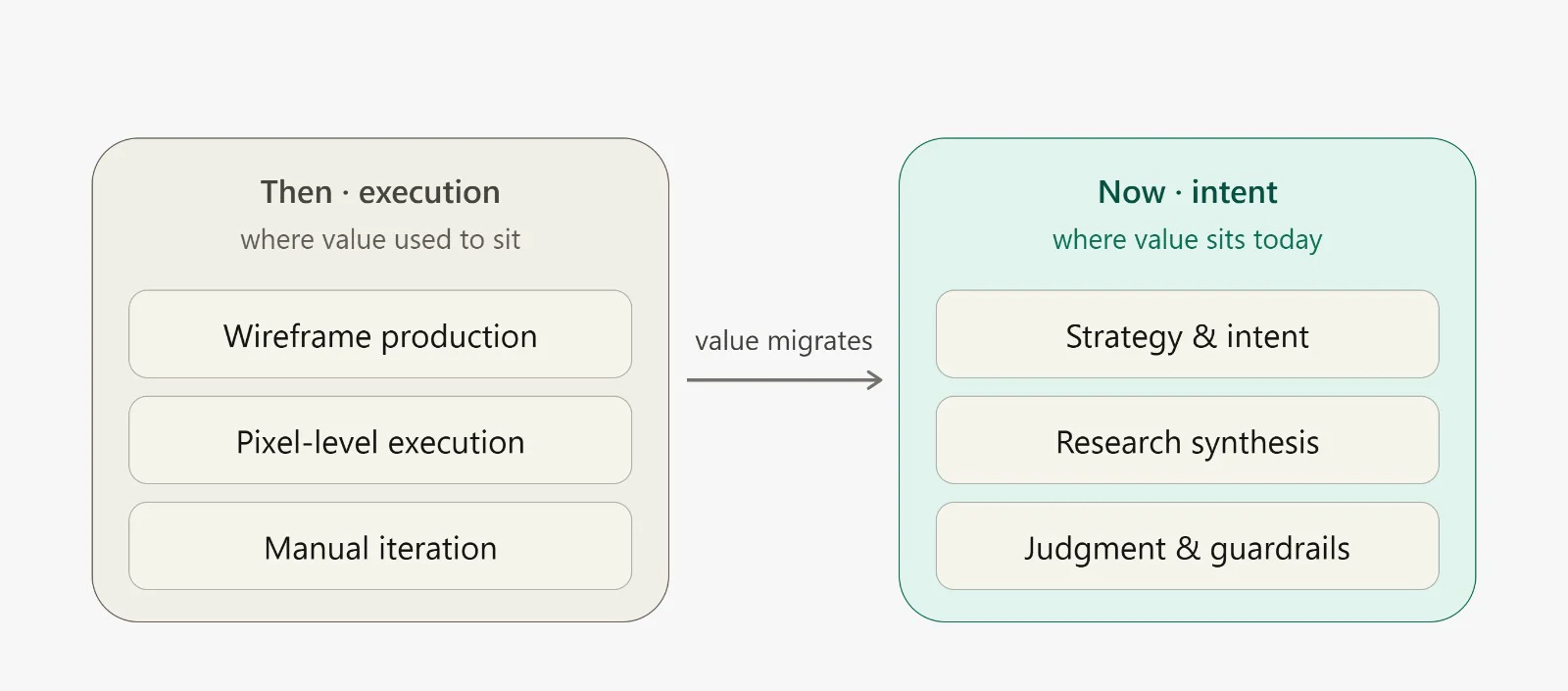
The 5-Year Shift: from Pixel-Pushing to Intent-Architecture
The relationship between AI and UX has restructured what it means to be a designer in a remarkably short span. In 2020, a UX designer’s day was familiar: wireframes in Figma, user interviews, competitive audits, manual iteration. The craft was inseparable from execution. By 2026, that same designer is more likely to be validating AI-generated flows, synthesizing research from automated tools, and making high-stakes decisions about why a product should behave a certain way, not just how it looks.
Using AI in design has gone from optional to default: most designers now report weekly, if not daily, use of AI in their workflow. That isn’t incremental adoption, it’s a structural change in how design work gets done. What’s emerged is a new mandate: intent-architecture. Where execution was once the primary deliverable, strategic intent is now the irreplaceable output. Designers increasingly define the purpose behind interactions, including the emotional logic, the ethical guardrails, and the contextual nuance no model can infer from a prompt. That is exactly why observing and testing real users remains as critical as ever.
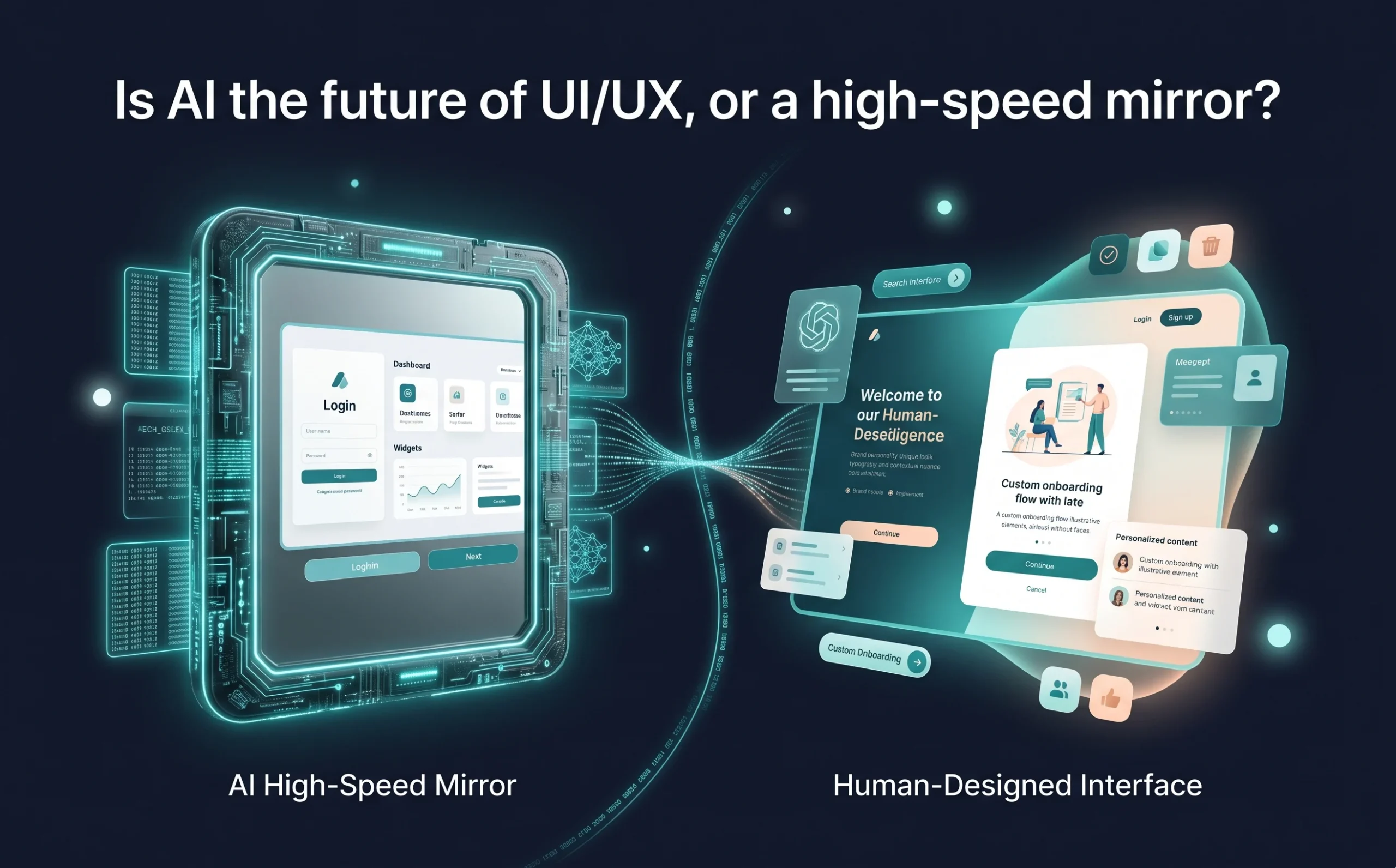
Is AI the future of UI/UX, or a High-Speed Mirror?
AI processes behavioral data at scale, but mistaking pattern recognition for design thinking is where organizations go wrong. A useful way to frame it: AI predicts needs; designers fulfill desires. AI tools can analyze millions of interaction signals to surface what users have historically done. What they can’t do is anticipate what users haven’t yet articulated, or design for the emotional resonance that makes a product worth returning to. McKinsey reports that 71% of consumers expect personalized interactions and that 76% feel frustrated when they don’t get them. Yet hyper-personalization driven purely by historical data risks a different failure mode: designs that mirror the past rather than shape the future.
The homogenization problem is real. When AI models train on existing UI patterns, they reproduce those patterns reliably and without deviation. The result is interfaces that are competent but culturally thin, optimized for average behavior rather than the specific context, brand voice, or community a product serves. The compounding risk isn’t that AI produces bad design; it’s that it produces good-enough design at a velocity that crowds out breakthrough thinking. That risk intensifies sharply in sectors where misreading a user need costs more than a poor conversion rate.
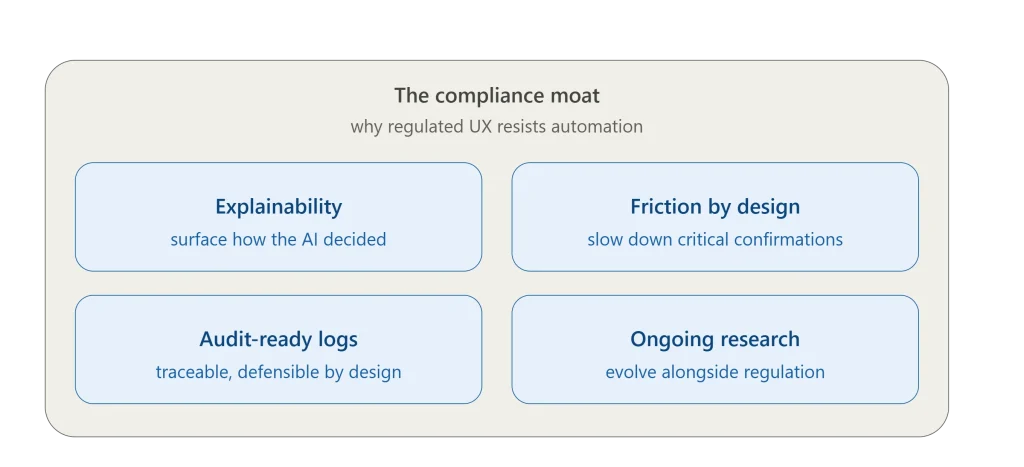
The Compliance Moat: Why Regulated Industries can’t Automate UX
Regulated industries face a hard ceiling on AI-driven automation, one built not from preference but from law. For organizations in banking, financial services, insurance (BFSI), and healthcare, thoughtful UX isn’t a differentiator; it’s a legal obligation. The EU AI Act mandates meaningful human oversight for high-risk AI systems, and the FDA applies similar expectations to AI-enabled medical software. In practice, the interface itself must be architected to keep a human meaningfully in the loop, not just nominally present.
Automation bias is the core risk regulators are responding to. When systems present AI recommendations with confidence and speed, users default to accepting them, even when they’re wrong. In a diagnostic tool or a loan-approval workflow, that shortcut can cause real harm. A checkbox labeled “I confirm” no longer satisfies compliance: regulators now scrutinize whether interfaces create genuine comprehension, not just logged acknowledgment. For C-suite leaders, this reframes UX as a risk-mitigation strategy — reducing regulatory exposure, avoiding costly remediation, and protecting brand trust. The imperatives:
- Explainability: interfaces must surface how an AI reached a decision, in language users can act on.
- Friction by design: deliberate patterns that slow confirmation steps prevent automation bias from becoming a liability.
- Audit-ready interaction logs: flows must be documentable, traceable, and defensible to regulators.
- Ongoing human-centered research: continuous research keeps interfaces evolving alongside regulatory guidance, not behind it.

The Death of the ‘Surface’ Designer and the Rise of the Strategist
So is AI the future of UI/UX design, or the end of a certain kind of designer? Both. AI is eliminating execution-heavy roles while making strategic design skills more valuable than ever. Junior roles built around deliverable production, such as basic wireframing and asset resizing, face the steepest displacement risk, because those tasks map onto what generative AI does well. What AI doesn’t replace is the judgment behind the output. The shift is from making to managing: the designer’s job in 2026 is increasingly to interrogate AI proposals, catching what’s technically unsound, misaligned with user needs, or culturally tone-deaf. The strategist-designer manages AI’s output; they don’t compete with it.
Beyond Wireframes: Where AI fails in Complex Enterprise systems
AI can sketch a dashboard in seconds, but sketching isn’t designing. AI wireframe generators produce generically competent layouts, including standard nav patterns, familiar card grids, predictable forms. What they can’t produce is a solution purpose-built for a manufacturing plant’s shift-handover workflow or a bank’s multi-entity loan-origination process, where regulatory dependencies, legacy-system hooks, and approval hierarchies are baked in. There’s also a feasibility gap: when generated components look right but can’t be built within the existing tech stack, engineering teams lose days reverse-engineering why. And stakeholder alignment, including reading the room, negotiating trade-offs across product owners, compliance officers, and IT architects, is organizational work no model handles. That depth of contextual judgment comes only from years of domain experience.
The Bottom Line: What Leaders Need to Know
AI is a force multiplier for efficiency, not a substitute for the strategic thinking that makes digital products succeed. The case for human-led design isn’t sentimental, it’s structural. AI stumbles when systems demand contextual judgment, regulatory awareness, and empathy. The brands that lead won’t be the ones that automate the most; they’ll be the ones that use AI to handle data while humans handle the experience. A research-first approach is the most reliable way to future-proof products against the churn of new tools and shifting expectations.
Frequently Asked Questions
How has UI/UX design changed in the last five years?
It has shifted from execution, such as wireframing and pixel-level production, to intent: defining why a product should behave a certain way. AI now handles much of the production, while designers focus on strategy, research synthesis, and judgment.
Will AI replace UX designers?
It is replacing execution-heavy junior tasks, not the discipline. Roles centered on strategy, research, stakeholder alignment, and contextual judgment are becoming more valuable, not less.
Why can’t AI fully automate UX in regulated industries?
Laws such as the EU AI Act require meaningful human oversight for high-risk systems. Interfaces in healthcare and finance must create genuine comprehension and an audit trail, design decisions that carry legal weight.
What is intent-architecture?
Designing the purpose behind interactions, including the emotional logic, ethical guardrails, and contextual nuance, rather than only the visual output.
Author: Written by Team ScreenRoot, 16+ years leading enterprise UI/UX for BFSI, SaaS and Healthcare clients.
When you’re ready, let’s talk.
📞 Call us (Toll-Free): 1800 121 5955 (India)
✉️ Email us: [email protected]