1800 121 5955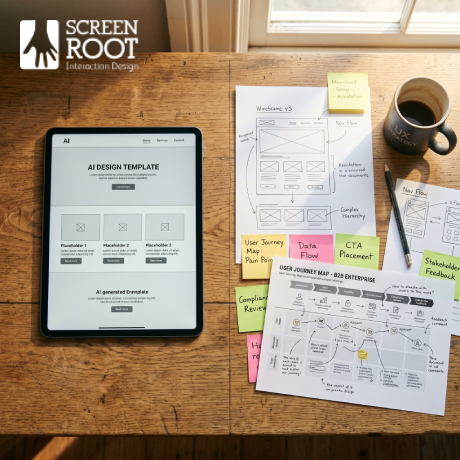
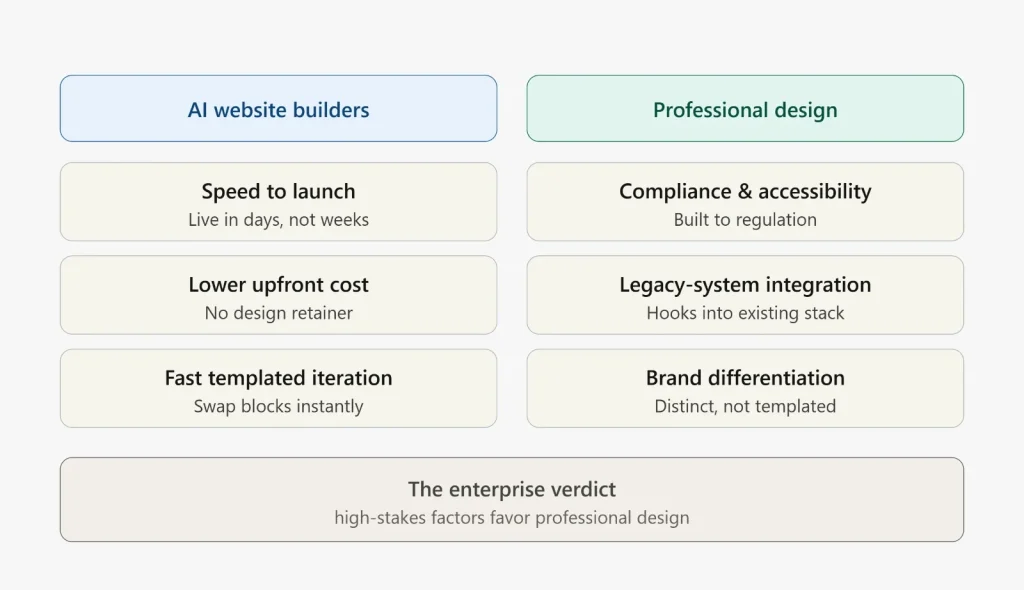
In short: AI website builders are excellent for speed and low-stakes pages. For an enterprise redesign, where scale, regulatory compliance, and brand credibility are on the line, professional, research-led design wins. Use AI to accelerate; use experienced designers to lead.
Choosing between an AI website builder and professional website design is no longer just about aesthetics, it’s about long-term ROI. For enterprises, a redesign isn’t a cosmetic fix; it’s a core component of UX strategy. AI tools offer speed and low entry costs, but they often lack the strategic depth and empathy that complex, regulated industries require. This guide weighs generative output against research-led results and helps leaders decide which path secures brand credibility and which risks the pitfall of generic “AI-sameness.”
Defining The Modern Design Landscape
Before comparing approaches, it helps to establish shared vocabulary. As industry leaders increasingly note, AI is a tool for efficiency, while professional designers provide the empathy and strategic thinking needed to solve complex business problems. That distinction starts with knowing what each term means.
- AI website builder: a template-driven, generative tool that automates layout, copy, and visual choices, optimized for speed and low cost, not strategic depth.
- Professional UI/UX design: a research-first methodology spanning usability testing, stakeholder alignment, and iterative validation, the foundation of any serious enterprise UX strategy.
- Information architecture (IA): the structural design of content and navigation so users can locate information across multi-layered workflows without cognitive overload.
- Heuristic evaluation: a structured usability inspection against established principles, critical in regulated industries where interface errors carry compliance risk.
- Generative output vs. strategic design: generative output produces plausible results from pattern-matching; strategic design solves defined business problems through research, journey mapping, and cross-functional alignment.
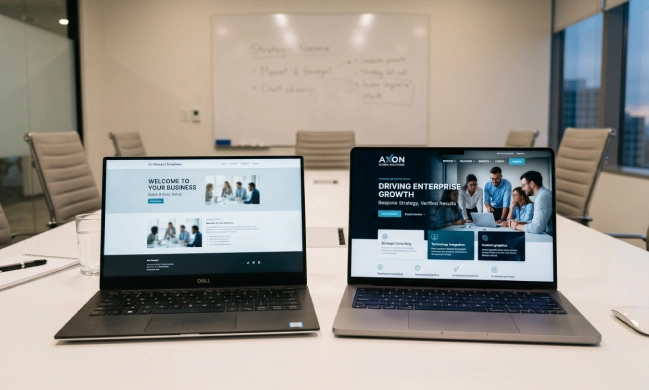
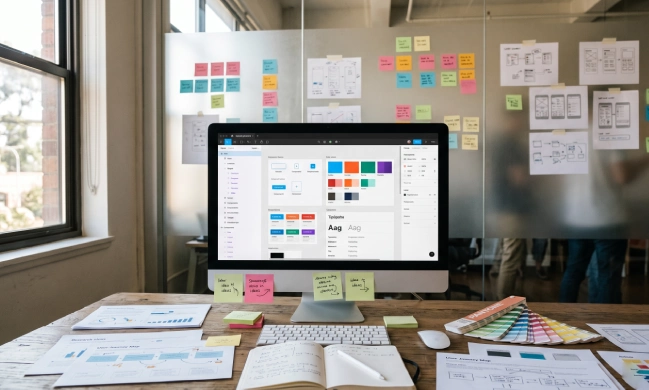
Head-to-Head: AI Builders vs. Professional Enterprise Design
The gap between the two widens as complexity increases. Here’s how they perform across four dimensions that matter most to enterprise decision-makers:
| Criteria | AI Builders | Professional Enterprise Design |
|---|---|---|
| Scalability | Well-suited to MVPs and low-traffic pages; struggles with complex, multi-service ecosystems and dynamic content logic | Architected for growth – handles integrated product suites, role-based access, and expanding user bases without structural rework |
| Regulatory compliance | Generic accessibility flags (basic WCAG); little grasp of HIPAA, RBI, or sector privacy rules | Compliance embedded into UX flows – disclosure placement, consent architecture, and audit-ready component libraries |
| User-journey depth | Linear, template-driven flows; multi-path journeys with conditional logic break the model | Strategically mapped journeys covering multiple personas, edge cases, and high-friction touchpoints |
| Brand differentiation | Risk of “AI-sameness” – outputs drawn from shared training pools feel generic | Original visual systems and proprietary design languages built around business positioning |
Brand differentiation deserves emphasis. Users form a first impression of an interface in roughly 50 milliseconds, and that judgment is driven overwhelmingly by visual design, so a generic, AI-generated interface can quietly erode credibility before a visitor reads a word. In regulated industries, that erosion compounds with trust deficits that conversion optimization can’t easily recover. That said, AI builders have merit for contained use cases, accelerating low-stakes launches or rapid prototyping inside an experienced team’s workflow. The problem is treating them as a substitute rather than a supplement.
The ROI Of Strategy: Why AI Can’t Replace Human Insight
The comparison ultimately comes down to one question: who understands your users well enough to reduce friction where it costs you most? Empathy-led design starts where automated tools stop. In finance, healthcare, or enterprise SaaS, users aren’t casually browsing, they’re making decisions that carry real consequences. Designing for that context requires research, stakeholder interviews, and iterative testing no template can replicate, and it directly reduces drop-off, lowers acquisition costs, and builds retention. Forrester’s research on UX ROI found that a superior user experience can lift visit-to-lead conversion rates by as much as 400%, a figure that puts any design investment in perspective.
Case Study — Edelweiss Mutual Fund: ScreenRoot’s redesign delivered a 40% increase in digital transactions by simplifying complex user journeys across the platform. This wasn’t a visual refresh, it was a strategic restructuring of how users navigated high-stakes financial decisions.
AI excels at pattern recognition and generation, but it lacks the judgment to weigh competing business priorities, navigate organizational constraints, or make calls requiring ethical reasoning. Those decisions belong to experienced designers working alongside leadership.
The Bottom Line: Choosing The Right Path
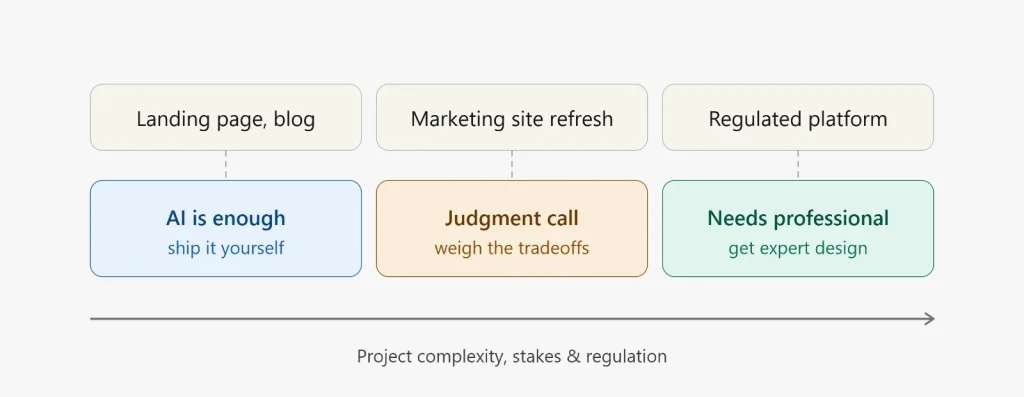
The debate doesn’t have a universal answer, it has a contextual one. Where you land depends on what your website is actually being asked to do.
| Approach | Typical Cost Range | Best for | Key Limitation |
|---|---|---|---|
| AI Website Builder | $20–$500 / month | Low-budget landing pages, rapid prototyping, internal tools | No strategic depth; limited compliance handling |
| Professional Enterprise Design | $1,0000–$500,000+ / project | Revenue-critical platforms, regulated industries, complex B2B systems | Higher upfront investment; longer timeline |
Key takeaways: $AI tools belong in the prototyping phase, not as the final solution for enterprise platforms. Professional design is non-negotiable when compliance, revenue, or trust is on the line. Strategy outlasts speed, a fast launch on weak foundations costs more to fix than to build right. And the decision is contextual, not categorical: smart enterprises use AI to accelerate and designers to lead. Your website isn’t just a design project; it’s a strategic asset.
Frequently Asked Questions
Can AI website builders handle enterprise compliance requirements?
Generally no. They offer basic accessibility checks but don’t embed sector-specific requirements like HIPAA or RBI guidelines, consent architecture, or audit-ready flows.
Are AI-built websites bad for SEO?
They can be. Common issues include thin content, generic metadata, limited schema control, and weaker Core Web Vitals – all of which affect both traditional and AI search visibility.
When should an enterprise use an AI website builder?
For low-stakes, contained needs, prototypes, internal tools, simple landing pages or to accelerate work inside an experienced team’s workflow. Not as the system of record for a revenue-critical platform.
How much does professional enterprise web design cost?
Project costs typically range from a few thousand to several hundred thousand dollars, depending on scope, integrations, and compliance complexity, versus roughly $20–$500/month for an AI builder.
Author: Written by Team ScreenRoot, 16+ years leading enterprise UI/UX for BFSI, SaaS and Healthcare clients.
When you’re ready, let’s talk.
📞 Call us (Toll-Free): 1800 121 5955 (India)
✉️ Email us: [email protected]